Electric Alpine A110 Focuses on Lightweight Construction
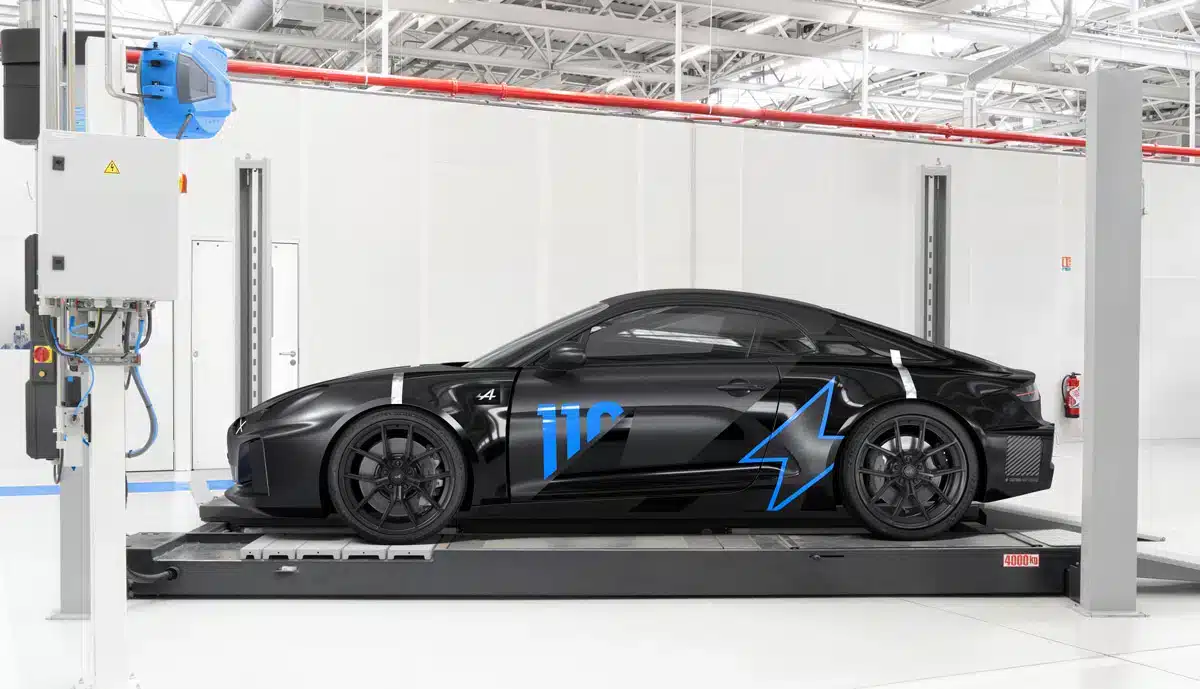
With the next A110, Alpine aims to prove that an electric sports car does not have to rely solely on high peak output. The focus is on low weight, precise handling and performance that does not fade even after several fast laps.
Alpine is targeting a weight of approximately 1,500 kg for the standard version. That would be remarkable for an electric car with a battery of around 80 kWh, although it would still be significantly heavier than the current combustion-engine A110.
| Specification | Target |
|---|---|
| Powertrain | Electric, rear-wheel drive |
| Battery capacity | Around 80 kWh |
| Range | Approximately 500 km |
| Vehicle weight | Approximately 1,500 kg |
| Electrical system | 800 volts |
| Sustained peak performance | Up to 20 minutes |
| Nordschleife target | Under 7 minutes |
Split Battery for a Low Center of Gravity
Technically, Alpine is using a two-part battery with special high-energy-density cells. It also features cell-to-pack technology, in which the cells are integrated directly into the battery pack without the conventional intermediate module layer. This saves space and can improve the ratio between weight and usable capacity.
Splitting the battery should give Alpine more flexibility when determining the seating position, center of gravity and vehicle height. This is crucial in a low-slung sports car, as a large battery pack in the floor can quickly result in a taller body and a less favorable seating position.
The 800-volt system also promises high charging power and lower currents at the same power level. Our comparison of 800-volt and 400-volt electric-car architectures shows the everyday benefits this architecture can provide.
20 Minutes of Full Performance Instead of a Brief Peak
Alpine is engineering the technology to deliver maximum performance for up to 20 minutes. To achieve this, the battery, inverter and electric motor must reliably dissipate heat even under sustained high loads. High output alone is not enough on a racetrack if the system reduces power after just a few minutes to protect its components.
The key promise is: fast lap → no immediate loss of performance.
The target for Germany’s Nürburgring Nordschleife is particularly ambitious. A production A110 with the standard setup, no additional aerodynamic package and no racing tires is intended to complete a lap in under seven minutes. Alpine wants this performance to be repeatable over three laps rather than achievable just once.
Until this becomes a verified production-car figure, the time remains a target. However, it makes clear that Alpine is developing the A110 not as an electric lifestyle coupe, but as a serious sports car and a potential rival to the upcoming electric Porsche 718.
Rear-Wheel Drive and Active Torque Vectoring
The electric A110 remains faithful to rear-wheel drive. The underlying Alpine Performance Platform also supports all-wheel drive in principle, but this is intended for other models in the range.
A closed-loop torque-vectoring system is intended to continuously adjust the vehicle’s handling. Among other inputs, the system processes speed, lateral acceleration and steering angle. Rather than responding only to individual driving situations, the control system continuously compares the desired state with the vehicle’s actual movement.
In the best-case scenario, this will give drivers more precise turn-in and more controllable load transfers without masking the typical character of a rear-wheel-drive sports car. The crucial question will be how natural the interventions feel and whether Alpine can achieve direct driving feedback despite the complex control technology.
95% of Components Will Be Newly Developed
Although the name and key design features will be retained, around 95% of the components are expected to be new. The biggest visible change is planned for the interior, whose architecture will be completely redesigned.
Technically, the platform could even accommodate a combustion engine. To do so, the rear crash structures would have to be moved by around 2 cm. However, Alpine is not currently planning this step and is clearly positioning the new model family as electric.
Convertible and 2+2-Seater to Follow
Following the launch of the electric A110, a convertible is initially planned. A 2+2-seater based on the same platform is then expected to follow. The electric A290 subcompact and the larger A390 battery-electric crossover are already available.
Plans for a large SUV have been put on hold for now. This model was originally closely linked to an entry into the US market. Alpine is now initially focusing on Europe and Asia before potentially expanding into North America step by step.
The brand is deliberately remaining small. After producing around 10,000 vehicles last year, Alpine expects slightly more than 18,000 units in 2026. According to Alpine, the comparison with Ferrari refers exclusively to production volume, not pricing or brand positioning.
Launch Timing Remains Dependent on Quality
The new A110 is scheduled to launch at the end of next year. However, Alpine makes clear that development quality takes priority over meeting the deadline. A premature start of production would be risky, particularly for an electric sports car with demanding thermal-management requirements.
Nevertheless, the technical concept appears coherent: moderate battery capacity, a rigorous focus on lightweight construction, an 800-volt system and a clear emphasis on repeatable driving performance. If Alpine can deliver figures close to those announced, the A110 could become one of the most exciting electric driver’s cars in its class.