Peugeot Electrifies the GTi
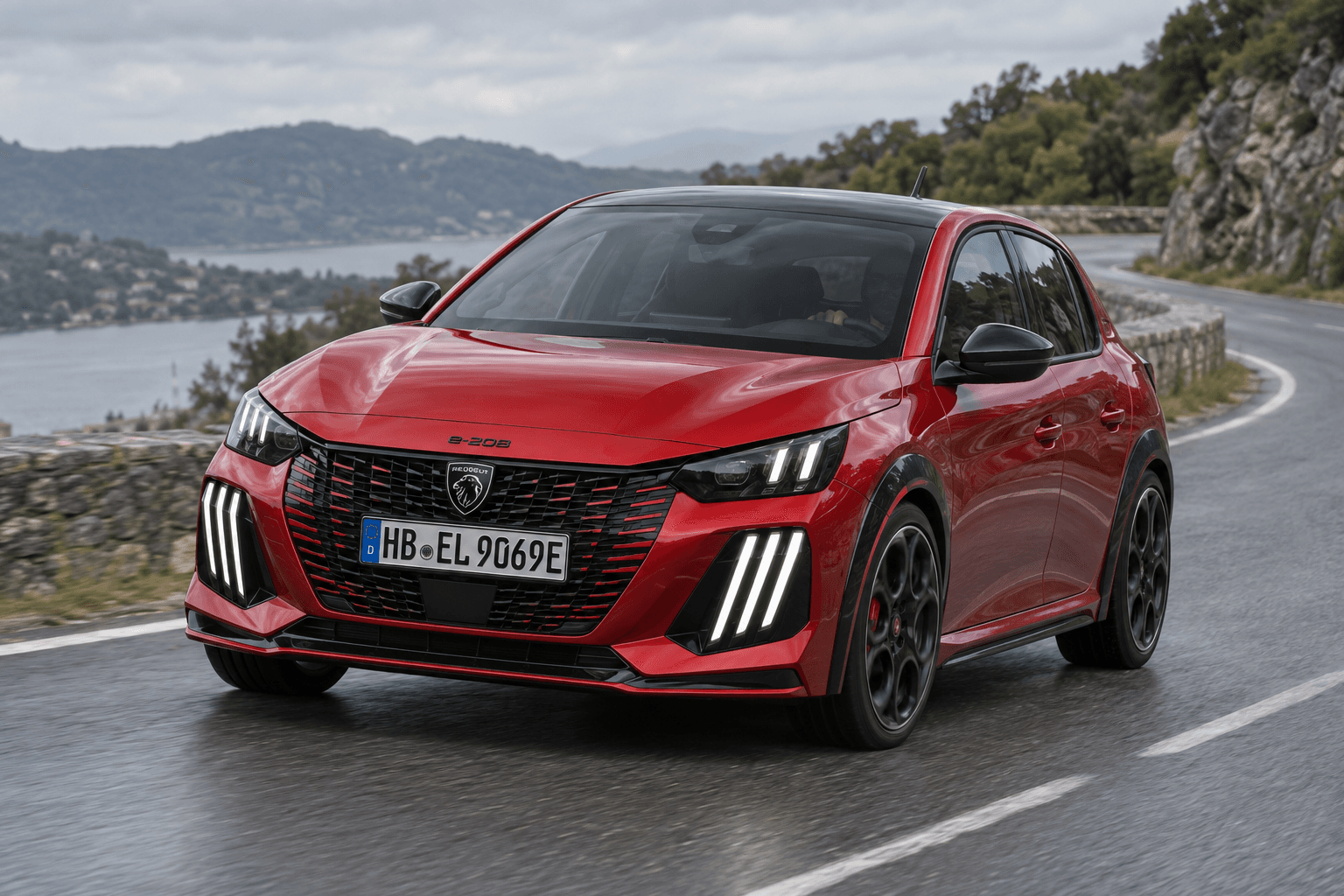
With the E-208 GTi, Peugeot is bringing its three best-known letters into the electric age. The electric subcompact produces 207 kW, delivers 345 Nm to the front wheels, and accelerates from 0 to 100 km/h in 5.5 seconds. Its top speed is electronically limited to 180 km/h.
Peugeot has not simply fitted a more powerful motor. A wider track, lowered body, mechanical limited-slip differential, and more capable braking system are intended to turn the E-208 into a genuine electric hot hatch.
The E-208 GTi is not merely a performance package, but a comprehensively revised sports version with its own dedicated chassis technology.
Peugeot E-208 GTi Specifications
| Specification | Peugeot E-208 GTi |
|---|---|
| Power | 207 kW |
| Torque | 345 Nm |
| Drivetrain | Front-wheel drive with mechanical limited-slip differential |
| Acceleration | 0 to 100 km/h in 5.5 seconds |
| Top speed | 180 km/h |
| Battery | 54 kWh gross, 51 kWh usable |
| WLTP range | 350 to 375 km |
| DC charging power | 100 kW maximum |
| Charging time | 20% to 80% in around 27 minutes |
| Trunk capacity | 309 to 1,118 liters |
| Price in Germany | €44,900 |
Limited-Slip Differential Puts the Power Down
The biggest technical challenge lies at the front axle. There, two wheels must transmit 207 kW while also handling the steering forces. A mechanical limited-slip differential directs torque more precisely to the wheel with greater grip, reducing wheelspin at the inside wheel when accelerating out of a corner.
The body sits 25 mm lower than on the regular E-208. At the same time, the track is widened by 56 mm at the front and 28 mm at the rear. Bespoke springs and dampers with hydraulic bump stops, along with a stiffer rear anti-roll bar, are intended to reduce body roll and sharpen responses.
In Sport mode, the electronic stability control intervenes later, giving the driver more freedom. Regenerative braking is also disabled so that the car behaves more predictably when the accelerator is released. This is particularly relevant on winding roads, where sudden deceleration caused by strong regenerative braking could affect the car’s balance.
Sporty Tuning Meets Substantial Weight
At more than 1.5 metric tons, the E-208 GTi remains significantly heavier than classic GTi models. The battery alone accounts for around 350 kg. Although placing this weight low in the vehicle floor reduces the center of gravity, its mass cannot be completely disguised under braking or during rapid changes of direction.
To provide the necessary stopping power, Peugeot fits four-piston Alcon brake calipers and 355 mm discs at the front. The 18-inch wheels feature openings to improve brake cooling and visually evoke the legendary Peugeot 205 GTi.
The firm suspension setup is likely to bring noticeable compromises in comfort on poor roads. Hydraulic bump stops are intended to cushion particularly harsh impacts, but they do not turn the E-208 GTi into a comfort-oriented long-distance car.
GTi Details Inside and Out
Widened wheel arches, a front spoiler, and a black rear diffuser distinguish the GTi from the regular E-208. Inside, red seat belts, red carpets, sports seats, and an Alcantara-trimmed steering wheel continue the model’s historic theme. The digital instrument cluster receives dedicated GTi graphics.
The familiar i-Cockpit remains. Its small, low-mounted steering wheel provides a distinctive driving experience, although it can obscure parts of the display depending on the driver’s height and seating position. Customizable i-Toggles provide quicker access to frequently used functions.
Apart from its sporty additions, the car remains a five-door subcompact. The trunk holds 309 liters and can be expanded to 1,118 liters by folding down the rear seats. Space in the rear is limited due to the car’s design.
100 kW Charging Is Merely Average in 2026
Usable battery capacity is 51 kWh. Depending on the tires, Peugeot quotes a WLTP range of 350 to 375 km and official energy consumption of approximately 16 to 17 kWh per 100 km. Consumption will naturally rise considerably during sporty driving.
Assuming consumption of 20 kWh per 100 km, the calculated range would be around 255 km before the battery’s entire usable capacity was depleted. The practical driving range may fall further on long highway journeys and in low temperatures.
At a fast charger, the maximum is 100 kW. Charging from 20% to 80% is expected to take approximately 27 minutes. That is practical for everyday use, but clearly lags behind modern electric cars with capable 800-volt architecture.
€44,900 Requires Conviction
In Germany, the Peugeot E-208 GTi starts at €44,900. Apart from the panoramic roof with a manual blind, its equipment is largely comprehensive. Nevertheless, the Peugeot costs around €5,000 more than the technically related Opel Corsa GSE.
Prices and standard equipment may differ in Austria and Switzerland. Even so, the German list price clearly shows that Peugeot is not positioning the E-208 GTi as an affordable electric subcompact, but as an emotive niche model with historic aspirations.
A Sporty Finale for the e-CMP Platform
The E-208 GTi is expected to be the final new model based on the current CMP and e-CMP platform. This architecture has underpinned the current 208 generation since 2019 and now imposes clear limits on charging performance.
The next generation of the Peugeot 208 is planned for 2027. It is expected to become the first production model to use Stellantis’ new STLA One platform. The GTi therefore serves as the sporty finale for the current model line before Peugeot begins a new technological chapter.
Powerful Hot Hatch with Two Clear Weaknesses
Peugeot has not simply installed a more powerful motor in the E-208. The limited-slip differential, wider track, revised chassis, and large braking system significantly alter the subcompact’s technical character.
The combination of 207 kW, compact dimensions, and focused chassis development makes the E-208 GTi one of the most exciting electric subcompacts. Its decisive disadvantages remain its charging power, which is limited to 100 kW, and its high price. Even so, buyers seeking Peugeot heritage and an uncompromisingly sporty setup will get an unusually distinctive electric car.