Powershare in the Cybertruck, and why Powerwall owners are waiting for it
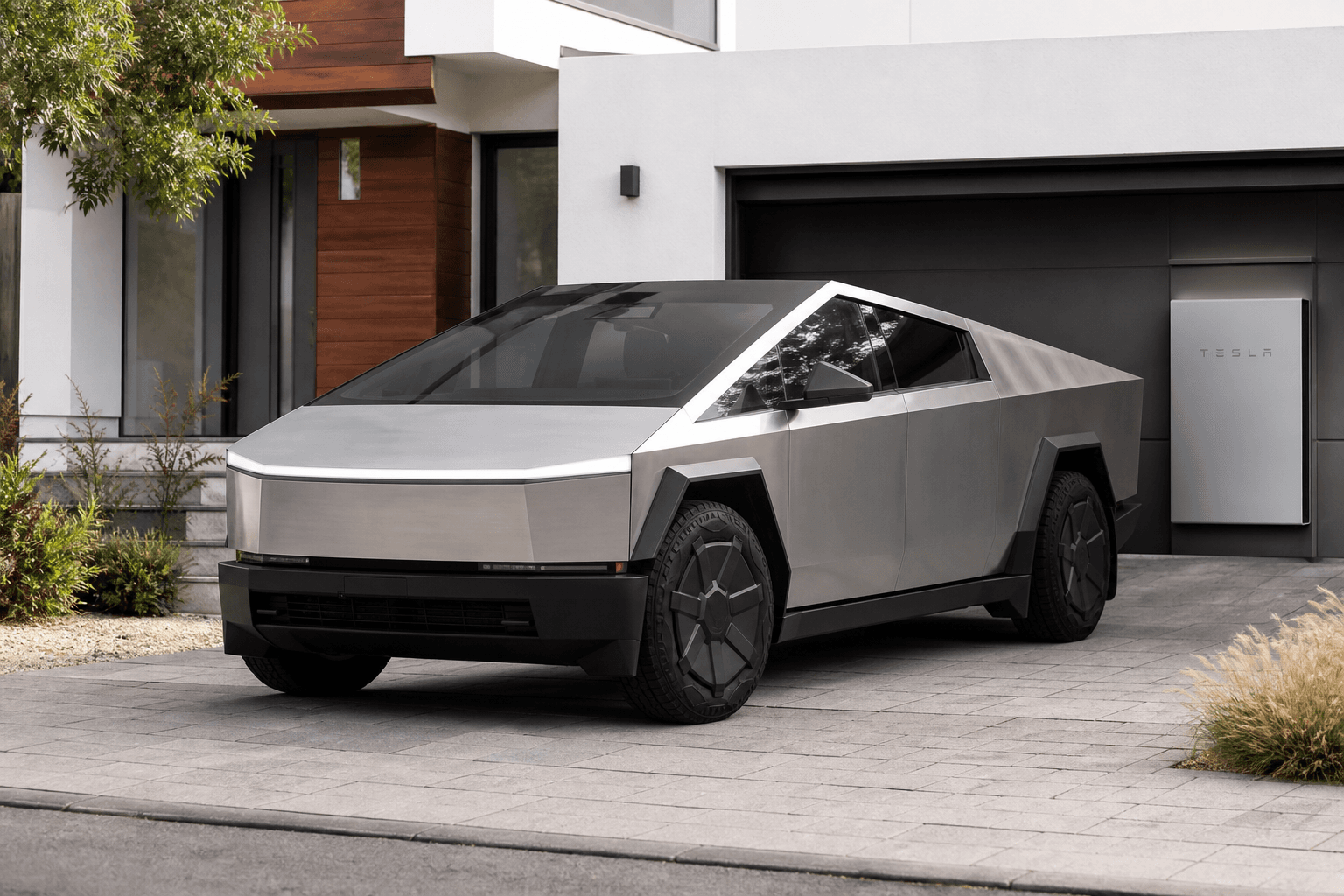
With its large battery (around 123 kWh), the Tesla Cybertruck should offer the perfect setup for backup power and optimizing self-consumption. Under the name Powershare, Tesla announced exactly that in 2023: The truck would be able to power a home during an outage, which is technically equivalent to the familiar concept of Vehicle-to-Home (V2H).
The sticking point, however, is not whether the Cybertruck can supply power in principle, but how seamlessly and automatically it can be integrated with a Tesla Powerwall. This integration has been causing delays for years, which is why many owners who are already part of Tesla’s energy ecosystem are watching developments particularly closely.
The timeline has slipped several times and is now vague again
In fall 2024, Tesla said that Powershare support for households with a Powerwall would arrive sometime in 2025. That timeframe passed, and the target was later pushed back to summer 2026.
Now, shortly before the end of that window, there is still no specific new date. Responding to a question, a senior Cybertruck engineer merely said, in essence, that the company was aware of the issue and would provide an update once there was something new to share. That is at least a sign that the feature has not been canceled, but it does not sound as though a rollout is imminent.
What V2H with Powerwall would offer in practice
In everyday use, the combination of a Powerwall and Cybertruck would be more than just a gimmick. The Cybertruck’s battery is roughly equivalent in capacity to several Powerwall units. That would provide significantly more energy in reserve, for example during an extended power outage or when seeking to maximize self-consumption of solar power.
One important point is that true V2H requires more than simply getting power out of the vehicle somehow. A proper implementation needs a coordinated energy management system that controls the home, inverter, battery storage and vehicle, including safety mechanisms and switching logic. Experience shows that this is where much of the complexity lies, especially when the complete system is expected to operate reliably.
What this means for Germany, Austria and Switzerland
In the DACH region—Germany, Austria and Switzerland—bidirectional charging is a major topic, but its practical usability depends not only on the vehicle, but also on standards, grid operators, electrical installations and the available hardware configurations in each market. With energy features like these, Tesla often takes the approach of first stabilizing the technology in selected configurations before rolling it out more widely.
For Cybertruck owners in Europe, this is primarily a look across the Atlantic anyway, as the Cybertruck is not officially sold here through regular channels. Powershare is still interesting because it shows how Tesla intends to position V2H within its own energy ecosystem over the long term, as well as the obstacles that can arise even for a vertically integrated provider.
What Tesla fans should take away from this
Ultimately, Powershare is still “alive,” but there is no firm date. Anyone waiting for Powerwall integration should expect that broad availability may still be some way off.
If you are generally interested in bidirectional charging, it is also worth looking at the latest developments surrounding V2L and V2H at Tesla: The Tesla Model Y with a V2L adapter already focuses on supplying power to devices, while V2H is on another level entirely. And because charging and system architecture play a key role in features like these, our comparison of 800V vs. 400V in electric cars also provides useful background.
You can also find more Tesla context on our model pages for the Tesla Model Y and Tesla Model 3, even though this article is specifically about the Cybertruck.