CATL invests in Qiyuan Green Power and expands its battery-swapping push
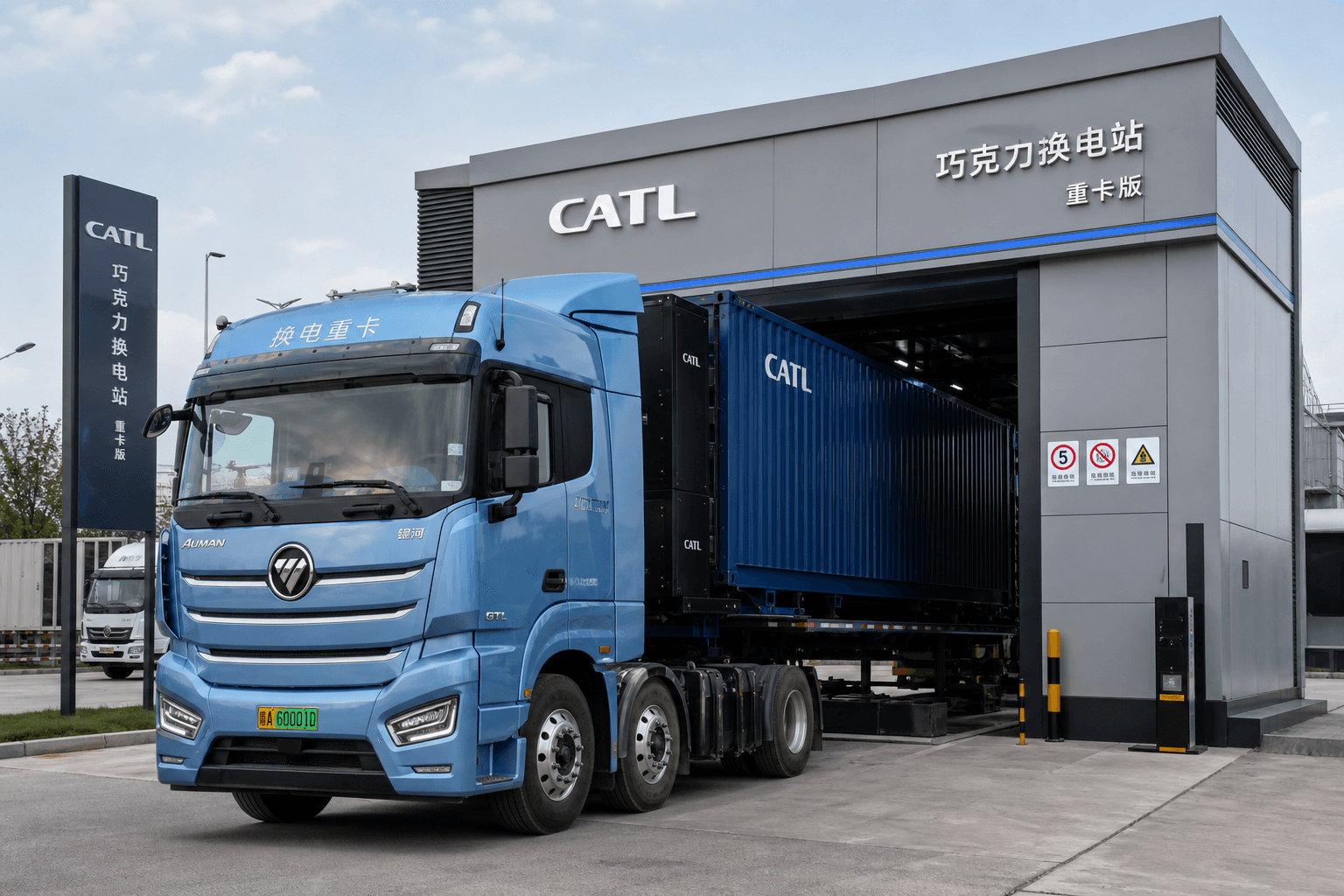
CATL is securing a 24.87% stake in Qiyuan Green Power, one of China’s leading operators of battery-swap stations for heavy-duty trucks. The purchase price is 2.56 billion yuan, equivalent to around €330 million. Qiyuan Green Power is backed by China Power, a subsidiary of state-owned energy group SPIC, giving CATL a direct connection to a strategically important infrastructure player.
The valuation is also noteworthy: Qiyuan Green Power was reportedly valued at around 10.275 billion yuan (approximately €1.3 billion) as part of the transaction. That represents a significant premium over book value and shows how high expectations for battery swapping in the commercial-vehicle sector have become.
Why battery swapping for electric trucks is scaling so quickly in China
In long-haul transport, downtime matters even more than it does in everyday passenger-car use. This is where battery swapping offers a key advantage: instead of waiting for a lengthy charging session, the energy storage unit is mechanically replaced. China also has a second growth driver: since the early 2020s, the government has specifically promoted battery swapping through industrial policy, including parallel standards and rapid infrastructure rollouts.
The result is a market that has already reached significant volumes. Reports indicate that almost 30,000 battery-swappable heavy-duty trucks were newly registered in China in 2024. This is not yet a mass-market model for Europe, but it is an interesting blueprint because it shows how electric logistics can become economically viable in certain scenarios even without megawatt charging.
Two swapping technologies under one roof: chassis versus rear-mounted system
The investment allows CATL to bring together two different battery-swapping approaches that do not replace each other in practice, but instead serve different operating environments.
| System | Mechanics | Strengths | Typical applications |
|---|---|---|---|
| Qiyuan Green Power | Swap system in a rear-mounted unit | High compatibility, reportedly suitable for more than 80% of the heavy-duty battery-swap trucks available in China | Closed or semi-public sites (mines, ports, steelworks, construction sites) |
| CATL Qiji | Chassis-mounted swapping with standardized modules | Standardization across vehicle classes, with a focus on predictable logistics routes | National highway and logistics network |
The combination is strategically significant: Qiyuan has a strong focus on “yard logistics” with clearly defined fleets, while Qiji is aimed more at long-distance corridors using standardized modules. Ideally, this means higher utilization for operators and fewer technological dead ends.
CATL’s “Choco-SEB” for trucks: a standardized 171 kWh LFP block
CATL’s Qiji system uses what it calls Swapping Electric Blocks (SEBs). For heavy-duty trucks, the company refers to the “Choco-SEB” with battery #75. This block is said to store 171 kWh and use LFP cells. LFP is attractive in the commercial-vehicle sector because it generally offers advantages in cost, cycle life and thermal robustness—precisely the factors that matter with high mileage and frequent energy throughput.
The “Choco” name refers to the system’s modular appearance, but the more important practical point is that standardized blocks simplify logistics, maintenance and billing. Treating the battery as a consumable → the vehicle no longer has to remain idle for as long while the battery is being charged, and the fleet can theoretically be deployed more flexibly.
How large the networks are—and why that matters
The scale of the two infrastructure networks also differs considerably. By the end of 2025, Qiyuan Green Power is said to have built around 1,600 charging and battery-swap stations in 208 prefecture-level cities. CATL’s Qiji brand reportedly reached around 300 stations by the end of 2025 and is targeting growth to 900 stations in the current year.
This cannot be transferred directly to the DACH region—Germany, Austria and Switzerland—but the signal is clear: China is not developing battery swapping for trucks as a niche solution, but as a scalable component of its infrastructure. With this deal, CATL is positioning itself not only as a cell supplier, but also as an operator and standard-setter for commercial-vehicle energy infrastructure.
European perspective: a complement to fast charging, not a replacement
In Europe, much of long-haul transport is likely to revolve around megawatt charging in the long term. Battery swapping could still make sense, particularly in closed logistics systems, on industrial sites or wherever grid connections are difficult to establish and high vehicle availability is essential. The key questions are whether cross-manufacturer standardization can be achieved and whether the infrastructure will actually see high utilization.