BYD Great Han Launches as New Flagship Sedan
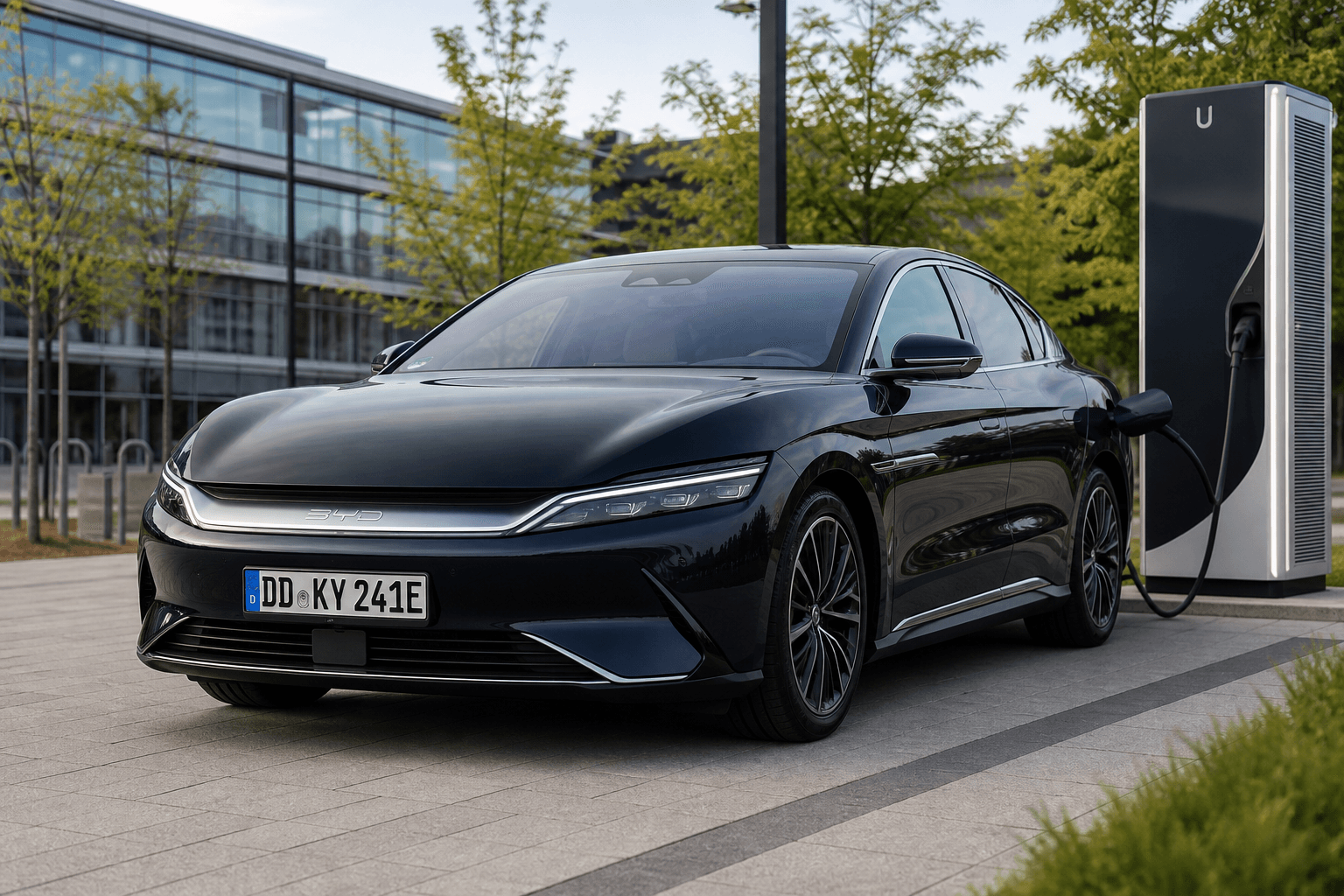
BYD has opened pre-orders in China for the Great Han, also known there as the Da Han. The model is positioned as the new D-segment flagship sedan in the “Dynasty” family and is clearly aimed at the premium segment—customers who want long range, high levels of comfort and modern driver-assistance systems in one package.
The main headline is that BYD claims a CLTC range of up to 1,008 km for the rear-wheel-drive versions. An important point for Germany, Austria and Switzerland—the DACH region—is that China’s CLTC test cycle is generally more optimistic in real-world use than WLTP. The figure should therefore be seen more as a technology statement than as a directly comparable everyday range figure for Europe.
Prices, Versions and Powertrains
Three rear-wheel-drive and all-wheel-drive versions will be available at launch. According to BYD, prices in China start at 249,900 yuan (roughly just under €40,000, depending on the exchange rate), while the better-equipped rear-wheel-drive version costs more. An all-wheel-drive version rounds out the line-up.
| Version | Drivetrain | Power | Battery | Range (CLTC) |
|---|---|---|---|---|
| Premium | Rear-wheel drive | 370 kW | 102.3 kWh | up to 1,008 km |
| Flagship | Rear-wheel drive | 370 kW | 102.3 kWh | up to 1,008 km |
| AWD | All-wheel drive | 570 kW | 102.3 kWh | up to 880 km |
The comparison with Tesla is interesting: BYD emphasizes range and charging time as practical everyday advantages, while Tesla has traditionally focused heavily on efficiency, its Supercharger network and its software ecosystem. In Europe, the decisive factors will ultimately be the WLTP figures, charging performance at local high-power charging stations and the price point BYD actually delivers.
Blade Battery 2.0 and “Flash Charging”: What the Charging Times Mean
All versions are expected to feature Blade Battery 2.0 and BYD’s Flash Charging. BYD claims extremely short charging times: 10% to 70% in 5 minutes and 10% to 97% in 9 minutes, based on 1,500 kW technology.
For everyday use, the key questions are whether suitable charging infrastructure is available and how consistently the charging rate can be maintained across different temperatures, charger utilization levels and battery conditions. In short, no matter how fast the battery and platform technology may be, the benefits will be limited in everyday European use without compatible high-power charging locations. Nevertheless, the claim shows how aggressively BYD intends to promote charging time as a differentiating feature.
Dimensions and Comfort Features: An Uncompromising Luxury-Class Ambition
At 5,256 mm long, 1,999 mm wide and 1,510 mm tall, with a 3,130 mm wheelbase, the Great Han is a truly imposing car. BYD is positioning it above conventional executive sedans and firmly in the luxury class, with dimensions closer to an S-Class than to typical midsize electric sedans.
According to BYD, standard equipment and key technical highlights include:
- DiSus-A dual-chamber air suspension
- Rear-wheel steering for improved maneuverability despite the vehicle’s length
- Zero-Gravity front seats focused on comfort and reclining positions
Driver Assistance: “God’s Eye B” and Automated Features
For driver assistance, BYD uses its God’s Eye B system. The listed features include a form of navigation-assisted driving comparable to “Navigate on Autopilot” concepts, as well as Remote Parking. How well these features can be adapted to European roads, markings and regulations will depend heavily on localization, the sensor setup and regulatory approval.
From a Tesla perspective, Tesla remains highly software-driven in advanced driver-assistance systems and automated driving, rolling out updates on a broad scale. BYD is pursuing a parallel approach with a strong hardware and feature package, combined with its own driver-assistance software stacks. For customers, what ultimately matters is not the name but how reliably the systems perform in practice.
Why This Model Is Relevant to Europe Too
The Great Han is part of BYD’s push into higher-end segments. The same pattern can be seen in its activities around Denza and in its powerful, large vehicle platforms. While that does not automatically mean this exact model will come to Europe, the technological direction is clear: more range, more comfort and extremely fast charging as the new benchmark.
If you are interested in BYD’s charging offensive, it is also worth looking at the previously announced 9-minute charging concept: BYD Da Han with 1,008 km of range and 9-minute charging. For technical context on how significantly platforms can differ, our comparison is also useful: 800V vs. 400V in everyday use in 2026.
Those following BYD’s premium ambitions in SUV form can also find interesting details about the Denza portfolio, for example in the Denza N8.