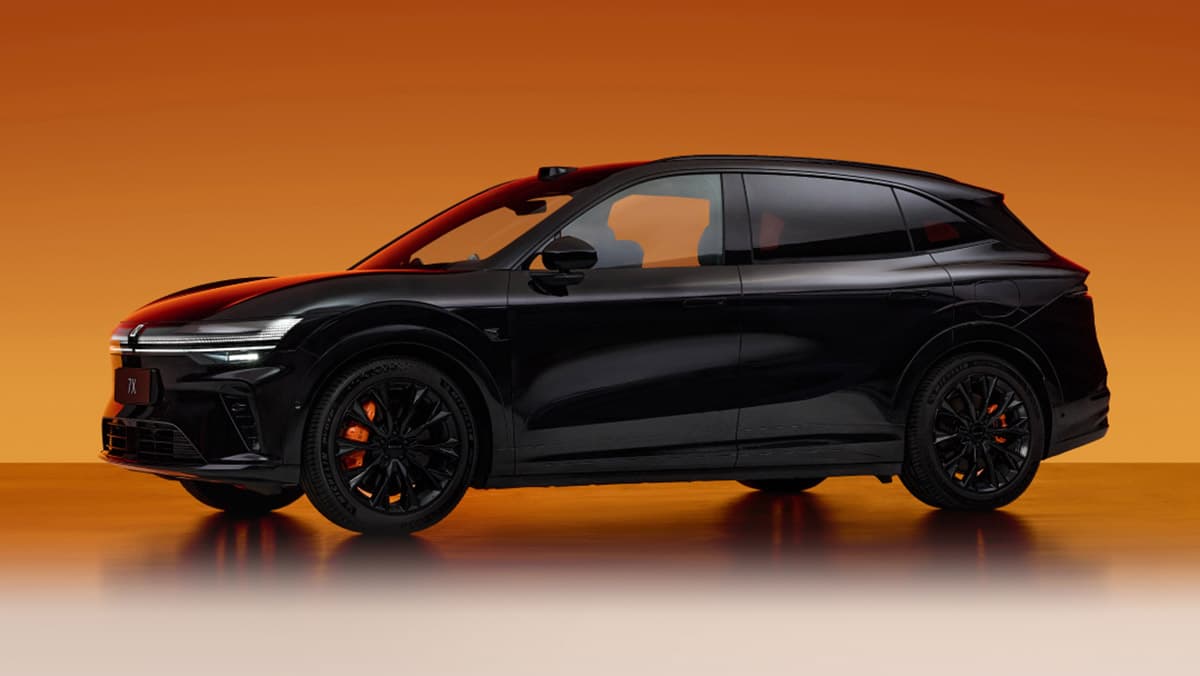
Zeekr 7X (2027): 85 kWh as the New “Sweet Spot” Option
Zeekr is planning an update to the Zeekr 7X SUV for the 2027 model year, with its Chinese launch scheduled for the fourth quarter of 2026. The familiar design will remain unchanged, while new exterior and interior colors are expected. The most important technical change confirmed so far is an additional 85-kWh battery option from Zeekr’s “Golden Battery” family.
This will give the 7X three battery sizes: 75 kWh, 85 kWh and 103 kWh. The move makes sense, as there was a fairly large gap between the two existing battery packs, directly affecting both range and pricing.
What the 85-kWh Version Is Expected to Offer in Practice
Zeekr has not yet provided range or charging figures for the new 85-kWh battery. Its strategic role is clear, however: the new battery is intended to sit between the entry-level and long-range versions, appealing to buyers who find 75 kWh too limiting but consider 103 kWh too expensive or too heavy.
This “mid-pack” trend is particularly common in Europe: a medium-sized battery can noticeably improve everyday usability without requiring buyers to pay the premium for the largest pack. In Germany, Austria and Switzerland—the DACH region—this could be especially attractive to high-mileage drivers who regularly travel on highways but do not necessarily need the maximum possible range.
800 Volts or 900 Volts? That Is the Open Question
It remains unclear whether the 85-kWh version will use an 800-volt or 900-volt architecture. The current 7X lineup is clearly divided: the 75-kWh model uses 800 volts, while the 103-kWh versions operate at 900 volts. This decision affects not only peak charging power, but also how consistently the charging rate is maintained across the charging session and how effectively the vehicle can take advantage of very powerful high-power charging stations.
For those interested in the subject, we have examined the differences and real-world impact of high-voltage systems in detail in 800V vs. 400V: Which EV Architecture Do You Need in 2026?.
Current Zeekr 7X: Key Specifications for Reference
To put the new 85-kWh option into context, it helps to look at the variants currently available in China. There are three versions at present, differing in battery size, platform voltage and range.
| Version (China, current) | Battery | Platform | Range (CLTC) | 10% to 80% charging | Performance |
|---|---|---|---|---|---|
| Entry-level | 75 kWh “Golden Battery” | 800 volts | 620 km | 10.5 min | N/A |
| Long Range | 103 kWh (CATL Qilin) | 900 volts | 802 km | 10 min | N/A |
| Performance (Dual Motor) | 103 kWh (CATL Qilin) | 900 volts | 715 km | 10 min | 0 to 100 km/h in 2.98 s |
Important: These range figures are based on the CLTC, China’s vehicle testing cycle, and are therefore considerably more optimistic than the WLTP figures commonly used in Europe. For everyday driving in the DACH region, the relationship between the versions is therefore more significant than the absolute figures. This is precisely where the 85-kWh version is intended to provide a middle ground.
Why Zeekr Is Updating the 7X So Frequently
Zeekr originally launched the 7X in September 2024 and introduced significant improvements to the current generation as early as October 2025, including upgrades to charging, the powertrain and driver-assistance systems. The upcoming update would therefore be the next revision roughly one year later. This kind of “continuous fine-tuning” has become normal for battery-electric vehicles in China because batteries, platforms and equipment strategies are evolving extremely quickly.
The 7X is also an important volume model for Zeekr: Deliveries totaled 62,865 units in the first seven months of 2026, accounting for around 29.35% of Zeekr’s total deliveries during that period, according to company data. Global orders are also said to have exceeded 200,000, and the 7X is offered in more than 50 countries and regions.
DACH Market Perspective: Competitive Pressure Extends to the Model Y
In the European market, the Zeekr 7X inevitably competes with the established leaders in the electric SUV segment, especially the Tesla Model Y. Tesla has long stood out for its efficient powertrain, strong charging ecosystem and highly integrated software, while brands such as Zeekr primarily compete with large batteries, high-voltage architectures and generous equipment levels.
The most interesting aspect of the 85-kWh option is not simply the figure itself, but its potential price point. If Zeekr manages to strike the right balance, it could become the most attractive configuration. Whether it succeeds will ultimately depend on two factors: real-world range close to WLTP figures and charging performance, particularly in cold temperatures and on long-distance journeys.
With 85 kWh, Zeekr is clearly targeting 7X buyers who want plenty of range without choosing the most expensive and heaviest battery pack.
Until the Update: Extras for the Current Model in China
Until the 2027 model year arrives, Zeekr continues to offer three free options for the current 7X in China, with a combined stated value of 18,999 yuan. These include an electrically adjustable rear-seat “sofa,” a cooling and warming compartment, and 20-inch wheels. Such bundled promotions do not necessarily carry over to Europe, but they show that Zeekr is actively managing sales of the current model ahead of the update.
What We Still Need to Know About the 7X (2027)
The key data needed to properly assess the real-world impact of the 85-kWh version are still missing: its CLTC range and, ideally, an estimate comparable to WLTP, peak charging power, charging curve, and whether it will use an 800-volt or 900-volt architecture. Once Zeekr provides these details, it will become clearer whether the new battery really is the “sweet spot” or merely another intermediate option on the specification sheet.
For more on Zeekr’s high-voltage ambitions, the 7X was also recently discussed in connection with its particularly high system voltage; see Zeekr 7X Reaches 200,000 Orders, with 900 Volts as Its Key Advantage.