BMW to put the iX5 Hydrogen into production in 2028
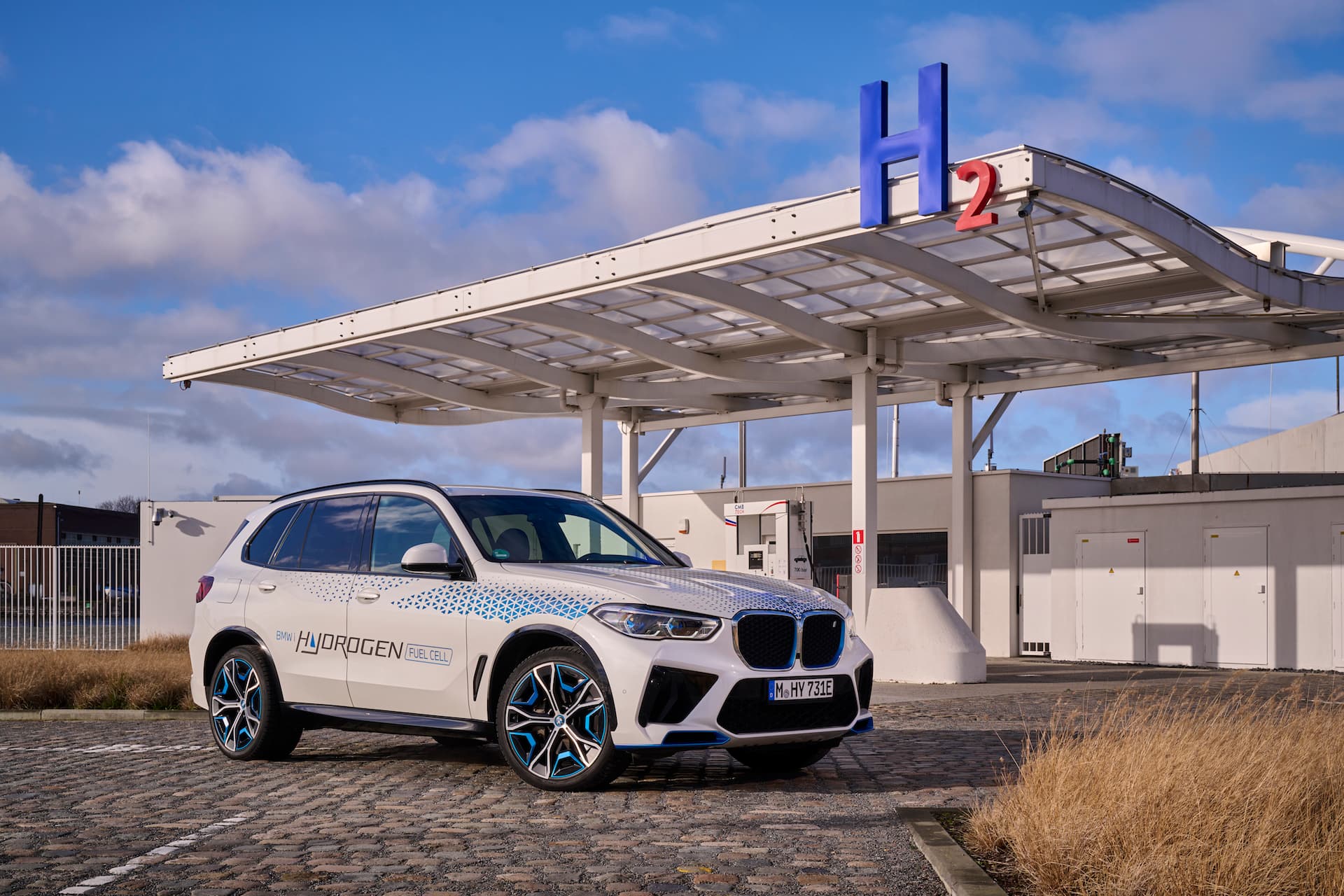
BMW remains committed to fuel-cell technology and plans to launch its first production hydrogen model in 2028. The iX5 Hydrogen is not intended merely as a technology demonstrator but will be offered as a regular production vehicle. BMW sees it as a complement to battery-electric cars, particularly for customers who need a long range and short refueling stops.
It will be based on the familiar BMW X5 model line. The powertrain itself remains electric, but most of the electricity is generated from hydrogen by a fuel cell. A high-voltage battery buffers energy, assists during acceleration and stores energy recovered through regenerative braking.
Up to 750 km with around seven kilograms of hydrogen
BMW is targeting a range of up to 750 km for the planned production model. This would require storing around seven kilograms of hydrogen. Refueling is expected to take less than five minutes, making it about as quick as filling up a conventional combustion-engine vehicle.
The new fuel-cell system is being developed jointly with Toyota. The third generation is expected to be more compact, more efficient and less expensive to produce. BMW is also using components from its battery-electric models to reduce development costs and integrate existing supply chains.
| Aspect | BMW’s target for the iX5 Hydrogen | Key obstacle |
|---|---|---|
| Market launch | 2028 | Sufficient demand must emerge by then |
| Range | Up to 750 km | The figure must be confirmed in the production vehicle |
| Hydrogen capacity | Around 7 kg | High fuel prices increase running costs |
| Refueling time | Less than 5 minutes | The advantage only applies when an H2 station is available |
| Technology | Fuel cell, battery and electric drive | More complex than a purely battery-electric powertrain |
Steyr prepares for series production
Production of the fuel-cell system is being prepared in Steyr, Austria. This also gives the project industrial significance for the German-speaking DACH region—Germany, Austria and Switzerland. The plant is already an important production site for BMW powertrains and is simultaneously taking on work for electric models based on the Neue Klasse, BMW’s next-generation vehicle platform.
BMW is therefore deliberately pursuing several technological paths. At the same time, the manufacturer is advancing its battery-electric platform with 800-volt technology, as demonstrated by its plans for the Neue Klasse BMW iX1. Fuel-cell technology is therefore not replacing this strategy but complementing it.
Germany’s H2 refueling network is shrinking
The biggest weakness currently lies not in the vehicle but in the surrounding infrastructure. Only around 50 publicly accessible hydrogen refueling stations remain in operation in Germany. Two years earlier, there were more than 80.
Moreover, a growing share of the infrastructure is being geared toward buses and trucks using 350-bar systems. Hydrogen-powered passenger cars generally use a higher storage pressure. A station for heavy commercial vehicles is therefore not automatically a practical everyday solution for a fuel-cell car.
This diminishes some of the practical benefit of short refueling times. Five minutes at the pump is of little help if drivers must make a substantial detour to get there or if the only station within reach is unavailable. The fast-charging network for battery-electric cars is now considerably denser along major long-distance routes.
Hydrogen remains expensive for passenger cars
The iX5 Hydrogen also faces a difficult starting point in terms of running costs. Assuming, for example, consumption of 1.3 kg of hydrogen per 100 km and a price of €19 per kilogram, energy costs would amount to almost €25 per 100 km. This is expressly not a consumption forecast for the upcoming BMW, but it illustrates the economic challenge.
One reason is the energy conversion chain. Electricity is first used to produce hydrogen, after which the gas must be compressed, transported and converted back into electricity inside the vehicle. Every step causes losses. Charging a battery directly is significantly more energy-efficient and usually less expensive with suitable electricity tariffs.
Meanwhile, fully electric cars continue to improve in terms of range and charging performance. Leading models already charge at well over 300 kW. Our comparison of 800-volt and 400-volt systems in electric cars shows the everyday benefits of modern high-voltage systems.
€273 million in public funding
The development and industrialization of the hydrogen powertrain are receiving extensive public funding. Germany’s federal government is providing €191 million for BMW’s HyPowerDrive project, while the state government of Bavaria is contributing another €82 million. Together, this amounts to €273 million in support.
The funding lowers the financial barrier to developing the technology and establishing production. However, it does not guarantee that a market will emerge. Just over 16,000 fuel-cell vehicles were sold worldwide in 2025, while Hyundai and Toyota together sold only 566 hydrogen cars in Europe.
Our assessment of the BMW iX5 Hydrogen
The iX5 Hydrogen could become a technically compelling electric vehicle. Its long range, short refueling time and the experience of BMW and Toyota point to a mature powertrain system. The concept could certainly work for specific fleets, regions or user profiles.
For the mass passenger-car market, however, good vehicle technology alone is not enough. Hydrogen would need to become cheaper and reliably available, while a sufficiently dense network of compatible refueling stations would also have to be established. As long as battery-electric cars charge faster, offer longer ranges and can obtain energy in far more places, the iX5 Hydrogen will remain, above all, a bold bet on technology.