BMW iX3 Long Wheelbase Preorders Open in China
BMW opened preorders for the new iX3 in a China-exclusive long-wheelbase version at the 2026 Chengdu Auto Show. Three variants are available, with prices that BMW says will be identical to the official prices at market launch.
Depending on the version, the model is priced between 269,900 and 339,900 yuan in China. This is particularly significant for the German-speaking DACH region—Germany, Austria and Switzerland—because the iX3 is being closely watched there as the first major production model based on the BMW Neue Klasse.
Dimensions: Long-Wheelbase Version with a 3,005 mm Wheelbase
The new iX3 L is clearly tailored to Chinese preferences for more rear-seat space. The wheelbase increases to 3,005 mm, while the exterior dimensions are 4,885 mm long, 1,895 mm wide and 1,635 mm tall.
On its own, this does not reveal anything about the potential specifications of a future EU-market iX3. However, BMW typically uses key technology modules across an entire platform, while body variants and equipment details differ depending on the market.
Neue Klasse Exterior: Illuminated Front and New Door Handles
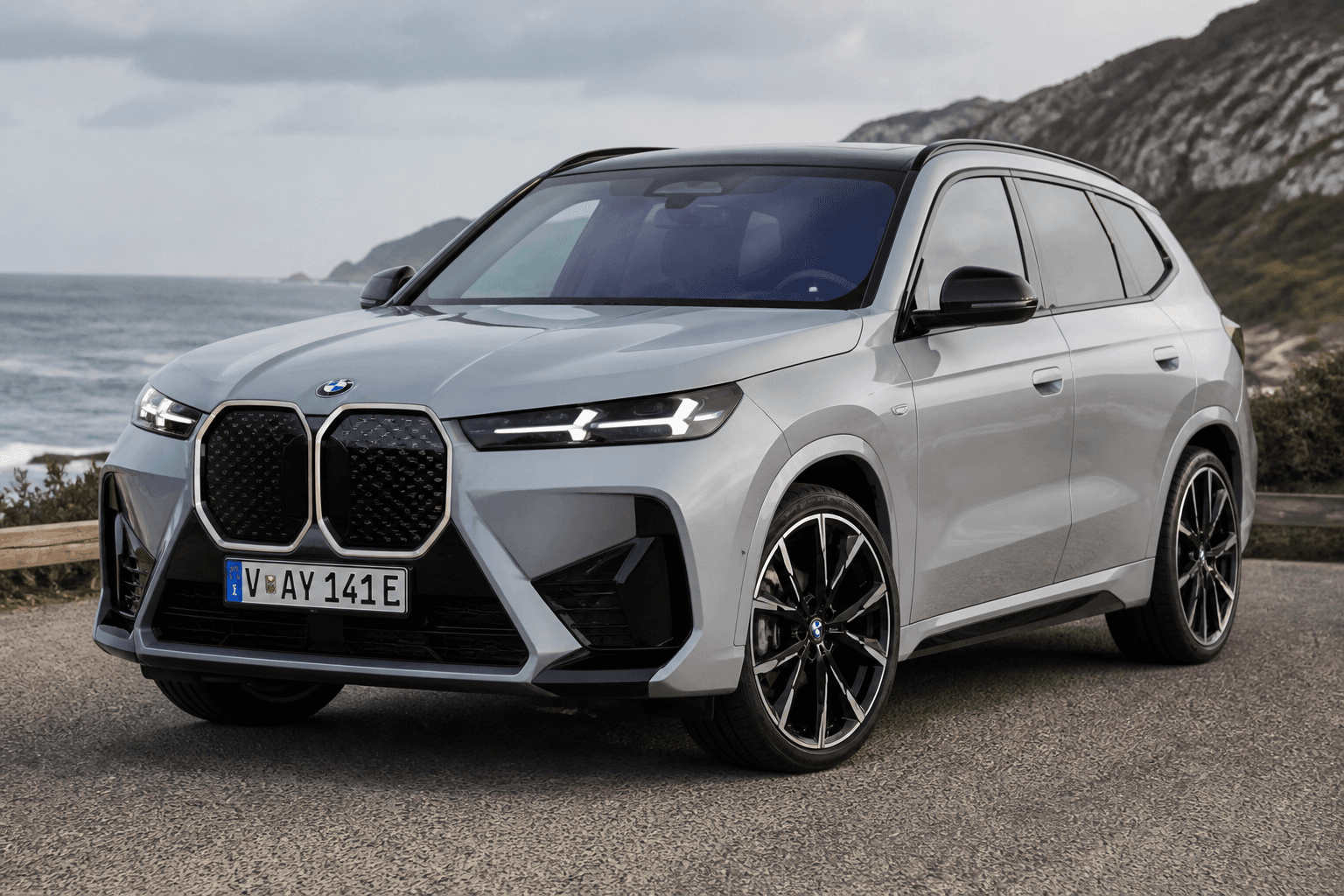
Visually, the iX3 adopts BMW’s new design language, featuring an illuminated 3D kidney grille and distinctive headlights. It also has partially recessed door handles that, according to the manufacturer, combine two opening modes: electric and mechanical.
Nine exterior colors and four interior color and material themes are planned, some with two-tone designs. Although the details depend on the market and trim level, they demonstrate that BMW is clearly positioning the Neue Klasse as a generational shift.
Interior and Infotainment: Panoramic iDrive and Large-Format HUD
The new BMW Panoramic iDrive takes center stage in the cockpit. The highlight is a large-format head-up display with ultra-short-throw projection, which is designed to display a 40-inch panoramic image in 4K quality on the windshield. This is complemented by a 17.9-inch touchscreen angled 17.5 degrees toward the driver.
For China, BMW supports Huawei HiCar alongside Apple CarPlay for smartphone integration. AI functions are also being integrated through local partners, an approach that is unlikely to reach Europe in this exact form because its service ecosystems and data protection requirements differ.
Driver Assistance Systems: End-to-End AI for China, with a Local Partner
For automated driving in China, BMW is working with a local provider on an end-to-end AI driving stack designed to handle both urban traffic and highway scenarios. Importantly, such systems are heavily tailored to local map data, traffic regulations and training data.
For the DACH market, the key issue is therefore not whether this exact Chinese technology stack will arrive, but that BMW is fundamentally designing the Neue Klasse as a software- and AI-centric platform. Similar approaches can be seen across the industry, including at Tesla, where software iterations and data feedback have been key topics for years.
Powertrain and Charging: 800 Volts, 108 kWh and Very Fast DC Charging
This is where the technology becomes particularly interesting: The iX3 L uses sixth-generation BMW eDrive and an 800-volt architecture. Its 108 kWh battery uses a cell-to-pack design, eliminating conventional modules. BMW claims a 20% increase in energy density and a 30% increase in range compared with the previous generation.
For China, BMW quotes a charging time from 10% to 80% of 21 minutes. A 10-minute charging session is also said to add 400 km of range under the China Light-Duty Vehicle Test Cycle (CLTC). However, CLTC is considerably more optimistic than WLTP, so these figures should clearly be viewed in Europe as best-case results under the Chinese test cycle.
Performance of the Top-of-the-Range iX3 50L
For the iX3 50L, BMW specifies a combination of an asynchronous front motor and an electrically excited synchronous motor on the rear axle. Together, they deliver a total system output of 351 kW.
Range, Consumption and Everyday Use: Impressive Claims, but Mind the Test Cycle
BMW quotes a maximum range of up to 900 km under CLTC. Official energy consumption is expected to start at 15.1 kWh/100 km. Even after accounting for the gap between CLTC figures and European real-world conditions, this indicates the direction of travel: greater efficiency combined with high charging performance, resulting in less time spent stopped on long-distance journeys.
There are also some practical figures to match: a 58-liter front trunk and 540 liters of cargo capacity, expanding to as much as 1,600 liters with the rear seats folded. The front trunk in particular shows that the new platform’s packaging and component layout have been optimized for an electric powertrain.
What Does This Mean for Germany, Austria and Switzerland?
The iX3 L is clearly a China-specific vehicle, but its core technology is the real news: 800 volts, new cell formats, cell-to-pack construction and an infotainment system focused on large displays and software integration. This is relevant to buyers in the DACH region because many of these elements are highly likely to appear in European Neue Klasse models as well.
For a broader explanation of 800-volt technology, see our comparison of 800V vs. 400V architecture in electric cars. And if you are particularly interested in BMW’s electrification plans for the coming years, it is also worth reading our article about the Neue Klasse BMW iX1.
Assessment: Competitive Pressure Is Rising, Including for Tesla
With specifications such as 108 kWh, 800 volts and short DC charging times, BMW is demonstrating how quickly premium manufacturers are catching up in the competitive landscape. For Tesla fans, that is ultimately positive: More credible 800-volt models on the market increase the pressure to improve charging speed, efficiency and software quality, benefiting everyone in the end.
For direct comparisons with Tesla, the model pages for the Tesla Model Y and Tesla Model 3 are a good starting point for comparing range, charging performance and vehicle classes.