
Zoox expands testing area with two additional US markets
Zoox is expanding its robotaxi activities in the US and will begin mapping and test drives in Houston, Texas, and San Diego, California, later this month. The Amazon-owned company is thus continuing to expand its presence before autonomous rides are made available to passengers.
For readers in the DACH region—Germany, Austria and Switzerland—this primarily provides an indication of how quickly robotaxi platforms are evolving in large, complex cities. Although these tests are currently focused exclusively on the US, they establish standards for sensors, validation and operations that could later become relevant in Europe as well.
How the rollout works: mapping first, then autonomy
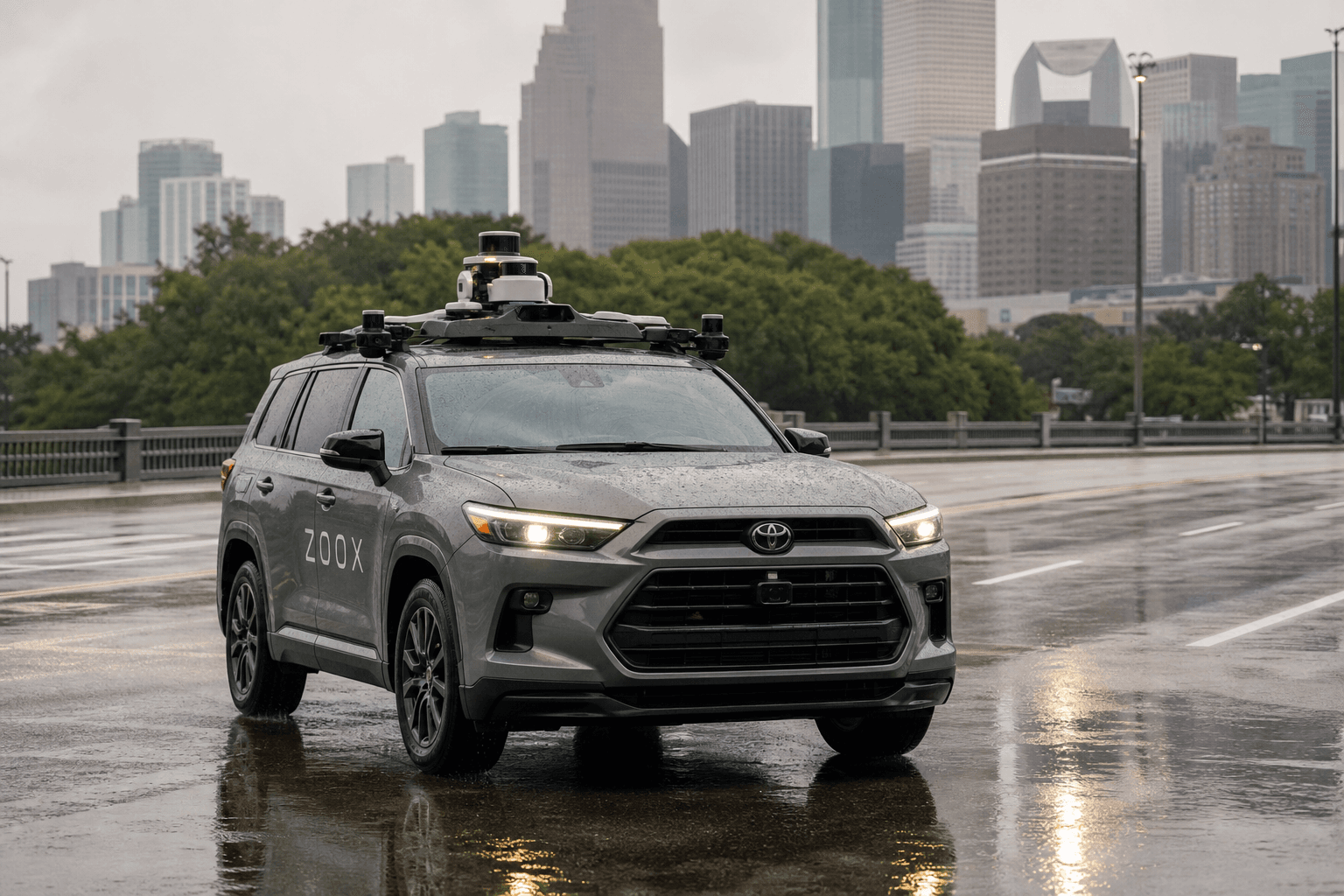
To begin with, Zoox is sending modified Toyota Highlanders onto the road. The vehicles are equipped with cameras, LiDAR and radar, but will initially operate with human safety drivers. The aim is to map local roads and collect driving data in order to train and validate the autonomous system for local conditions.
This approach is common in the industry: first, the system develops a data-based “understanding” of its surroundings, after which more autonomous functions are introduced gradually. In practical terms, before a robotaxi can operate without a driver, infrastructure, the behavior of other road users and regional characteristics are recorded in great detail.
Why Houston and San Diego are technically challenging
Zoox itself cites the environmental conditions as a challenge: in Houston, the focus is on heat and heavy rain, while San Diego presents a different set of conditions with coastal fog and fast-moving freeway corridors. Such changes in weather and visibility are a rigorous test of sensor fusion and decision-making logic.
Rain and fog in particular reveal how robustly a system’s LiDAR, radar and camera stack performs, and how well it balances being “cautious” against being “unnecessarily defensive.” Excessive caution can disrupt traffic flow, while insufficient caution increases risk.
Present in 12 US markets, but paid rides currently available only in Las Vegas
With the addition of Houston and San Diego, Zoox says it is now present in 12 US markets, including Seattle, Austin, Miami, Atlanta, Los Angeles and Washington, D.C. Importantly, presence here primarily means testing and data collection, not necessarily a fully operational ride service.
Zoox currently offers paid rides only in Las Vegas. In San Francisco, selected users can reportedly take free rides. Zoox has not yet provided a timeline for when passengers will be able to ride in Houston or San Diego.
Analysis: The robotaxi race is expanding
Zoox announced its expansion on the same day that Waymo began rolling out paid robotaxi rides in additional markets, highlighting the momentum in this segment. More cities mean more data, more edge cases and, ultimately, more mature operations.
For Tesla fans, this offers an interesting point of comparison: Zoox and Waymo rely heavily on highly equipped test fleets and geofenced operating areas, while Tesla is pursuing a scalable software-based approach with FSD across its customer fleet. Which strategy will lead more quickly to a widely available robotaxi service in the long term depends not only on the technology, but also on regulation, liability, operating costs and the pace at which new regions are approved.


