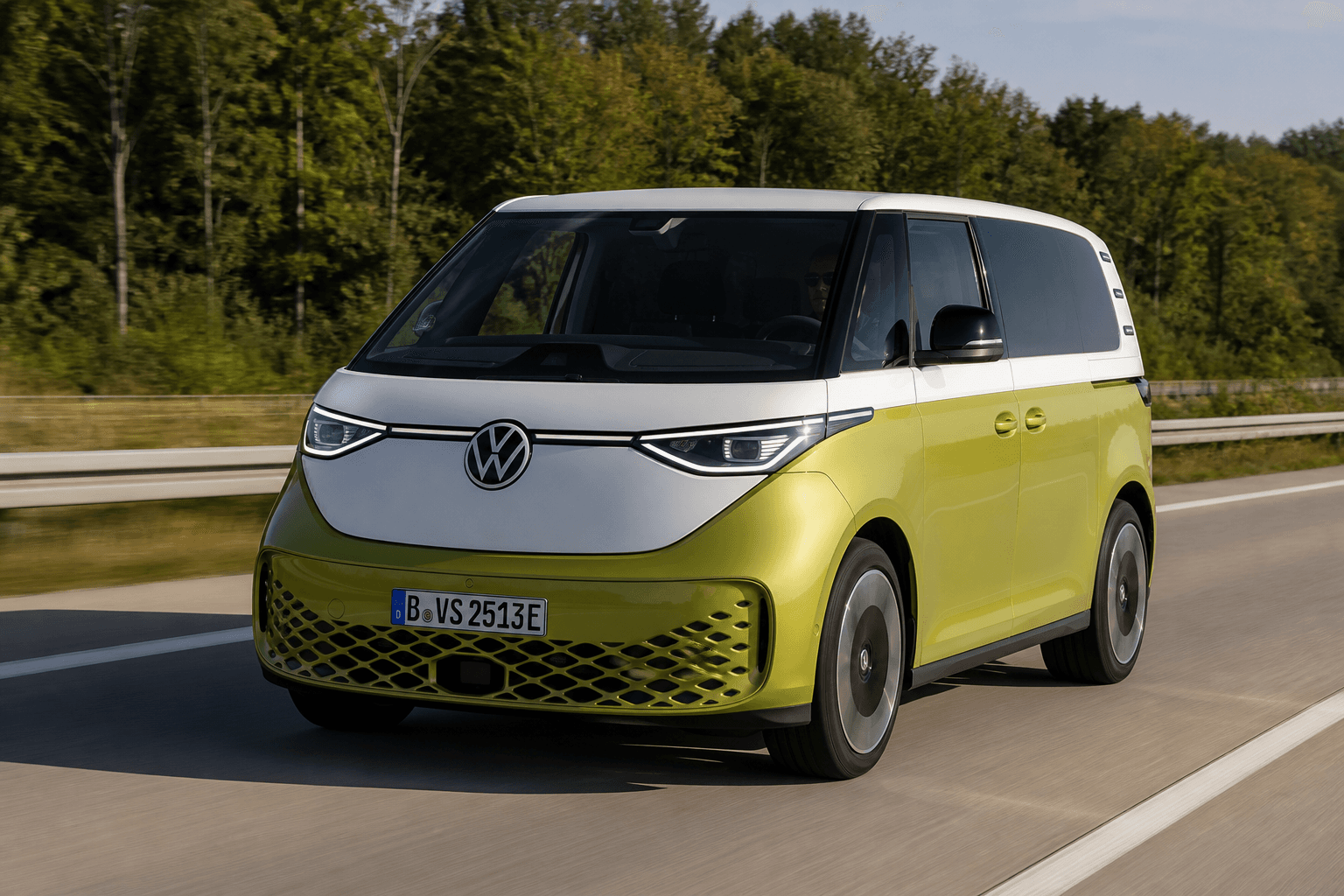
VW upgrades the ID. Buzz with new driver assistance systems
Volkswagen is significantly expanding the driver assistance features of the VW ID. Buzz. The new IQ.Drive package combines an enhanced version of Travel Assist with predictive speed control, automatic lane changes and a more comprehensive emergency assistant.
This brings VW’s functionality in line with more modern driver assistance systems. However, the electric van does not gain an autonomous driving mode. The driver remains responsible at all times, even if individual maneuvers can be performed without steering input.
The biggest advance is not any single feature, but the interaction between lane guidance, speed control and emergency detection.
These features are included in the new IQ.Drive
The technology is not intended solely for the ID. Buzz. The Golf, Tiguan and Atlas, the latter primarily sold in North America, will also receive key elements of the package. It is designed for vehicles based on the MEB and MQB Evo platforms.
| Feature | Purpose | Announced models |
|---|---|---|
| Predictive ACC | Adjusts speed to traffic and the road ahead, and also assists with highway exits | ID. Buzz, Golf, Tiguan, Atlas |
| Travel Assist | Handles lane guidance and initiated lane changes | ID. Buzz, Golf, Tiguan, Atlas |
| Emergency Assist Plus | Warns if the driver fails to respond and can bring the vehicle to a controlled stop | ID. Buzz, Golf, Tiguan, Atlas |
| Road Experience Management | Supplements the sensors with cloud-based road data | ID. Buzz |
Automatic lane changes using the turn signal
The new Travel Assist can perform a lane change automatically after the driver activates the turn signal. The vehicle looks for a sufficiently large gap and then handles the steering maneuver. A flashing green arrow in the digital cockpit indicates that the maneuver is being prepared.
The system waits up to 12 seconds for a safe opportunity. If the adjacent lane is blocked, a red indicator initially appears. As soon as the lane change becomes possible, the display switches back to green and the vehicle performs the maneuver.
In everyday driving, this primarily reduces the number of manual interventions required on long highway journeys. However, it is not a permanently hands-free highway mode. Unlike more comprehensive systems that still require supervision, such as the announced Tesla FSD v15, VW focuses on assisting with individual driving tasks.
Predictive ACC recognizes exits and speed changes
The adaptive cruise control system is also gaining additional capabilities. Predictive ACC can account for a highway exit, assist with moving into the exit lane and reduce speed accordingly. The system also responds to the traffic situation and suggests speed changes.
Before increasing speed, the system prompts the driver, who can accept or reject the suggestion. This is useful because automatically detected speed limits or map data may not always match the actual road layout.
Emergency Assist Plus responds in an emergency
The revised Emergency Assist Plus operates differently depending on which assistance mode is active. If the lane-keeping assistant detects several consecutive lane departures without a response, visual and audible warnings follow. If these are ignored, the vehicle attempts to pull over in a controlled manner.
When Travel Assist is active, the escalation begins if no steering input is detected for 25 seconds. The car sounds the horn, applies three brief braking pulses and tightens the seat belt. This is intended to alert a distracted or medically impaired driver as clearly as possible.
If there is still no response, the vehicle stops in a suitable location, provided the traffic situation allows it. It then activates the hazard lights, selects park, unlocks the doors, switches on the interior lighting and places an emergency call.
Cloud map helps when road markings are poor
The ID. Buzz is set to exclusively receive the feature known as Road Experience Management. It uses cloud-based information from real-world camera data to digitally record road markings, traffic signs and traffic lights, among other things. This can partially compensate for hard-to-see lines or weather-related restrictions on camera visibility.
The feature is expected to be tied to a paid premium in-vehicle service. The regional availability of collected road data will also be crucial. The denser and more up to date the data, the better the virtual map can support the vehicle’s onboard sensors.
Availability in Germany remains unclear
The announcement clearly refers to the North American model lineup, where the VW Atlas plays a central role. This does not automatically mean that all features will come to Germany, Austria or Switzerland unchanged. Regional approvals, mapping services, subscriptions and software versions may differ.
Nevertheless, the upgrade is an important technical step for Volkswagen. The ID. Buzz in particular benefits from more convenient highway features and an emergency assistant that can do significantly more than issue a simple warning. IQ.Drive does not make the electric van autonomous, but it does make it noticeably more capable and safer on long journeys.