Audi A2 e-tron production starts in Ingolstadt
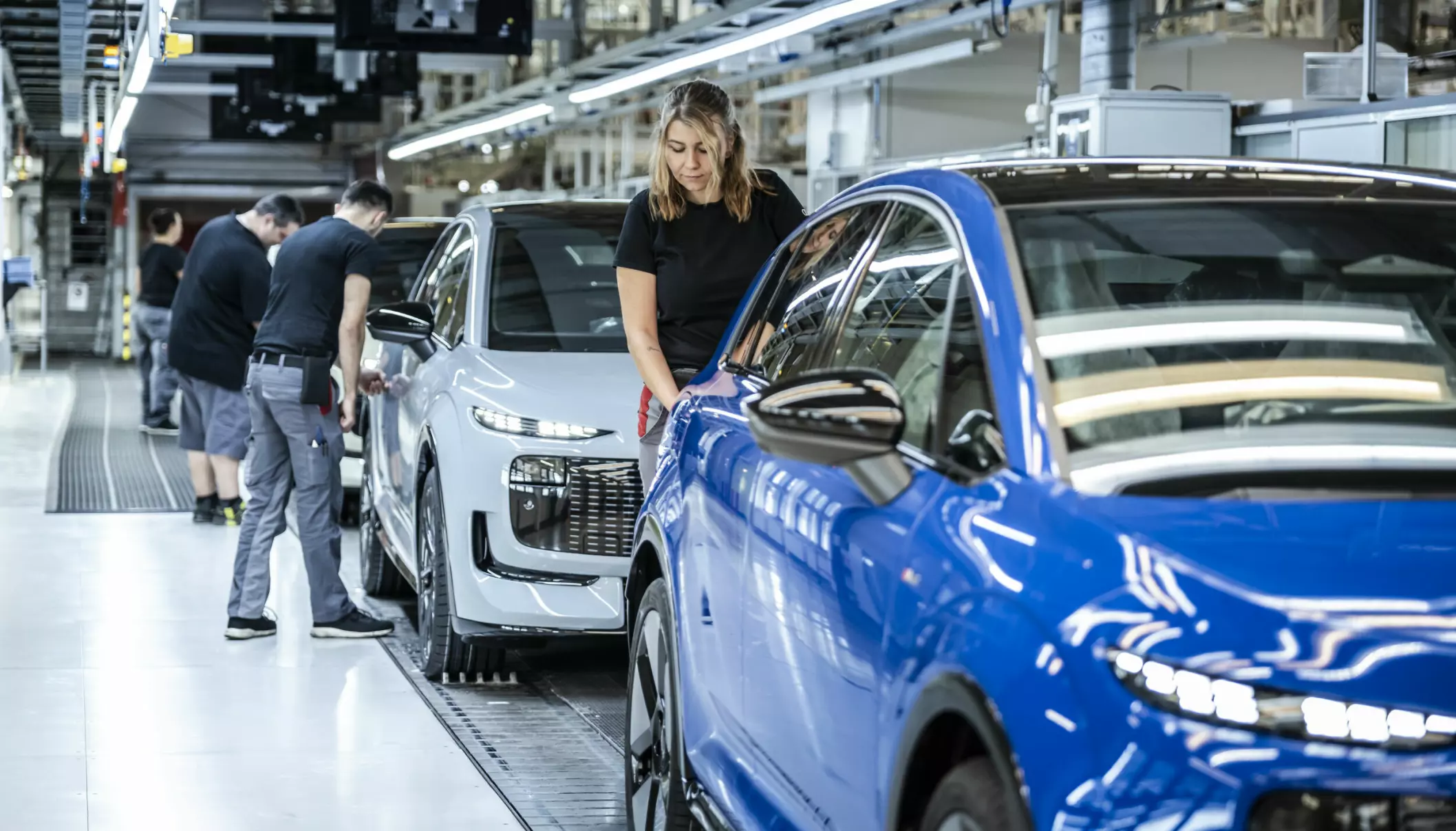
The Audi A2 e-tron is entering series production at the company’s main plant in Ingolstadt. The compact electric car is based on the Volkswagen Group’s enhanced Modular Electric Drive Matrix, MEB+, starts at €38,200 and is scheduled for delivery from December 2026.
It is not only the return of the model name that is noteworthy. Audi says it has shortened the development time by 21 months compared with previous vehicle projects. This also makes the A2 e-tron a test case for faster and less complex development processes.
| Key figure | Audi A2 e-tron |
|---|---|
| Platform | MEB+ |
| Production site | Ingolstadt |
| Base price | €38,200 |
| Deliveries begin | December 2026 |
| Reduction in development time | 21 months |
Why Audi was significantly faster
Audi did not have to start from scratch with the A2 e-tron. Experience from previous vehicle projects, the Group’s established architecture and streamlined coordination processes allowed the vehicle to reach technical maturity earlier during pre-series production.
The platform strategy plays a central role. MEB+ combines previously developed components and processes, meaning fewer bespoke solutions have to be newly designed and validated. The upcoming VW ID. Tiguan with MEB+ technology also shows how widely the Group intends to use the updated architecture.
More shared components and clearer processes mean less coordination, earlier pre-series production and ultimately a faster start of production.
The reduced number of variants also helps. Fewer part numbers simplify purchasing, storage and material supply. Shorten development time → reduce production complexity: this is precisely the combination intended to make the A2 e-tron more economical.
More than 1,200 components are being reused
At the Ingolstadt plant, Audi is reusing more than 1,200 existing production components. These include robotic welding guns and around 250 robots that were previously used for other models and are now being reused or adapted.
Sharing body production with the Audi A3 also reduces the conversion work required. Existing equipment remains usable, while new stations are installed selectively wherever they deliver a clear efficiency gain.
This is particularly relevant for Audi because the Group is sharpening the focus of its electric vehicle strategy and prioritizing investments more carefully. The A2 e-tron therefore adds an important compact model to the relatively limited number of new Audi electric cars planned through 2029.
Pearl-chain scheduling organizes every customer order in advance
For the first time in Ingolstadt, Audi is using the pearl-chain scheduling principle, which is already in use at its Neckarsulm plant. Under this system, production control sets the sequence of customer orders six days before assembly begins, after which it is binding.
This sequence then applies across all production areas. Suppliers can therefore produce parts to match the planned vehicle sequence and package them in the correct order. This is intended to largely eliminate the need for additional storage space and subsequent sorting.
In day-to-day factory operations, this means fewer material movements and more precise supplies to the assembly line. However, the system can only work reliably if the supply chain, software and production operations are closely integrated.
Robots now pick directly from unsorted bins
At the same time, Audi is increasing the level of automation. In chassis pre-assembly for the front and rear axles, fully automated robotic stations are replacing the previous semi-automated fastening stations.
Body production also uses a process known as bin picking. Cameras and image-processing systems identify small sheet-metal parts in unsorted containers, after which a robot picks up the correct component and feeds it into the production process.
Tasks like these were difficult for conventional industrial robots because the position and orientation of each part varied. Modern camera systems make the station more flexible and reduce the need for components to be precisely presorted.
Cloud-based control replaces more than 450 industrial PCs
Another component is Edge Cloud 4 Production. Among other things, it controls the testing system used when commissioning the vehicle’s control units and handles vehicle-specific configurations.
According to Audi, this allows more than 450 industrial PCs to be eliminated from the assembly process. Instead of using numerous individual computers at production equipment, computing power and applications are provided centrally. This makes updates easier and can reduce maintenance and hardware costs.
AI-powered assistants are also intended to help employees find documentation, process knowledge and solutions to faults. One system focuses on supply-chain questions, while another helps maintenance teams with diagnostics and repairs.
What faster development means for customers
Cutting development time by 21 months does not automatically mean that technical testing is being omitted. The crucial factor is whether Audi can more efficiently combine established components, digital development tools and experience from previous projects. That is precisely what the approach used for the A2 e-tron is based on.
For customers, a shorter cycle could mean faster model updates and a quicker response to new market requirements. However, the starting price of €38,200 also shows that savings in development and production are not necessarily passed on in full through the list price.
Nevertheless, the start of production is strategically important. Audi is demonstrating that a new electric car can be manufactured in Germany with a high level of automation and by largely using existing equipment. The A2 e-tron is therefore not only a new compact EV, but also a blueprint for future Audi projects.