VW begins producing battery cells in Salzgitter for the next wave of entry-level EVs
Volkswagen is bringing more of the value chain for one of the most critical EV components to Germany: production of its own battery cells is getting underway in Salzgitter. Cells for test vehicles had already been produced there, but the move toward ramping up series production is now significant because the first models equipped with them are set to go on sale.
For the German, Austrian and Swiss market, commonly known as the DACH region, this is particularly significant in terms of industrial policy and pricing. Batteries are the largest cost component in an electric car, while Europe remains heavily dependent on Asia for cells and raw-material supply chains. Any locally scalable production reduces risks related to supply chains, prices and geopolitical tensions.
Why this matters: Europe still relies heavily on China and Korea for battery cells
The global battery market continues to be dominated by Chinese manufacturers such as CATL and BYD, alongside major players from South Korea. Although Europe has a strong automotive industry, its role in cell production has so far been much smaller than in vehicle manufacturing itself. VW ramping up its own output is therefore more than a symbolic move.
The move also comes after several European battery projects recently failed to proceed as planned. Following the collapse of a major European initiative in which VW was also involved, pressure is growing to establish reliable in-house capacity and then bring it to full utilization quickly.
Starting with 37 and 52 kWh: these batteries are central to the “Urban Electric Car Family”
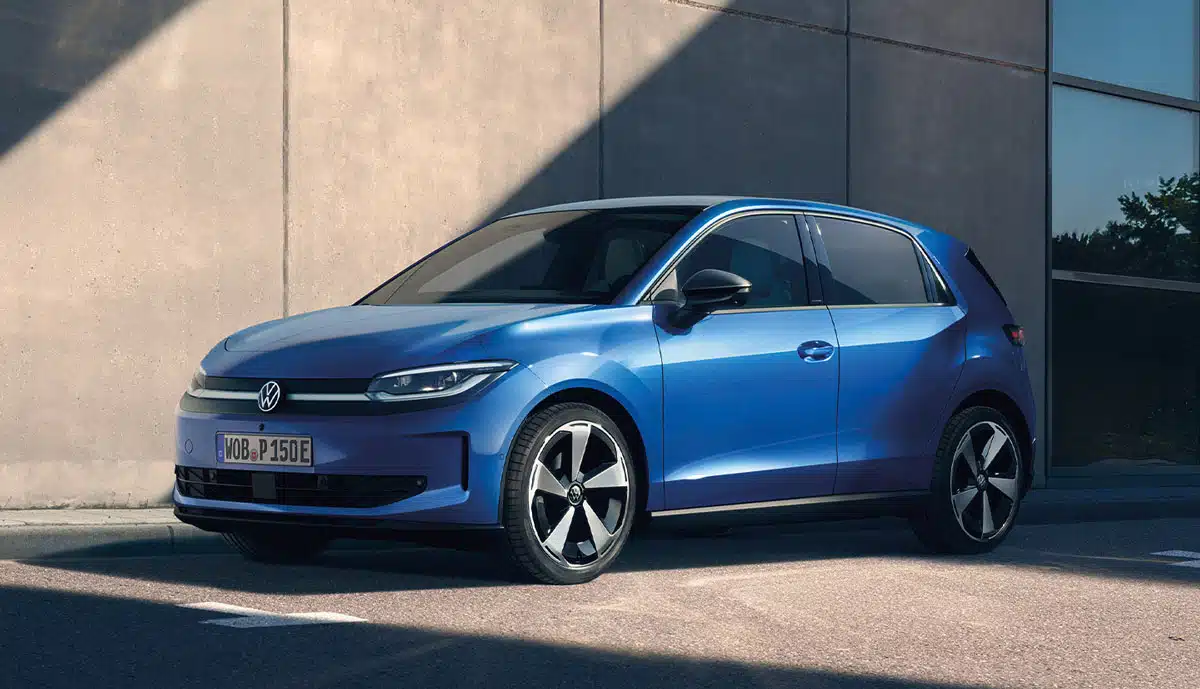
For the initial ramp-up, VW is focusing on the “smaller” battery sizes, specifically 37 and 52 kWh. These are precisely the capacities intended for the group’s upcoming entry-level models: the ID. Polo and its sister models, the Cupra Raval and Skoda Epiq. The cells are also expected to be used in additional models later, including the ID. Cross.
At the same time, the group is also developing cell production in other countries, including through VW subsidiary PowerCo in Spain. Ultimately, it is all about scale, because battery costs can only be reduced significantly through high production volumes.
Unified cell and LFP: the key to lower prices and greater scale
From a technical perspective, VW’s so-called unified cell plays a key role. The idea is to supply as many models as possible using a standardized cell platform, simplifying development, procurement and production while lowering costs through high volumes. VW sees this as a cost advantage that should translate directly into competitive vehicle prices.
The chemistry is also important: VW is using LFP, or lithium iron phosphate, for these entry-level battery packs. LFP has been widely used in China for years because it offers a strong balance of cost, everyday practicality and longevity. European manufacturers are only now beginning to adopt LFP as a standard on a larger scale. This fits with the strategy of making EVs in the €25,000 price bracket genuinely feasible, as VW intends with its new small-car family.
What LFP means in everyday use
- Lower cell costs, which are especially important in the entry-level segment
- Robust chemistry capable of many charging cycles, often with approval for routine charging to 100%
- Typically lower energy density than NMC, or nickel manganese cobalt, which can mean less range for a battery of the same physical size
Capacity: 20 GWh initially, rising to as much as 40 GWh
For the production ramp-up, VW initially cites an annual capacity of 20 GWh, which should be enough for roughly 250,000 electric cars. The maximum planned capacity is stated as 40 GWh. However, for the plant to operate economically, two things must happen at the same time: stable demand for the new EV models and a smooth production ramp-up without prolonged initial losses.
That is the real test: cell production is capital-intensive, and output must meet expectations. If the new generation of small cars succeeds, Salzgitter could become a genuine strategic advantage, both for pricing and supply security.
Context: where the market is heading
The trend is clearly moving toward scalable platforms, lower-cost cell chemistries and more local production. VW’s move fits squarely into that direction. At the same time, competition remains intense, with many manufacturers also adopting LFP and faster-charging architectures, as illustrated by current discussions surrounding 800-volt versus 400-volt systems.
For buyers in Germany, Austria and Switzerland, what ultimately matters most is whether affordable models arrive in sufficient numbers, with solid range and reliable delivery times. If the battery cells from Salzgitter can help ensure that, it will be a positive signal for the entire EV market.