Volvo prepares its biggest-ever model offensive
Volvo plans to launch a total of 13 completely new models by the end of 2030. According to the manufacturer, this will be the largest product offensive in the company’s nearly 100-year history.
Seven new models are intended for Europe, the US and other Western markets. Six additional models will be tailored specifically to China. Of particular relevance to the German-speaking DACH region—Germany, Austria and Switzerland—is Volvo’s plan to stop focusing its electric lineup primarily on SUVs.
| Market region | New models by 2030 | Planned focus |
|---|---|---|
| Europe, the US and other Western markets | 7 | Broader electric vehicle lineup with both high-riding and low-slung body styles |
| China | 6 | Dedicated models for local requirements |
| Total | 13 | Electric vehicles and new hybrid models |
SPA3 is intended to enable more than electric SUVs
The upcoming models for Western markets are expected to be based on the SPA2 and SPA3 architectures. SPA2 already underpins the EX90 and the electric ES90 sedan, while SPA3 is ushering in a new generation with the EX60.
According to Volvo, SPA3 can be scaled from the B-segment to the particularly large F-segment. Its technology includes cell-to-body construction, which integrates the battery more closely into the vehicle structure, as well as large cast components and a largely standardized software platform.
The shared HuginCore computing architecture is intended to consolidate key vehicle functions and allow software to be reused across different model lines. This reduces development work: compared with the EX60, the required investment for the second SPA3 model is expected to fall by around 60%, and by around 80% for the third model.
The key point is not just the number of new models, but the platform’s flexibility: SPA3 is intended to make SUVs, sedans and wagons economically viable on the same technical foundation.
Volvo EX50 considered a likely candidate
One of the next SPA3 vehicles is expected to be the Volvo EX50, due in 2027. The electric crossover is expected to launch first in the US, where it will replace the EX40 and be positioned at a lower price despite its larger dimensions.
However, Volvo did not officially confirm the model name in its latest strategy update. A European launch has not yet been finalized either. For Germany, Austria and Switzerland, the key question will be whether Volvo positions the EX50 as an addition to its existing compact models or as their long-term successor.
Alongside platform efficiency, range and charging performance will also play an important role in future SPA3 models. Our comparison of 800-volt and 400-volt architectures shows the practical differences between modern high-voltage systems.
Why new electric Volvo wagons are becoming more likely
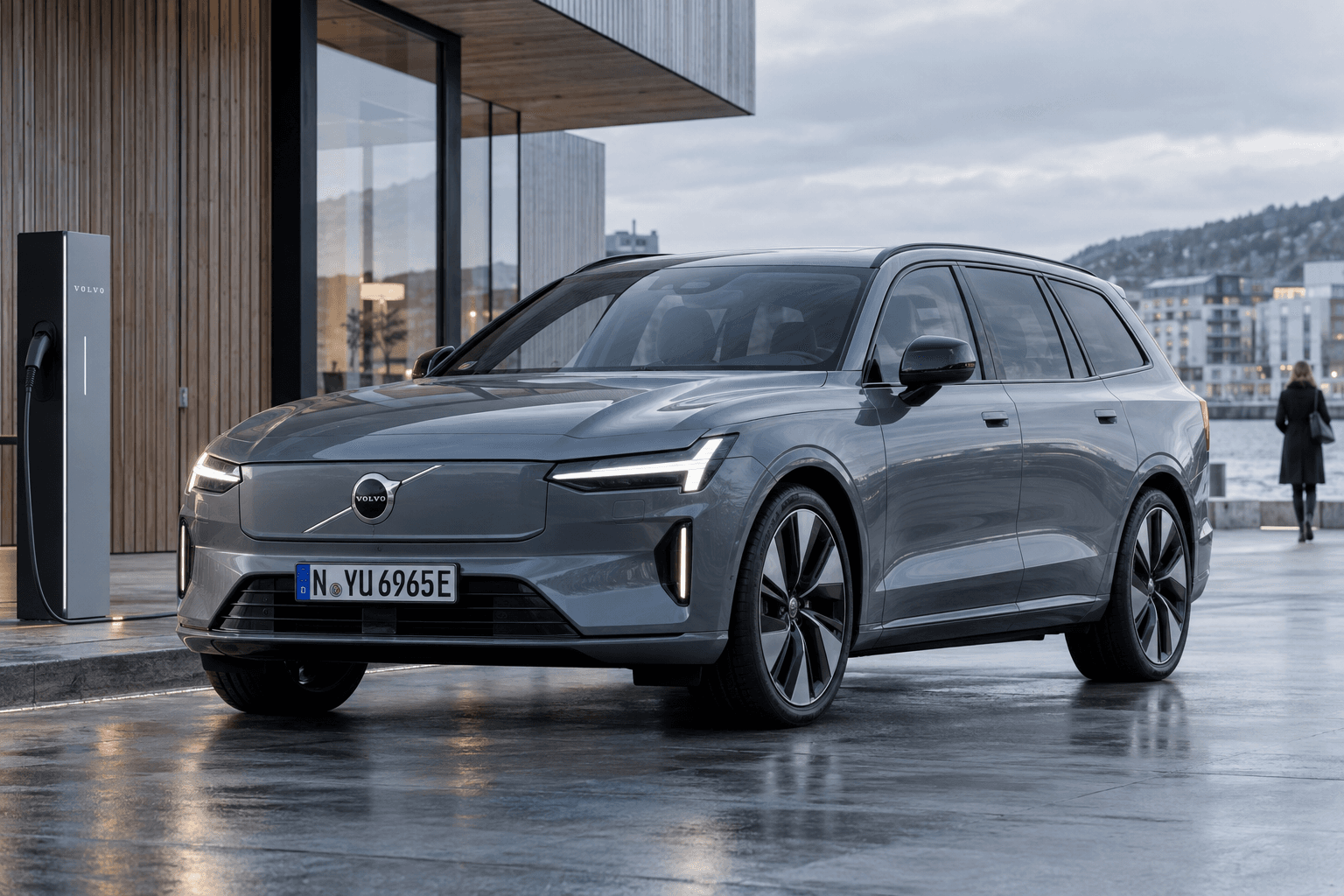
Volvo’s announcement that it intends to place greater emphasis on lower body styles again is particularly interesting. Conventional skateboard platforms with a flat battery pack in the floor work extremely well for SUVs, but make low seating positions and elegant proportions more difficult to achieve.
SPA3 is intended to reduce these limitations. This would make electric sedans and, above all, wagons possible without the battery compromising the roofline, seating height or use of interior space too severely.
Names such as ES60 or EV60 have been suggested as obvious possibilities, but neither has been officially confirmed. The only certainty is that Volvo plans to offer both high-riding and low-slung electric vehicles in Europe by 2030.
Arguments in favor of an electric wagon
- Volvo has explicitly announced lower body styles.
- SPA3 was developed for vehicles with different heights and across multiple size classes.
- Wagons continue to have a loyal customer base, particularly in Europe.
What remains unclear
- No model name has yet been confirmed.
- Dimensions, battery capacities and ranges are unknown.
- No specific production launch date has been announced for an electric wagon.
First preview planned for the 100th anniversary
Volvo plans to unveil a concept vehicle in spring 2027 to mark the brand’s 100th anniversary. It is intended to provide an initial preview of the next model generation and could demonstrate how Volvo will use the new design freedom offered by SPA3.
Large electric vehicles also remain part of the strategy. Another electric D-segment SUV is planned for the US, while Volvo also considers a particularly large F-segment model a possibility in the longer term.
Electric vehicles remain the priority for Europe
Volvo will not completely abandon combustion engines by 2030. New hybrid powertrains are intended primarily for markets where the transition to fully electric vehicles is progressing more slowly.
For Europe, however, the manufacturer sees a clear shift toward battery-electric powertrains. The EX60 provides an important indication of the business case: according to Volvo, the electric SUV is already more profitable than the comparable XC60.
This increases the likelihood that the planned model offensive will produce several distinct electric vehicles. A new electric Volvo wagon has not yet been confirmed, but it now appears much more realistic from both a technical and an economic perspective.