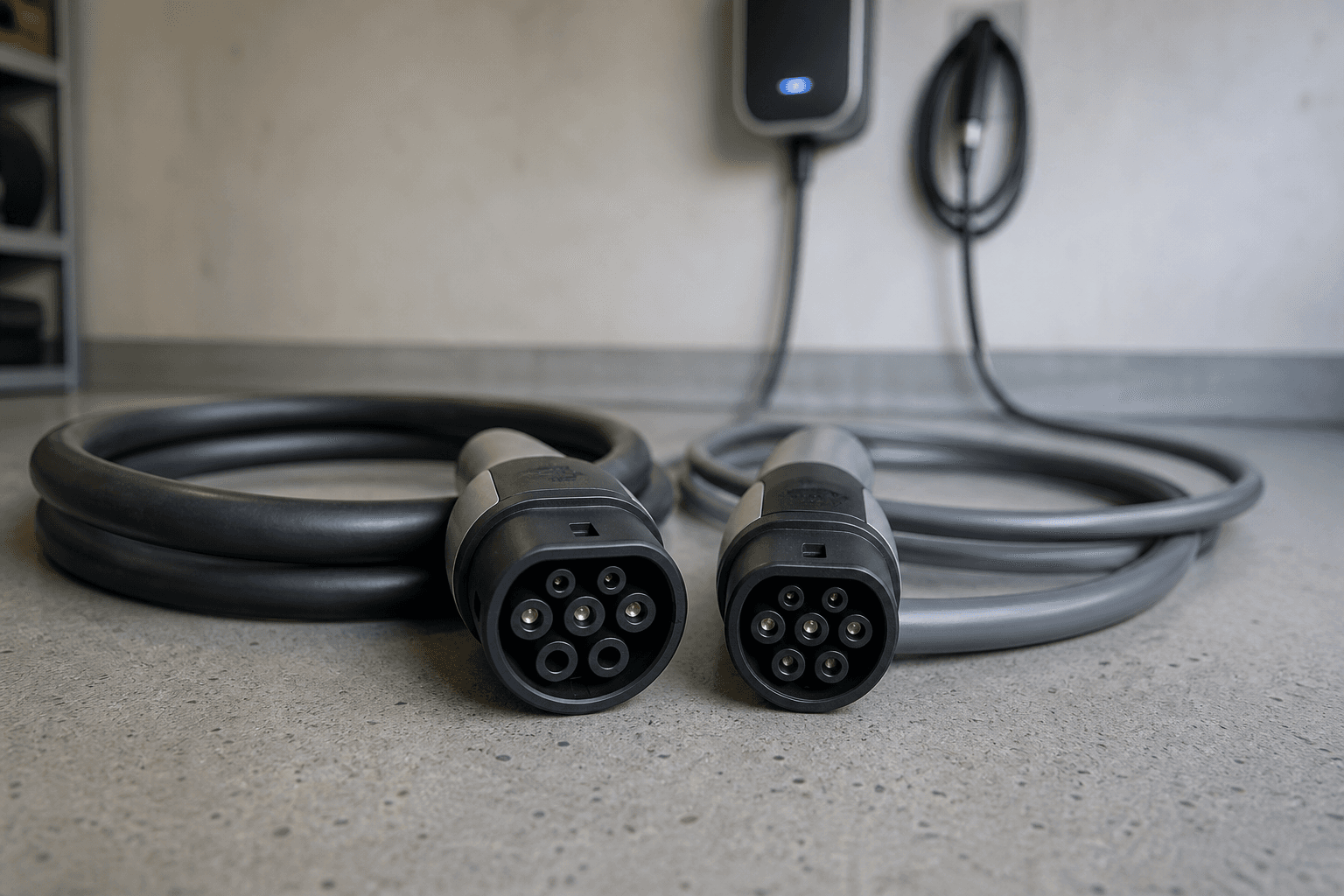
A Type 2 charging cable connects an electric car to a wallbox or public charging station for alternating-current charging. However, the standardised connector alone does not indicate how quickly the car will charge. The decisive factors are the cable's rated power capacity, its number of phases and the limits of the vehicle and charging point.
The actual charging power is always determined by the weakest link among the charging point, cable and onboard charger.
11 or 22 kW: What is the difference?
A three-phase 11 kW cable is usually rated for 16 amps per phase. Achieving 22 kW requires 32 amps per phase. A 22 kW cable can also be used at an 11 kW charging point without any issues. Conversely, an 11 kW cable limits the power even if the car and charging station support 22 kW.
| Feature | 11 kW cable | 22 kW cable |
|---|---|---|
| Rating | Three-phase, usually 16 A | Three-phase, usually 32 A |
| Maximum AC power | 11 kW | 22 kW |
| Handling | Usually lighter and more flexible | Usually thicker and heavier |
| Use | Vehicles supporting up to 11 kW AC | Vehicles supporting 22 kW AC or for future-proofing |
| Backward compatibility | Limited to 11 kW | Also suitable for 11 kW and lower |
When is 11 kW enough?
An 11 kW cable is sufficient for many electric cars because their onboard chargers can accept no more than 11 kW of AC power anyway. A higher-rated cable will not reduce charging time in this case. Drivers who mainly charge at home overnight often gain no benefit from 22 kW either.
Before buying, you should therefore check the vehicle's specifications for its maximum AC charging power. The often significantly higher DC charging power available at rapid chargers is not relevant here because these chargers use a permanently attached direct-current cable.
When is a 22 kW cable worthwhile?
A 22 kW cable makes sense if the car can charge at 22 kW using three phases. It can also be a future-proof choice if you plan to buy a different vehicle later. However, it is usually more cumbersome and takes up more space in the boot.
If the current car can accept only 11 kW, the following applies: connect a 22 kW cable → charging will still take place at no more than 11 kW. A lower-powered wallbox or a restricted charging station will also reduce the power accordingly.
Why the number of phases matters
Type 2 cables are available in single-phase and three-phase versions. A three-phase cable can use all three live conductors and is required for 11 or 22 kW. By contrast, a single-phase cable transfers energy through only one phase, thereby limiting the possible charging power.
For universal use, a three-phase cable is usually the better choice. It also works with vehicles that charge using only one phase. The car then simply uses one of the available phases. A single-phase cable, however, cannot enable three-phase charging.
The cable's current rating also matters for single-phase charging. A three-phase 22 kW cable is designed for higher currents on each phase and therefore offers more capacity than a 16 A version. However, the vehicle and charging point still determine the power that can actually be used.
What cable length makes sense?
The right length depends more on the parking space than on the car. Before buying, check which side of the vehicle has the charging port and where the wallbox or charging station is typically located.
- Around 5 metres: compact, easier to store and often sufficient for conveniently positioned charging points
- Around 7 metres: more flexible for varying parking positions and public charging stations
- 10 metres or more: useful only when the distance is genuinely large, as the extra weight makes the cable harder to handle
The cable should reach the charging port without placing strain on the connector. However, excessive extra length is also impractical: long cables are more likely to lie on the ground, get dirty more quickly and require more careful storage. Extension cables or interconnected Type 2 cables are not a suitable solution.
Other factors to consider when buying
Wallboxes and public AC charging points with sockets require a Mode 3 cable with Type 2 connectors. If the wallbox already has a permanently attached cable, no separate cable is required. The appropriate cable is also permanently installed at DC rapid-charging stations.
- Current rating and number of phases clearly specified
- Robust connectors and adequate protection for outdoor use
- Clearly legible standards and manufacturer markings
- A suitable bag for clean, dry storage
For most vehicles, a three-phase 11 kW cable is the practical and easy-to-handle solution. Drivers who can use 22 kW, regularly charge different vehicles or deliberately want additional power capacity should choose a three-phase 22 kW cable. The real parking situation should determine the length, rather than simply choosing the longest model available.