Why ladder-frame EVs need a special battery solution
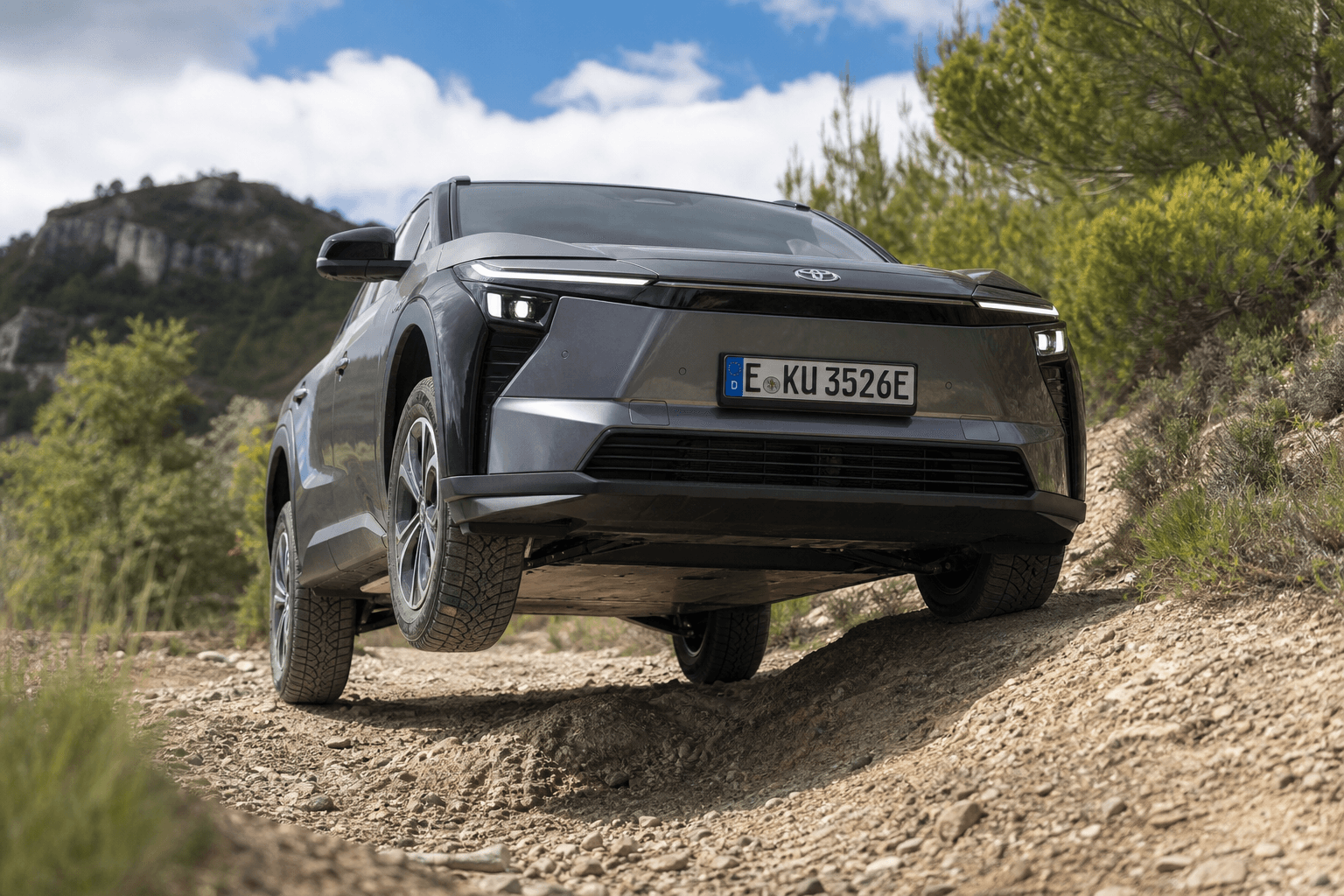
Electric off-road vehicles, pickups and many commercial vehicles traditionally use a ladder frame. It is robust and is intentionally designed to have some flexibility off-road, as each wheel moves differently during axle articulation, causing the frame to twist. In electric vehicles, however, this twisting creates technical stress.
Instead of a relatively light fuel tank, an EV usually has a heavy battery pack beneath the vehicle floor. If it is rigidly bolted to a frame that twists, high bending and torsional forces act on the battery enclosure. This can affect durability, sealing and, in extreme cases, safety in crashes and off-road use.
Toyota’s concept: Support the battery in the center and “hinge” it at one end
In a new patent, Toyota describes an underbody design intended to reduce mechanical stress on the battery during off-road use. The basic idea is simple but effective: The energy storage system is supported mainly in the central section of the frame, because this area typically moves less when the frame twists.
At one end, the concept uses a rotating joint that works like a hinge. This allows the frame to twist without rotating the battery to the same degree → the battery pack remains more stable, while the suspension can still articulate.
Off-road torsion in the ladder frame is fine—but it should not become a constant load on the battery enclosure. That is precisely what Toyota’s patent aims to address.
Real-world impact: Greater durability and potentially more battery capacity in the same vehicle
In practice, this type of isolation could offer several benefits. First, it reduces the constant load on the enclosure, seals and mounting points. This is particularly relevant for vehicles regularly driven on rough tracks or construction sites, or operated with heavy payloads.
Second, optimized underbody mounting could free up installation space. If the battery does not have to meet the same structural requirements at every point, some platforms might be able to accommodate larger batteries without redesigning the entire vehicle. Toyota’s patent considerations also suggest that the technology could be relevant not only to fully electric off-road vehicles, but also to pickups, commercial vehicles and hybrid models.
Toyota is also considering “controlled movement” in crashes
Another recently published patent from Japan points in a similar direction: Instead of bolting the battery pack to the vehicle structure as a rigid structural component, Toyota is exploring a design in which the battery sits within the frame and is surrounded by reinforced structural elements and suspension components.
In a crash, these elements would deform first and absorb impact energy before it is transferred directly to the battery. The approach follows the familiar principle of crumple zones, but focuses on the protective environment around the battery pack.
Perspective: Patents are not a promise of production, but they are a clear indication
Importantly, patent applications initially serve to protect ideas; they do not confirm that production will begin. Nevertheless, they show where manufacturers are investing development resources. Toyota’s message is clear: If electric off-road vehicles are to be produced in large volumes, frame twist, battery mounting and crash load paths must be considered together from the outset.
That is also good news for the market in general: Details like these will ultimately determine whether an electric off-road vehicle can remain as unfazed by everyday demands as its combustion-engine predecessor.