
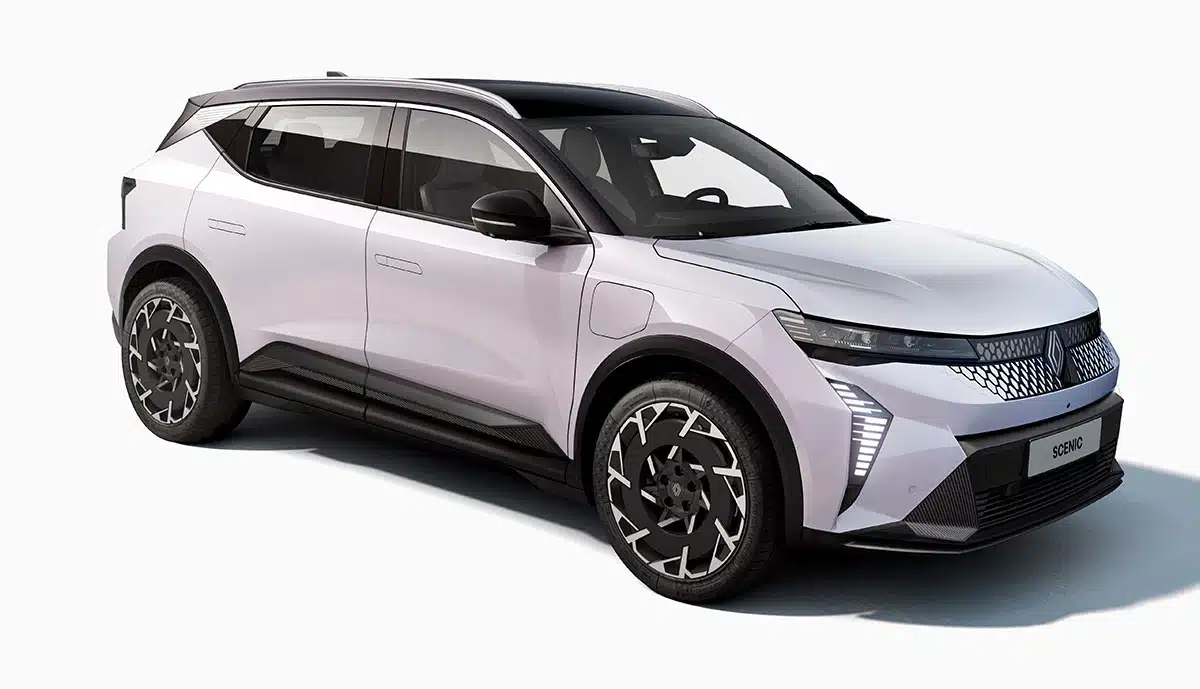
Renault Scenic E-Tech Electric gets new batteries
Renault is giving the Scenic E-Tech Electric a technical and digital upgrade. The focus is on two new battery options, both paired with the unchanged 162 kW electric motor.
The body remains 4.47 metres long, while the vehicle continues to weigh less than 1,900 kg. This makes the Scenic a comparatively light family EV positioned between a conventional compact SUV and a spacious crossover.
LFP or NMC: Two batteries for different drivers
The new Comfort Range version receives a 67 kWh battery with LFP cell chemistry. It provides up to 467 km of WLTP range and supports a maximum DC charging rate of 165 kW.
The Long Range version with an 89 kWh NMC battery is aimed at high-mileage drivers. Its official range increases from the previous 614 km to as much as 642 km, while its maximum charging rate is 150 kW.
| Specification | Comfort Range | Long Range |
|---|---|---|
| Battery | 67 kWh LFP | 89 kWh NMC |
| Power | 162 kW | 162 kW |
| WLTP range | up to 467 km | up to 642 km |
| Maximum DC charging rate | 165 kW | 150 kW |
| Charging time from 15% to 80% | 24 minutes | 28 minutes |
| Price in France | from €39,990 | from €46,990 |
| French market launch | autumn 2026 | already available to order |
The smaller battery’s higher peak charging rate does not automatically mean it will charge faster on every long-distance journey. The charging curve, usable energy capacity and battery temperature are the decisive factors. A comparison of 800-volt and 400-volt technology likewise shows why a single peak figure describes only part of the charging performance.
What the new battery options mean in everyday use
The LFP battery is likely to appeal primarily to price-conscious drivers who mainly travel within their local region. LFP cells do not require nickel or cobalt, are considered robust and are increasingly being used in European mass-market models, including the announced Renault 5 with an LFP battery.
Drivers who regularly cover long motorway distances gain up to 175 km of additional WLTP range with the 89 kWh battery. Despite the larger battery, Renault says a charging stop from 15% to 80% takes only four minutes longer. However, speed, weather and preconditioning can significantly affect real-world figures.
For both versions, DC charging time is expected to be 25% shorter than in the previous variants. Bidirectional 11 or 22 kW onboard AC chargers, regenerative braking paddles and a one-pedal driving function also remain available.
Google Gemini comes to the OpenR Link system
The OpenR Link infotainment system gains Google Gemini as an alternative to the previous Google Assistant. This should allow the voice controls to understand naturally phrased and more complex requests more effectively.
Google Maps can be configured more precisely when planning charging stops. Among other things, drivers can specify preferred charging networks, desired charging rates and payment methods. A monthly data allowance of 2 GB is included for three years or until the end of a corresponding lease agreement.
A Qi2-standard wireless charging pad is also new. It is designed to position and charge compatible smartphones more reliably than many previous in-car solutions.
More driver assistance and automatic driving modes
Renault is revising the adaptive cruise control system and the Active Driver Assist feature available on certain trim levels. A multi-target function detects several vehicles simultaneously and is intended to assess traffic situations in greater detail.
If the driver stops responding, Emergency Stop Assist can bring the car to a controlled stop. The standard interior camera monitors signs of fatigue and distraction. It also identifies the driver and can automatically load personal settings.
A predictive eco-driving function provides recommendations for more efficient driving. Renault claims potential savings of up to 6%, although in everyday use this will depend heavily on the route and driving style. A new Smart mode automatically switches between Eco, Comfort and Sport.
Revised interior and more storage space
The Techno trim receives new seat covers made from PET fabric containing more than 95% recycled yarn. Other coated fabrics contain at least 12% recycled material. In the Esprit Alpine trim, certain new interior panels are made from at least 75% recycled materials.
Seven paint finishes and new 19- and 20-inch wheels are available for the exterior. Satin Slate Blue and Exo Galaxy Grey are new additions to the colour range.
The standard boot holds 545 litres. An Aero Cargo Box mounted on the tow bar adds 310 litres of capacity, making it particularly useful for holiday trips. Renault is also expanding its accessories range with a double boot floor, organisers and pet transport solutions.
German launch of the new Scenic remains unconfirmed
The Scenic E-Tech Electric continues to be developed and built in Douai, France. Its batteries are also assembled there using cells from Poland, while the electric motor comes from Cléon in Normandy.
In France, the Techno Long Range with the 89 kWh battery is already available to order and costs at least €46,990. The Techno Comfort Range with 67 kWh is due to follow in autumn 2026, priced from €39,990.
No confirmed launch dates or prices have yet been announced for Germany, Austria or Switzerland. The French figures cannot be transferred directly because of differences in taxes and equipment. In Germany, the current Scenic E-Tech Electric starts at €43,000.


