Chery focuses on solid-state batteries and targets 400 Wh/kg
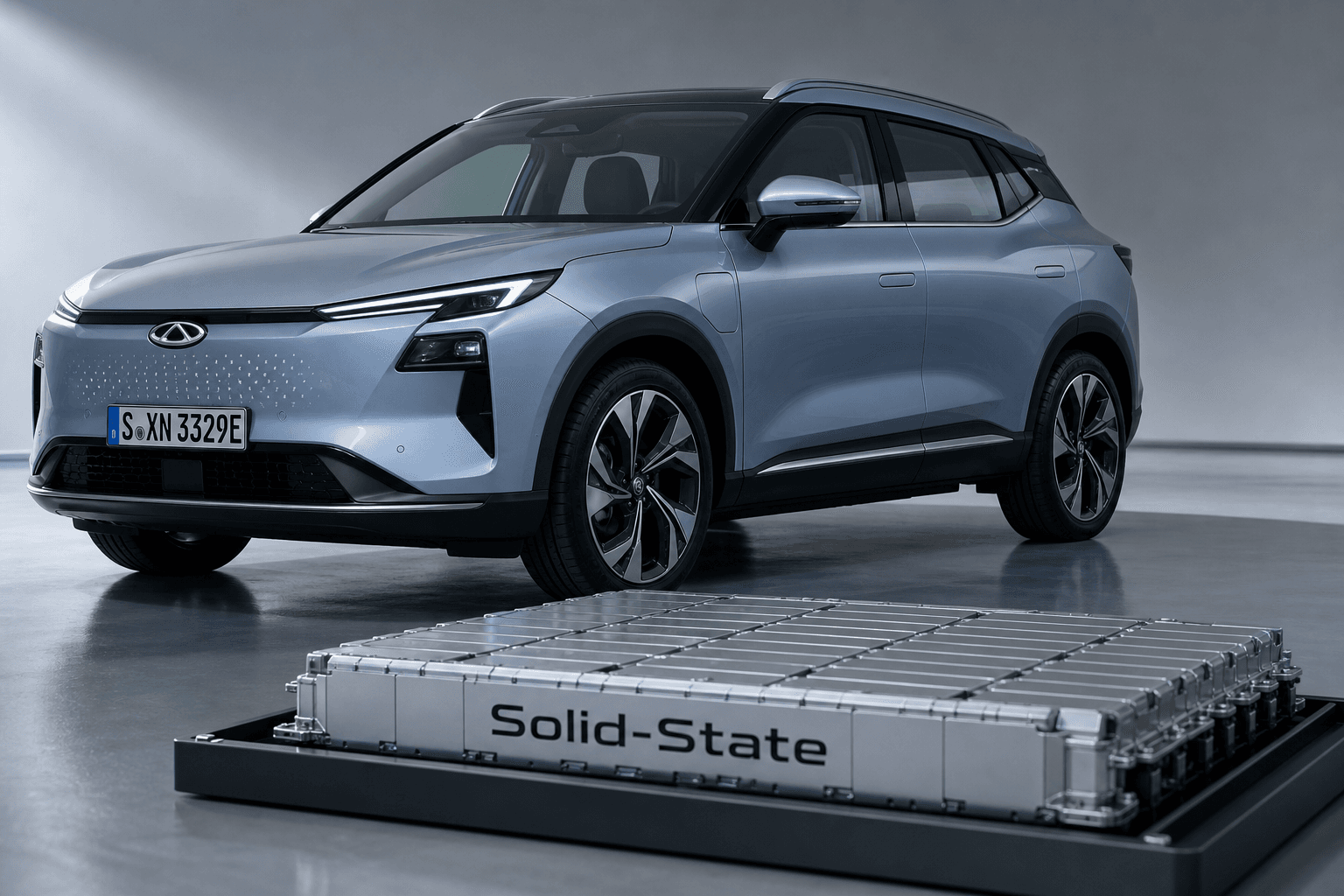
Solid-state batteries are seen within the industry as a potential next major leap for electric cars because they promise less weight and space for the same range. Chinese manufacturer Chery has now announced new details of its “full solid-state” program. The company is targeting an energy density of 400 Wh/kg and plans to begin “on-vehicle validation” in 2027—in other words, testing cells of an automotive-grade size in real vehicles.
For comparison, many of today’s production batteries are roughly in the range of around 170 to just over 200 Wh/kg at cell level. On paper, 400 Wh/kg would therefore represent a huge leap. However, whether and how much of that ultimately translates to pack-level energy density in the car depends heavily on the housing, cooling, safety structures and battery management system (BMS).
What solid-state cells are expected to deliver in everyday use
The basic idea is simple: a solid electrolyte is used instead of a liquid one. This could combine several benefits that drivers may notice directly in everyday use, with range, weight and charging performance at the top of the wish list.
If energy density does increase significantly, there are two possible strategies: the same battery size with more range, or a smaller battery with the same range. The latter would be particularly attractive for many vehicles because lower battery weight often also improves efficiency, driving dynamics and the cost structure. A smaller battery with the same range → less weight and potentially better efficiency in winter and on highways.
The expected benefits
- More range with a similarly sized battery
- Less weight or more interior space thanks to more compact packs
- More consistent charging performance across a wider state-of-charge window, depending on the chemistry and cell design
The real test is mass production, not the laboratory
As impressive as figures from conference slides or prototype announcements may sound, the real challenge is producing large volumes with consistently high quality. This is precisely where many ambitious cell concepts fail, because scrap rates, material availability, production speed and costs determine whether they succeed or are delayed.
Chery is talking about in-vehicle validation in 2027. That is an important step, but it does not automatically mean a widely available production model for Europe. Many experts still expect solid-state batteries to appear first in smaller production runs or premium applications before reaching high-volume models.
Meanwhile, LFP and fast charging are advancing rapidly
For drivers in the German-speaking DACH region—Germany, Austria and Switzerland—the bottom line is that solid-state batteries are worth watching, but there is no need to wait for “the next big thing.” Current cell technology is making tangible advances, particularly in cost, longevity and fast charging.
A good example is the current trend toward extremely high charging rates in lithium iron phosphate (LFP) systems. BYD is visibly driving this development with its own approaches, including exceptionally powerful DC chargers and new cell and pack concepts. If you are interested, our overview of BYD’s 1,500 kW charging network shows how aggressively it is currently being scaled.
Other manufacturers are also adopting new platform architectures that can noticeably reduce charging times in everyday use. Anyone looking to understand the basic principle can find a practical explanation in our 800V vs. 400V comparison, which explains why voltage levels and thermal management are so crucial.
European perspective: exciting, but timing and costs remain uncertain
Chery is already present in Europe through various brands and projects, and the group clearly does not intend merely to keep pace technologically. Whether a production car with a solid-state battery will actually be available to buy in Germany, Austria or Switzerland as early as 2027 remains uncertain. Initial vehicle testing and pilot production are more likely, while higher volumes and lower prices will take more time.
For anyone deciding what to buy over the next one or two years, it is therefore more important to consider how well current models perform in terms of efficiency, charging losses and real-world long-distance capability. If you are currently concerned about range, our guide to EV range anxiety offers facts and practical strategies.
From Tesla’s perspective, the company continues to focus heavily on optimizing proven production chemistries, pack integration and software rather than switching early to riskier cell technologies. That is not a contradiction, but a different strategy for managing risk and scaling production. Solid-state batteries could still become relevant later if they can achieve the necessary standards for cost, durability and manufacturing.