Tesla discontinues Solar Roof and overhauls its solar business for 2026
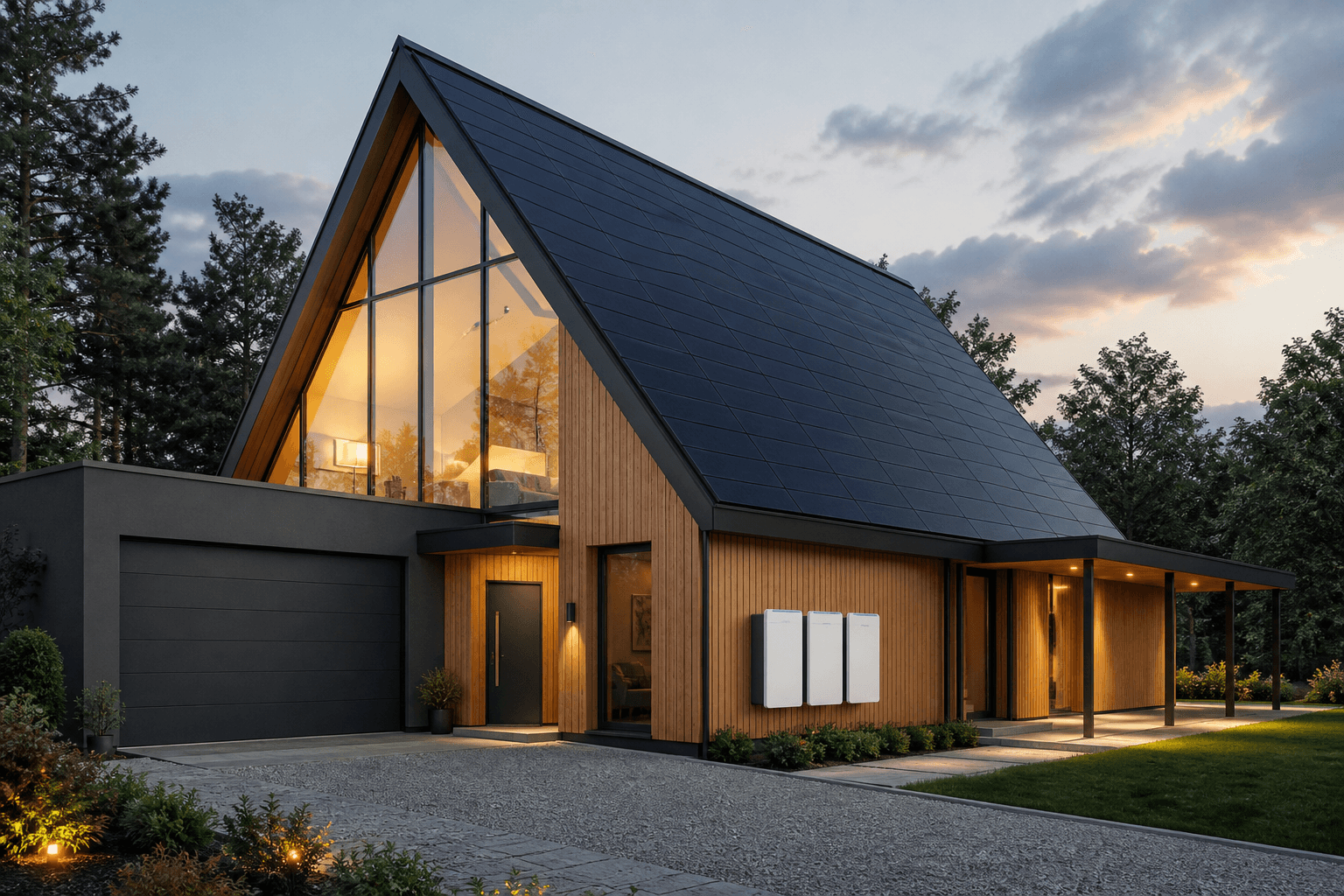
Tesla has discontinued its Solar Roof, the well-known glass solar tiles. Although the product was prominently marketed for years, it remained a niche offering in practice and proved difficult to scale to high volumes. The move therefore looks less like a retreat from solar and more like a change of direction: away from a complex roofing product and toward standard hardware and battery storage.
For the DACH region—Germany, Austria and Switzerland—this is particularly interesting as a sign that Tesla is strategically reorganizing its energy division. While regulatory conditions and incentive programs in Germany, Austria and Switzerland differ from those in the US, the product concept and technical direction are very similar: solar PV plus home battery storage is becoming the standard solution, rather than solar PV alone.
What Tesla will sell instead in 2026: solar panels plus Powerwall 3
At the heart of the offering is a new solar panel developed by Tesla itself, with an output of 420 W. Tesla has it assembled in the US using manufacturing capacity that was previously also used for Solar Roof components. The panel features an “all-black” design and is intended to stand out through an integrated mounting system and improved yields under partial shading.
The second component is the Powerwall 3. This is where the crucial simplification of the system design comes into play: the battery and solar inverter are combined into a single unit. This reduces installation complexity and is aimed at a setup that primarily covers two everyday needs: a higher self-consumption rate and backup power during grid outages.
Tesla is no longer positioning solar in 2026 as “turning the roof into a power plant,” but as an easy-to-plan solar PV system with battery storage as its central hub.
Solar without battery storage remains possible, but is no longer the default
A solar-only setup remains possible in principle, but Tesla’s configuration preselects the Powerwall as standard. This fits the current rationale: time-of-use electricity tariffs, rising energy prices and resilience during outages. In practical terms, prospective buyers who only want solar panels will generally have to actively scale back the system rather than add battery storage as an option later.
The biggest overhaul is happening in installation and service
Perhaps the most important change concerns not the product but the go-to-market strategy. Tesla is increasingly acting as a hardware and platform provider and less as an installer with nationwide coverage. Instead of using its own teams everywhere, Tesla is increasingly working with certified installation partners that handle quotations, installation and service.
From both a technical and organizational perspective, much depends on a shared software platform that partners use for planning and commissioning. This can work well for customers because local companies are often more experienced at coordinating roofing work, electrical systems and grid-operator procedures. At the same time, the experience becomes less consistent: speed, communication and service quality depend more heavily on the individual partner.
Two routes to Tesla Solar, depending on the area
- Direct-service area: Tesla sells and installs using its own teams, where available.
- Partner area: Tesla hardware is offered through certified installers, including system design, pricing, installation and maintenance.
It is not always clear which option applies before an address is entered into the configurator. This is an important consideration for buyers because it can affect the pricing structure, the process and, in some cases, the available contract models.
Why the end of Solar Roof fits the new strategy
Solar Roof was technically fascinating, but fundamentally it was a difficult product: expensive, complex to install and dependent on roof geometry and the availability of skilled contractors. Those factors are all obstacles to rapid scaling. Conventional solar PV panels combined with battery storage, by contrast, are more standardized, faster to plan and easier to roll out through partner networks.
At the same time, Tesla’s energy business as a whole is growing rapidly, driven primarily by battery storage solutions. This is important context: the market currently rewards systems that can smooth demand peaks, maximize self-consumption and support the grid. Solar supplies the electricity, while the battery is the control element.
What does this mean for everyday use and for the DACH region?
Although many of the details come from the US, the trend can readily be applied to Germany, Austria and Switzerland: a solar PV system plus home battery storage is increasingly being treated as a complete package, including app-based controls, backup power capability depending on the setup, and tariff-based optimization. Anyone planning a system today should focus less on panel output alone and more on the system as a whole: How high is the self-consumption rate, how flexible are the controls and how reliable is the service chain?
If you are generally interested in Tesla’s energy ecosystem, it is also worth looking at bidirectional applications involving vehicles: The Tesla Model Y with a V2L adapter shows how closely electricity use involving cars and homes is becoming integrated. And anyone wondering how such systems could eventually fit into the charging network can find useful technical context on efficiency and charging performance in 800 volts vs. 400 volts.
What you should pay particular attention to in an offer
With the stronger emphasis on partners, comparing offers will be more worthwhile than ever in 2026—not only in terms of price, but also components, warranties, monitoring and service response times. Above all, make sure the battery actually suits your load profile and that backup power functions are clearly explained and explicitly listed in the offer.
Overall, Tesla remains active in the solar market, but with a different approach: less installation contractor, more product platform. The end of Solar Roof is therefore not a step backward, but a sharper focus on solutions that can be implemented more quickly, reliably and at scale in everyday use.