Tesla is developing FSD into a personal AI copilot
Tesla is working on several features intended to make Full Self-Driving (Supervised) significantly more personal and predictive. The focus is on more natural voice control with Grok, pothole detection and a system that remembers recurring driver interventions and parking habits.
At the same time, Tesla is preparing the next major leap in its neural network with FSD v15. A new generation of hardware is also intended to provide more computing power for more complex driving models over the long term.
The next stage of FSD is intended not only to interpret roads, but also to better understand the driver’s intentions and habits.
Overview of the planned FSD upgrades
| Upgrade | Intended benefit | Status |
|---|---|---|
| Grok voice control | Complex navigation requests in natural language | Planned, with features varying by region |
| Pothole detection | Visually detect damaged road surfaces and avoid them where possible | Announced by Tesla, timing still open |
| Learning-based parking | Adopt personal positioning and preferred parking orientation | In development |
| Memory of interventions | Take preferred routes and driving decisions into account | Expands on route preferences already introduced |
| FSD v15 | Earlier hazard detection and improved collision avoidance | Expected in late 2026 or early 2027 |
| AI4+ and AI5 | More computing power and memory for larger AI models | Timeline and retrofitting details have not yet been finalized |
Grok is intended to understand complex navigation requests
Conventional in-car voice assistants usually expect short, precisely worded commands. Grok is instead intended to understand the context of a request and combine multiple preferences.
For example, a driver could ask to travel through the city center to a supermarket, avoid a construction site and then look for covered parking. FSD would have to turn this into a route, several constraints and a specific parking destination.
This would be more than a new user interface. Grok would translate the driver’s intent, while the FSD driving stack handles the appropriate planning. However, it remains unclear whether all features will launch simultaneously and in German.
Potholes should no longer require driver intervention
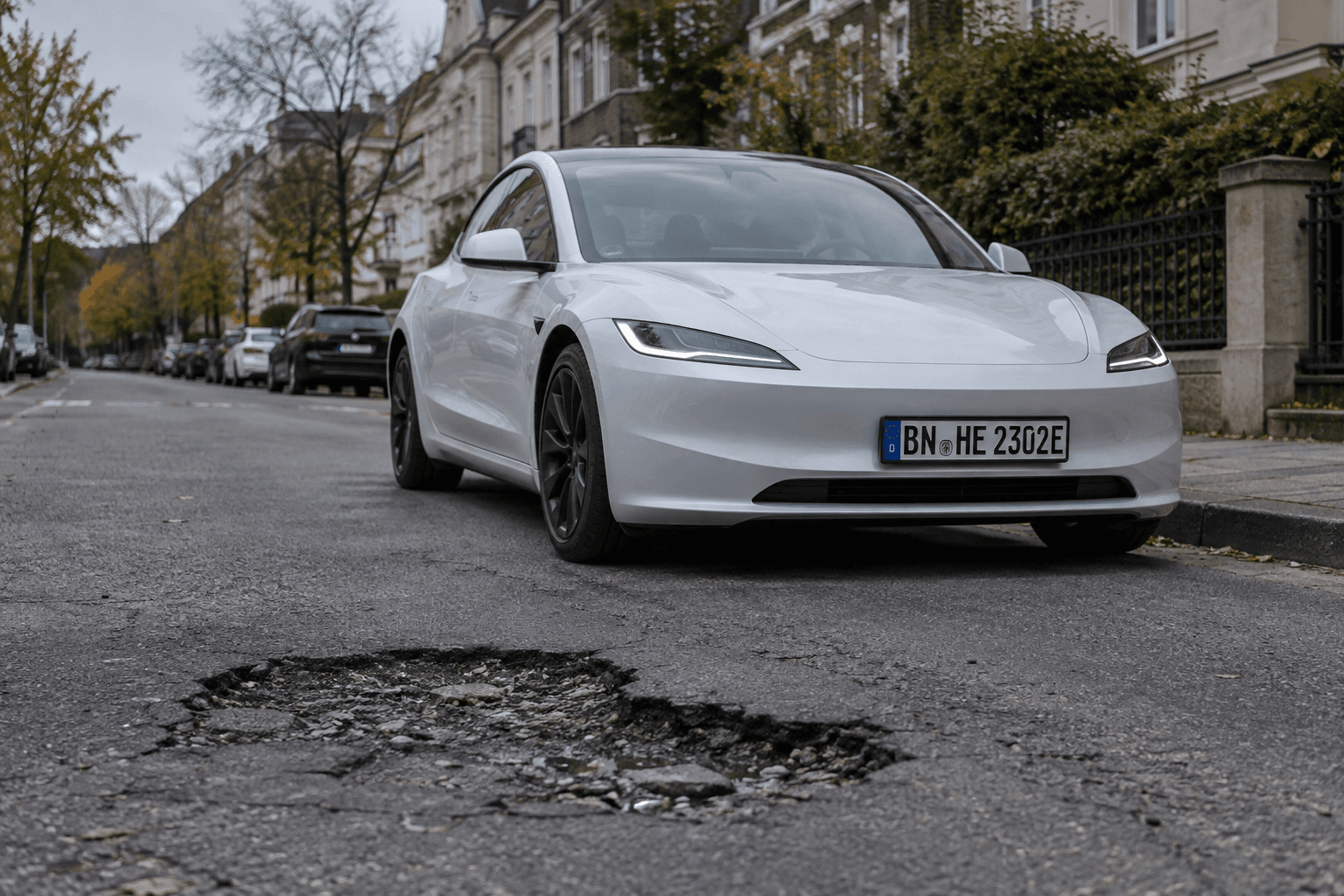
Uneven roads are among the situations in which driver assistance systems often fail to respond proactively. Tesla wants to use the vehicle’s cameras to detect potholes and gently adjust its path within the available space.
Previous approaches used fleet data to respond to known poor road sections in the Tesla Model S and Tesla Model X with air suspension. The new system, by contrast, is intended to identify road damage directly in the camera image.
In everyday driving, this could protect tires, wheels and suspension components. However, it is crucial that FSD does not swerve abruptly and endanger other road users. It must therefore assess available lateral space, oncoming traffic and road markings at the same time.
FSD is intended to learn individual parking habits
Until now, Autopark has primarily relied on markings, open spaces and distances from other vehicles. In the future, the system is also intended to observe how the driver parks.
Drivers who reverse into their driveway, deliberately park close to a garage wall or leave extra space on the driver’s side might no longer have to specify these preferences each time. Recurring manual parking maneuvers would serve as learning signals.
FSD is intended to handle interventions while driving in a similar way. If the driver regularly chooses a particular lane, exit or side street, the system could give preference to that decision in the future. A manual intervention would then serve not only as a correction, but also as feedback for subsequent journeys.
FSD v15 is intended to make the AI model much larger
The next major development step is FSD v15. According to current plans, the number of model parameters is expected to increase by roughly a factor of ten compared with the current generation, from around one billion to approximately ten billion parameters.
More parameters do not automatically mean better driving. However, they give the model more capacity to represent complex traffic situations, movement patterns and rare edge cases. Tesla expects this to provide earlier hazard detection, faster responses and more robust collision avoidance.
More background on the planned architecture and Tesla’s statements can be found in our overview of Tesla FSD v15 and HW4. No firm release date has yet been set.
AI4+ and AI5 provide more computing power
Larger neural networks require more memory and computing power. For older vehicles with Hardware 3, a potential retrofit solution based on a more powerful AI4+ computer is therefore under consideration. It is intended to provide additional headroom if Hardware 3 cannot meet the requirements of a future unsupervised version of FSD.
Owners of affected vehicles should note that the details regarding compatibility, scope and timing of a retrofit have not yet been finalized. FSD v14 Lite could be the last major development stage for Hardware 3, but there is not yet definitive confirmation for every vehicle variant.
Further in the future is Tesla’s AI5 chip, manufactured using a 2-nanometer process. Mass production is planned for 2027, although AI5 could initially be used in data centers and the Optimus humanoid robot. It remains unclear when the chip will enter customer vehicles.
What the FSD plans mean for Germany, Austria and Switzerland
The announced features are likely to appear first in markets where FSD is widely used, particularly North America. In the DACH region—Germany, Austria and Switzerland—the scope will continue to depend on type approvals, national requirements and European regulations governing driver assistance systems.
Even with the new features, Full Self-Driving (Supervised) will initially remain a driver assistance system that requires constant supervision. The driver remains responsible, must stay attentive and must be ready to intervene at any time. The name FSD should therefore not be equated with fully autonomous Level 4 or Level 5 driving.
Despite this limitation, the direction of development is compelling. Pothole detection, learned routes and naturally phrased navigation requests could make a greater difference in everyday use than spectacular demonstrations under ideal conditions. Tesla is thus trying to develop FSD from a general-purpose driving assistant into an adaptable digital driver.