Tesla FSD Records Strong Safety Data in Belgium
Tesla’s Full Self-Driving (FSD) driver-assistance system recorded significantly fewer collisions per kilometer driven in Belgium than manually driven Tesla vehicles. The figures were submitted to the Flemish government as part of the Belgian approval process and cover the period from June 11 to August 31.
In total, the participating vehicles covered 24.6 million km with FSD activated. The largest differences were seen away from highways—precisely where intersections, cyclists, trams, and changing traffic layouts pose particular challenges for driver-assistance systems.
Collision Rate Nearly Ten Times Lower Away From Highways
On roads other than highways, Tesla recorded one collision over 9.5 million km driven with FSD. Manually driven Tesla vehicles recorded 150 collisions over 146.9 million km.
| Type of road | FSD active | Manual driving | Comparison |
|---|---|---|---|
| Away from highways | 1 collision per 9.5 million km | 150 collisions over 146.9 million km | Collision rate roughly 9.6 times lower with FSD |
| Highway | 4 collisions over 15.1 million km | 32 collisions over 95.1 million km | Collision rate about one-quarter lower with FSD |
The advantage is smaller on highways, but it is still evident. This is plausible because highway driving is generally less complex, and human drivers can also drive relatively consistently there.
Hard Braking and Steering Maneuvers Also Declined
In addition to collisions, Tesla recorded other safety-related events. According to the data, automatic emergency braking occurred 93% less often. Abrupt maneuvers such as hard braking or rapid steering interventions fell by 82% to 90%, depending on the category.
These figures are relevant to everyday driving because they do not merely reflect serious incidents. Fewer abrupt interventions may indicate earlier hazard detection and a smoother driving strategy.
The Belgian data is a strong indication of FSD’s safety potential, but it is not yet definitive proof for every traffic situation.
The Crashes Had Minor Outcomes
Five crashes involving participating vehicles were reported to the Flemish authorities. In one case, FSD was no longer active because the driver had deactivated the system early while exiting a roundabout.
According to the available information, no causal connection with FSD was found in the other four incidents. They were minor, low-speed collisions, and no one was injured.
Why the Figures Should Still Be Treated With Caution
The underlying data comes from Tesla and was provided as a condition of approval. This does not automatically constitute a fully independent scientific assessment using identical routes, weather conditions, and traffic situations.
Furthermore, the study covers only a few months. The single collision away from highways creates a large statistical difference, but it also makes the result sensitive to even a small number of additional incidents.
The analysis also does not provide separate results for individual model ranges. It therefore cannot be used to derive specific safety figures for the Tesla Model 3 or the Tesla Model Y.
FSD Remains a Supervised Driver-Assistance System
The name Full Self-Driving should not obscure the fact that the driver must continue to supervise the system and be ready to intervene at any time. In Europe, it does not constitute fully autonomous driving without human responsibility.
At the same time, Tesla is working on the next stage of development. The technical advances the company is promising for FSD v15 and vehicles with HW4 are also likely to become relevant to European regulators.
Belgian Roads Were Part of the Preparations
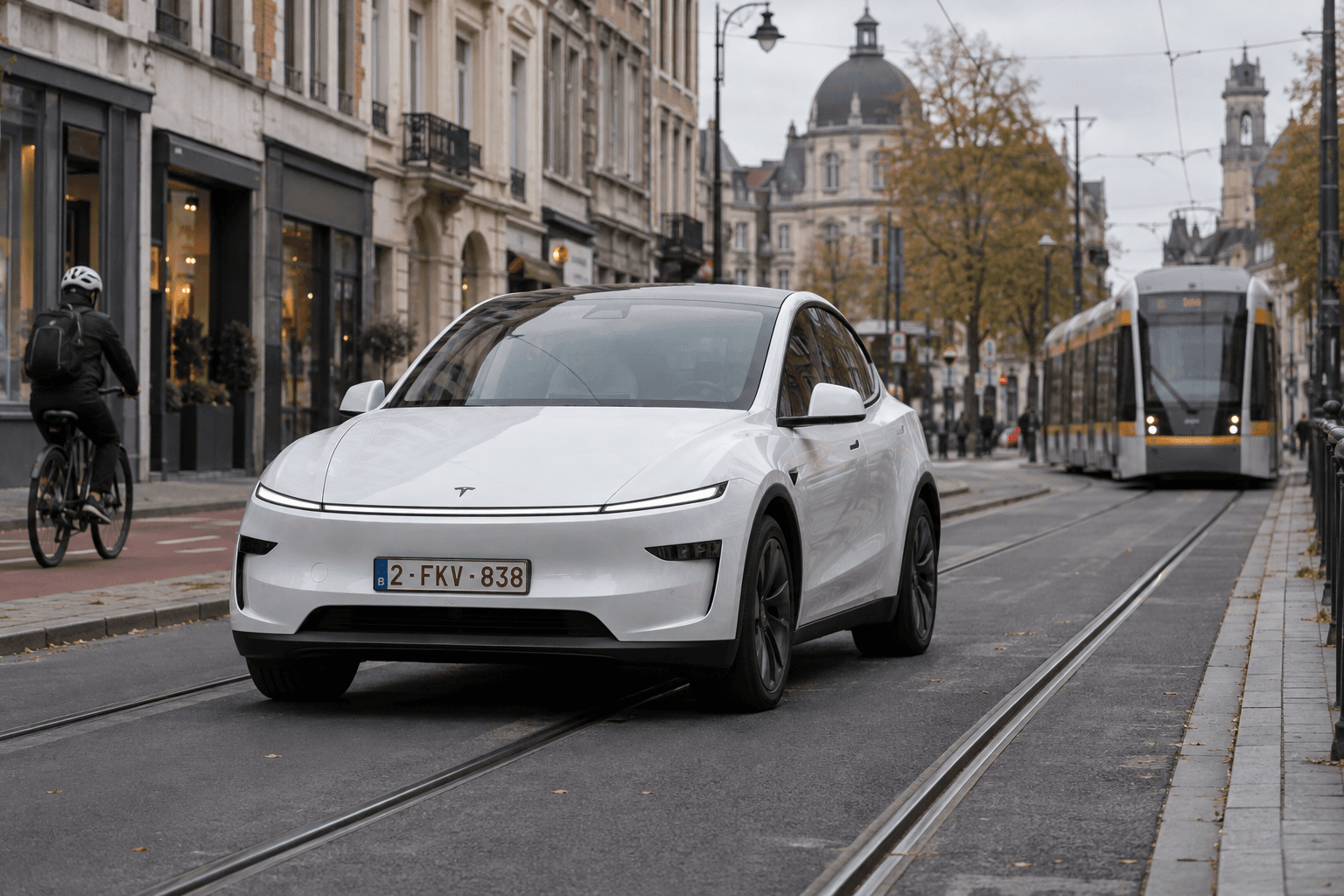
Before approval, Tesla covered around 5,000 km on Belgian roads over approximately one month. The testing included tram networks, bicycle streets, advisory bike lanes, additional signage, and temporary traffic layouts in construction zones.
According to the information submitted, FSD has now been approved in Belgium, the Netherlands, Denmark, Estonia, and Lithuania. More than 70,000 customers there are said to cover a combined total of over 1 million km with the system every day.
A Positive Sign, but Long-Term Data Remains Crucial
The initial Belgian results clearly support the potential of Tesla’s driver-assistance technology. The particularly large difference in urban and rural driving demonstrates the safety potential that predictive software may offer.
A robust overall assessment will now require longer observation periods, more independent analyses, and a transparent definition of the collisions being recorded. If the trend is confirmed across larger fleets and different seasons, Tesla would have a strong argument for broader approval in Europe.