Tesla Loses Senior Director of AI Hardware to DensityAI
Tesla has suffered another departure from its AI hardware organization. Chip industry veteran Shishuang Sun, most recently Senior Director of AI Hardware Design, has been working at DensityAI since July in an area focused on packaging and system hardware, according to his public profile. This is not a junior role, but precisely the level responsible for turning a chip design into a robust, production-ready system.
This is particularly relevant for Tesla because the company is tying its future closely to proprietary AI hardware, autonomy and robotics. At the same time, the market for specialists with these skills is extremely tight, as the most challenging bottlenecks today lie less in transistor design itself than in integration, cooling and power delivery.
Why “Packaging” Is the Bottleneck for AI Chips
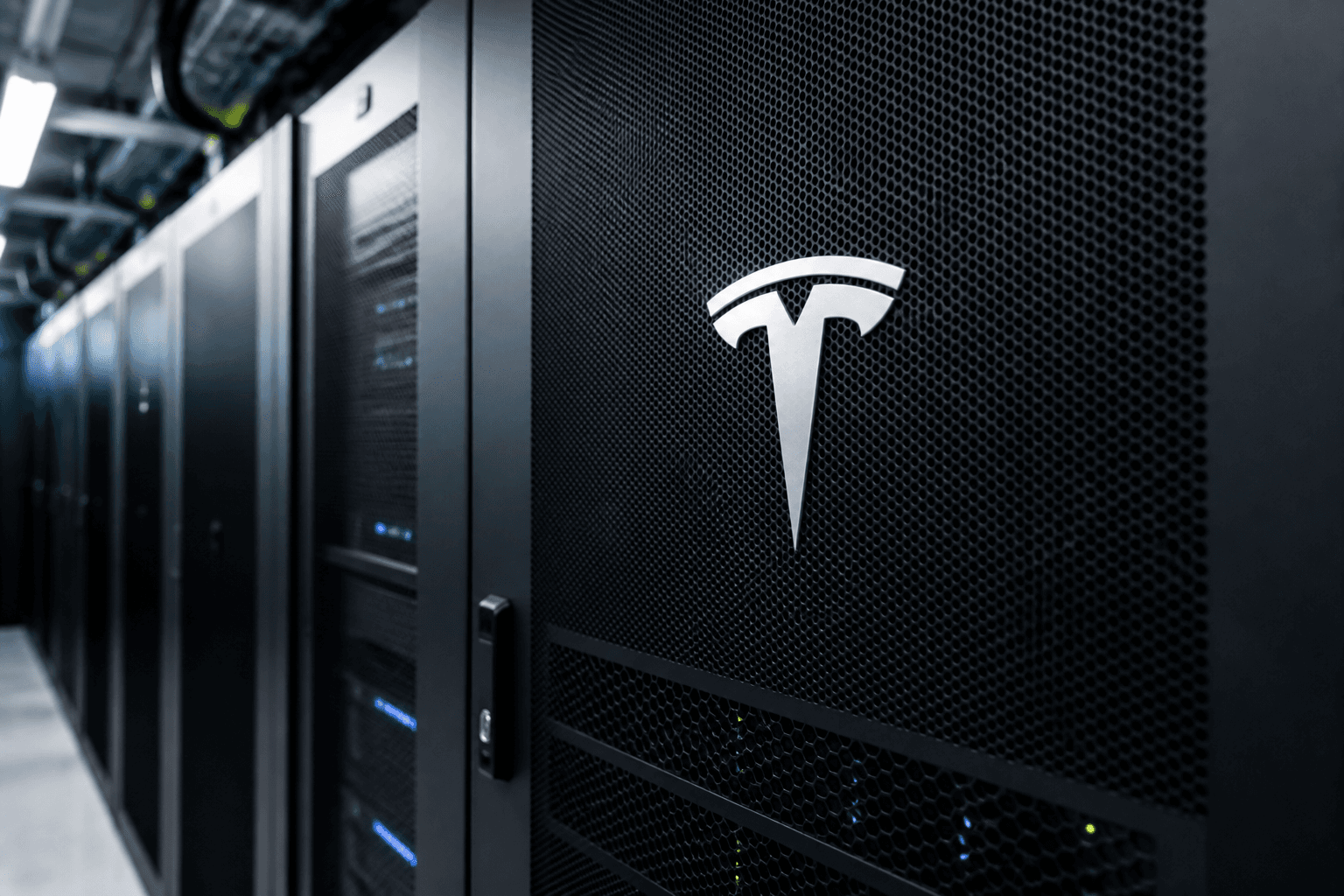
Discussions about new AI chips often revolve around nanometers, TOPS and computing performance. In practice, however, the surrounding system is often what matters most: How can power be delivered to the chip reliably, how can signals be routed cleanly, and how can waste heat be dissipated without the system throttling or failing? This is exactly Sun’s area of expertise: system integration, power delivery, signal integrity and thermal management.
The real-world impact is easy to understand: More computing power in a car or data center is useful only if it can be sustained under actual operating conditions. Fully load the chip → heat increases → clock speeds fall. Good packaging and system engineering ensures that this throttling occurs later—or is not needed at all.
DensityAI, a Startup with Roots in the Former Dojo Team
DensityAI is not just another new player; it was established by former Dojo executives. Publicly available information indicates that a significant portion of Tesla’s former supercomputer team has joined the company, which is developing AI hardware and data-center platforms for target industries including automotive, robotics and manufacturing.
An important point for readers in the DACH region—Germany, Austria and Switzerland—is that this type of hardware is not aimed directly at private EV buyers, but it can indirectly determine how quickly AI training, vision models and robotics stacks evolve. These are strategic capabilities for manufacturers because, over the long term, they can influence the cost per computing operation and reduce dependence on external suppliers.
Tesla’s Chip Roadmap: Major Ambitions, Long Timelines
Tesla is pursuing several components in parallel: proprietary in-car inference computers, its own training hardware and a roadmap for new generations of chips. In this context, AI5 and AI6 are among the technologies being discussed internally and externally, including manufacturing plans involving contract chipmakers. Tesla is also reportedly considering major long-term investments in manufacturing capacity.
Projects like these, however, are less about individual announcements than about whether they can be executed over a period of years. That is precisely why expertise in system hardware and packaging is so valuable: Completing the chip design and sending it for manufacturing—known as tape-out—is one thing; achieving production-ready volumes with stable yields and reliable thermal performance is another.
What the Departure Could Mean for Tesla—and What It Does Not
A single departure is not evidence of a structural problem. Moves to startups or well-funded specialist companies are normal in the semiconductor and AI industries, particularly when teams from previous projects establish new businesses. Nevertheless, it is a notable signal for Tesla because once again the person leaving comes from the management tier responsible for critical integration work.
On the other hand, Tesla is known for rebuilding teams quickly and bringing expertise in-house. It is also clear that the company is continuing to work on its own AI hardware, as demonstrated by successive hardware generations and its focus on autonomy.
What This Means for Tesla Fans and EV Buyers
In the short term, nothing changes for buyers of the Tesla Model Y or Tesla Model 3: Driving, charging, efficiency and over-the-air updates do not depend on any one person. The issue is more likely to become relevant in the medium term if new hardware generations for driver-assistance and AI features reach production sooner or later as a result.
Anyone who wants to explore Tesla’s AI stack in greater depth can find interesting details on the current debate surrounding HW4 and model optimization in our article about Tesla’s HW4 and “distilled” FSD models. And if you are interested in how Tesla positions new vehicle projects more broadly, it is also worth looking at Tesla Model 2 (Project Redwood), including a careful assessment of the rumors.
With AI hardware, it is not just the chip design that matters, but above all its implementation as a system: power in, heat out, and stable performance in mass production.