Mercedes Returns to the Taxi Business
Mercedes-Benz wants to devote more attention to the German taxi market again. After the manufacturer partially withdrew from the business due to low margins, rising market share and new offers now point to a change in strategy.
In the first half of 2026, Mercedes accounted for 18% of new taxi registrations in Germany. In the same period of 2025, the figure was just 8%. However, the brand remains well below its 2022 level, when Mercedes still achieved a 45% share.
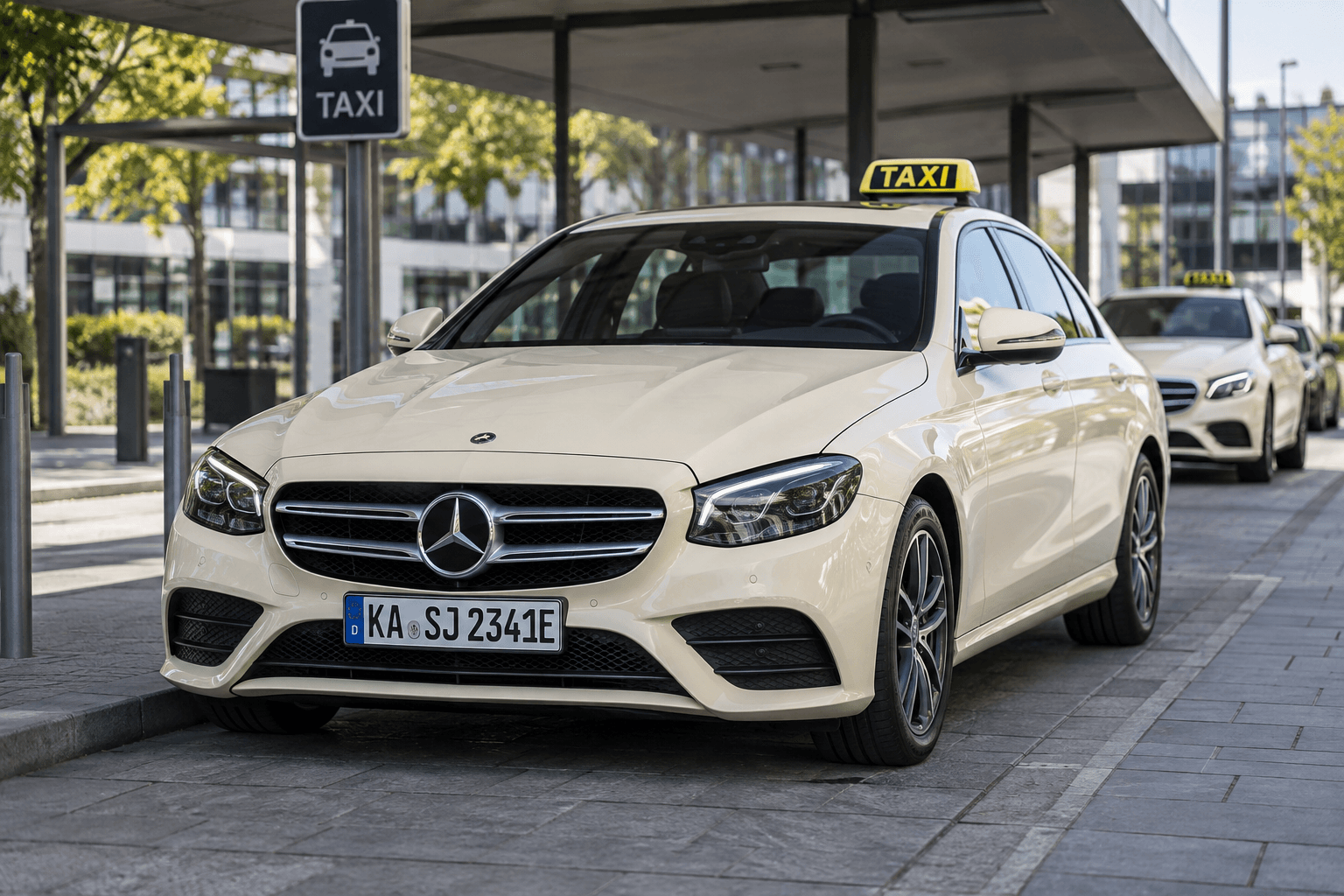
The E-Class is the main driver of growth. In the first half of the year, 126 vehicles were newly registered as taxis. Despite the growing selection of SUVs and new competitors, the traditional sedan therefore remains a relevant workhorse for taxi operators.
Steep Discounts Aim to Make the E-Class More Attractive
Since January, Mercedes has offered a 24% discount on two diesel versions of the E-Class. This reduces the price of suitably configured vehicles to below €40,000. Discounts are also planned for the Vito and V-Class.
This shows that Mercedes is initially taking a pragmatic approach. Instead of immediately switching entirely to electric taxis, the manufacturer is offering models for different operating profiles. Particularly where daily mileage is high, downtime, energy supply, maintenance costs and resale value matter alongside the purchase price.
The renewed push is not a full return of the former factory-built taxi, but a strategy focused more heavily on discounts and third-party conversions.
The typical light ivory taxi paint finish will not return as a factory option. Taximeters, roof signs and other taxi equipment will also be handled by specialist conversion companies. Mercedes will therefore supply the production vehicle, while the industry-specific equipment will be installed afterward.
BYD Sets Ambitious Targets
At the same time, BYD is expanding its business with German taxi operators. Although only ten vehicles from the Chinese brand were newly registered as taxis in the first half of the year, the total is expected to reach 500 units by the end of the year. BYD is even targeting a four-digit figure for the following year.
Price is the main lever. The Seal 6 plug-in hybrid wagon is being offered to taxi operators for less than €30,000 after a 37% discount. BYD is thus intensifying the already growing price pressure on plug-in hybrids in Germany.
| Criterion | Mercedes-Benz | BYD |
|---|---|---|
| Position in the first half of 2026 | 18% market share | 10 new taxi registrations |
| Key offer | E-Class diesel below €40,000 | Seal 6 plug-in hybrid below €30,000 |
| Stated discount | 24% | 37% |
| Electric outlook | VLE planned as a taxi | Atto 3 and Sealion 7 planned |
For electric cars, BYD plans to expand its taxi range with models including the BYD Atto 3 and the Sealion 7. However, whether the ambitious registration targets can be achieved will not depend on discounts alone. A dependable service network, short repair times and suitable charging options are at least as important to taxi operators.
Mercedes VLE to Close the Electric Gap
Mercedes also plans to offer the upcoming all-electric VLE as a taxi. The model could be particularly attractive for airport transfers, high-capacity taxi services and commercial shuttle fleets. However, specific taxi pricing and equipment details have not yet been announced.
In everyday operation, the usage profile determines the most suitable powertrain. An electric car can deliver low operating costs with predictable shifts and dedicated charging infrastructure. Where reliable charging is unavailable or very long shifts are common, diesel and plug-in hybrids will remain competitive for the time being.
The German Taxi Market Is Being Reshaped
Mercedes benefits from strong brand recognition, an established service network and decades of experience in the taxi business. BYD is countering with low entry prices and a growing range of electrified models. The competition is therefore likely to be decided less by individual technical benchmarks than by total operating costs and fleet support.
The stated discounts and registration targets apply to Germany. They cannot be transferred directly to Austria and Switzerland because taxi regulations, incentives and fleet terms vary by region. Nevertheless, the underlying trend is relevant across the DACH region—Germany, Austria and Switzerland: New providers are increasingly challenging established taxi brands with aggressive commercial terms.