Skoda Epiq delivers first reliable consumption figures
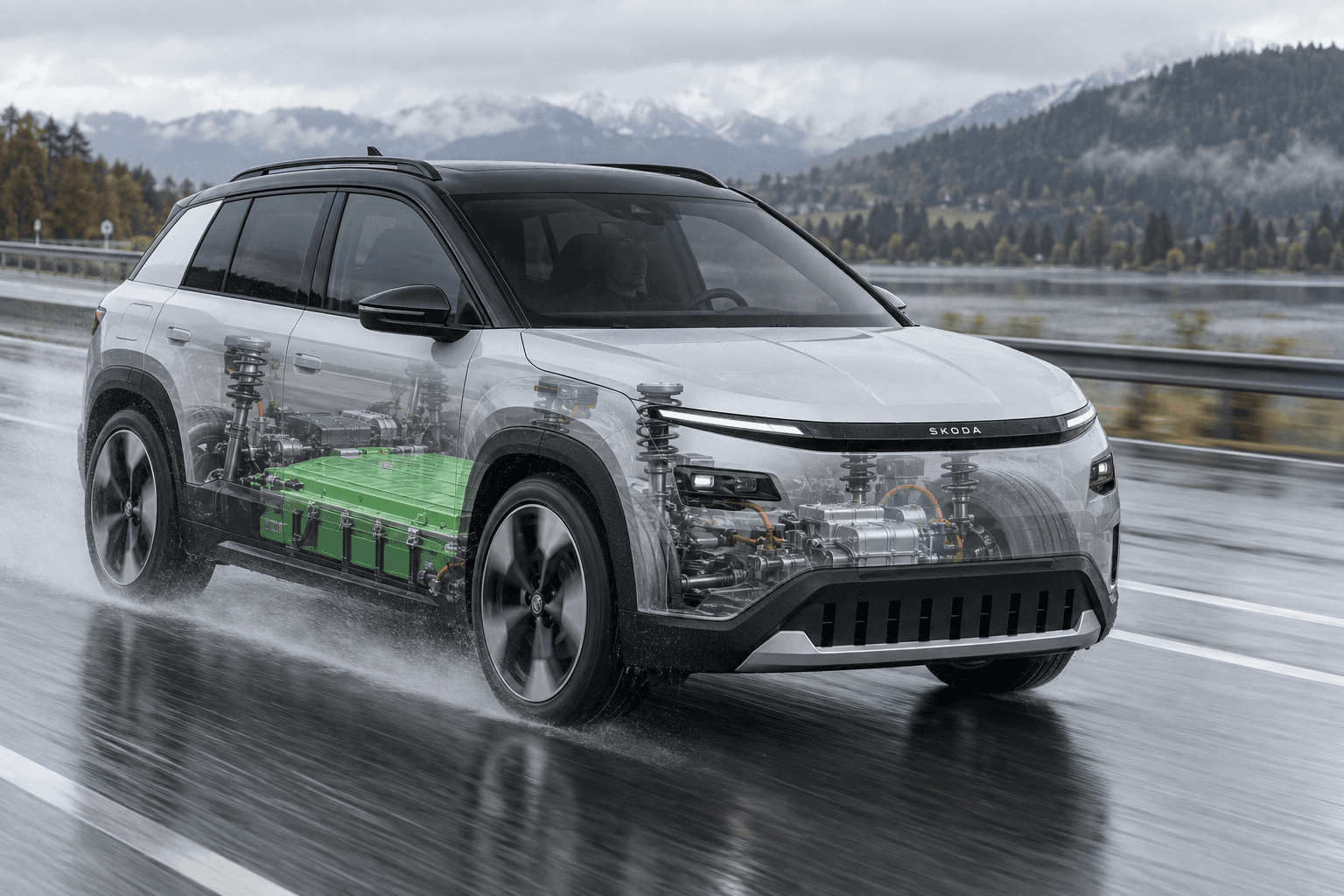
The Skoda Epiq is the latest electric SUV based on MEB+ to hit the road. Following details about its equipment and the purchase price of the Skoda Epiq, the first published consumption tests now provide an indication of how far the compact EV can travel in everyday use.
Highway range is particularly interesting. While the WLTP figure combines various driving scenarios, aerodynamics, weather, and tires have a much greater impact at sustained higher speeds.
45 kWh battery provides around 300 km with gentle driving
During a drive on wet roads at an average speed of about 70 km/h, consumption was measured at 14.9 kWh/100 km. Based purely on the numbers, 45 kWh of usable energy provides a range of around 300 km if the battery is almost fully depleted.
Another consumption test at an even lower average speed returned 15.3 kWh/100 km. Differences in route, weather, tires, and vehicle configuration may explain the small discrepancy.
| Driving scenario | Consumption | Calculated range |
|---|---|---|
| Gentle driving, averaging around 70 km/h | 14.9 kWh/100 km | around 300 km |
| Even lower average speed | 15.3 kWh/100 km | around 294 km |
| Brisk driving, averaging over 114 km/h | just under 20 kWh/100 km | about 225 to 230 km |
These calculated ranges assume that almost all of the usable battery capacity is consumed. In everyday travel, drivers usually plan for a reserve and head to a charging station well before reaching 0%.
Higher highway speeds change the picture
During a shorter drive at an average speed of more than 114 km/h, consumption approached 20 kWh/100 km. This reduces the theoretical full-battery range to just over 220 km.
This scenario is particularly relevant in Germany, where drivers often travel faster on unrestricted sections of the autobahn. In Austria and Switzerland, consumption is likely to be lower when observing local speed limits, although elevation changes and temperatures continue to have a major impact.
Moderate speed → around 300 km is possible. Brisk highway driving → range drops closer to 225 km.
Charging stop of around 25 minutes
When DC fast-charging, the Epiq is expected to take approximately 25 minutes to charge from 10% to 80%. That is practical for an affordable electric SUV, but it does not set a new benchmark in its class.
Accordingly, a charging stop of just ten minutes restores a fairly limited amount of energy. On longer journeys, it therefore makes more sense to plan for slightly longer breaks and a wider charging window. Drivers who regularly find range and charging stops stressful can find practical strategies in our guide to EV range anxiety.
The SUV body costs less efficiency than expected
The Epiq sits higher and has a larger frontal area than its lower-slung sister models, the VW ID. Polo and Cupra Raval. Nevertheless, the additional consumption appears to be manageable. Depending on the route and driving style, the lower MEB+ models are likely to consume around 2 kWh/100 km less and travel approximately 20 to 50 km farther.
That is a respectable result for Skoda. The Epiq combines the more practical SUV body with consumption that is not far removed from conventional small electric cars. Strong demand for the new entry-level EVs from VW, Skoda, and Cupra already shows how important this particular combination is for the European market.
Suitable for road trips, but not without planning
The Skoda Epiq is not a long-distance specialist with a huge battery, but it can certainly handle vacation journeys. At moderate speeds, legs of well over 200 km are realistic, while fast highway driving requires more frequent stops.
The key factor is therefore not a single range figure, but the driver’s individual usage profile. The Epiq should be efficient in urban and rural driving, while speed and charging plans remain the main variables on the highway.