Li Auto i9 Launches as an Electric Flagship
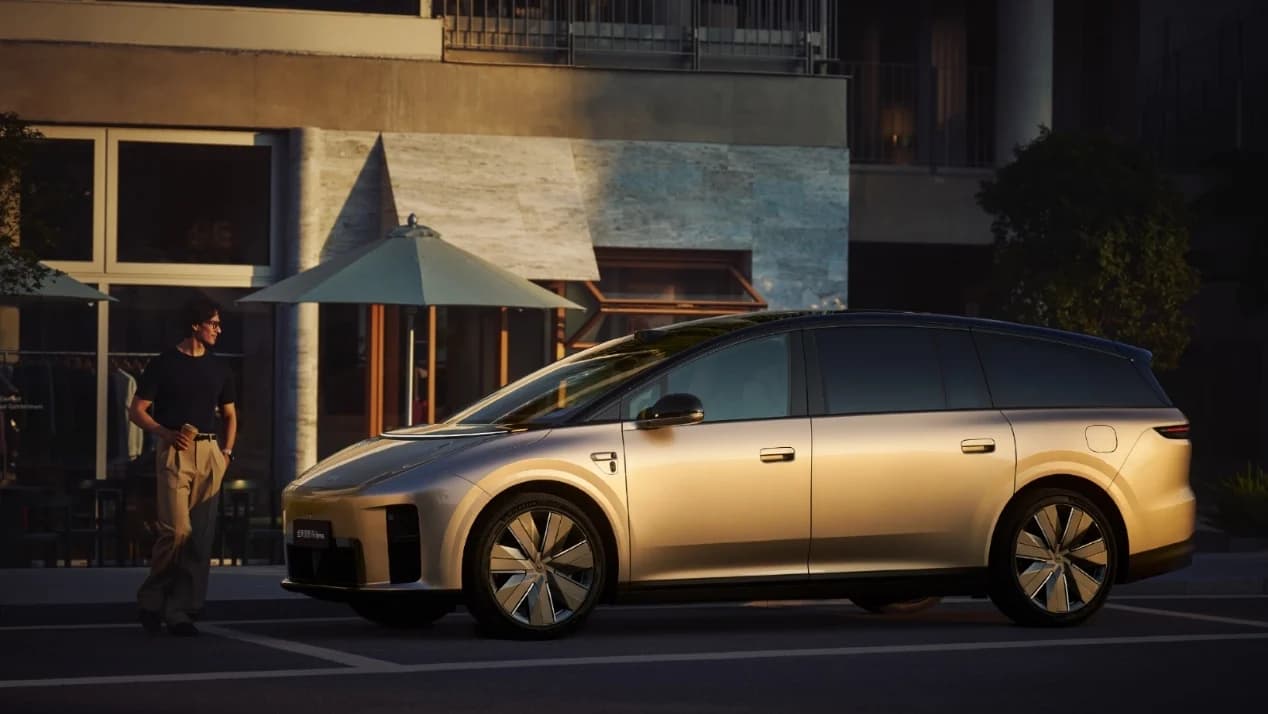
Li Auto is expanding its lineup in China with the all-electric i9. The 5.23-meter luxury SUV will cost 369,800 yuan at launch, roughly equivalent to €44,000. However, that figure cannot be applied directly to Europe because of taxes, transportation costs and potential tariffs.
One particularly striking figure is the manufacturer-claimed drag coefficient of 0.215. On this basis, Li Auto describes the i9 as the world’s most aerodynamic production SUV. Such record claims depend on the vehicle configuration and measurement method, but the figure is remarkable for a vehicle of this size in any case.
Low aerodynamic drag is particularly beneficial on highways: Lower energy consumption at high speeds → more real-world range from the same battery.
Li Auto i9 Technical Specifications
| Specification | Li Auto i9 |
|---|---|
| Length | 5,225 mm |
| Width | 1,970 mm |
| Height | 1,752 mm |
| Wheelbase | 3,168 mm |
| Turning circle | 10.6 m |
| Drivetrain | All-wheel drive with two electric motors |
| Power | 400 kW |
| Torque | 660 Nm |
| Acceleration | 0 to 100 km/h in 4.9 seconds |
| Battery | 101 kWh, NMC chemistry |
| Range | 705 km under CLTC |
An induction motor powers the front axle, while a permanent-magnet synchronous motor drives the rear. The combination of 400 kW and 660 Nm makes the large six-seater sufficiently quick despite its dimensions, without positioning it as an uncompromising performance SUV.
5C Battery Promises Very Short Charging Stops
According to Li Auto, the 101 kWh battery supports a charging rate of up to 5C. The C-rate describes the relationship between battery capacity and potential charging power. It does not mean that the vehicle charges continuously at maximum power throughout the entire charging session.
The i9 is claimed to add enough energy for another 500 km of range within 10 minutes. This range figure is based on China’s CLTC test cycle, which is usually more optimistic than WLTP. For everyday use, however, the key point is that a short stop at a suitable charging station could restore a large proportion of the usable range, further easing concerns about EV range anxiety.
The first vehicles will receive batteries from CATL. Li Auto later plans to switch to batteries developed in-house and manufactured by Sunwoda. The company has not yet specified what technical differences this second battery version will bring.
Rear-Wheel Steering Makes the 5.23-Meter SUV More Maneuverable
To achieve the tight 10.6-meter turning circle, Li Auto combines rear-wheel steering with steer-by-wire. This transmits steering inputs electronically rather than implementing them solely through a mechanical connection.
Particularly in tight parking garages and city centers, this technology can make everyday use of an SUV more than five meters long considerably easier. Its turning circle is comparable to that of many substantially more compact vehicles.
Interior with Four Zero-Gravity Seats
The i9 is clearly designed as a luxurious travel lounge. Four zero-gravity seats can simultaneously be moved into a particularly relaxing position. The second-row seats can also swivel in both directions and be combined with a table.
- Electric 10-liter refrigerator with cooling and heating functions
- 29-inch display with 6K resolution in the front
- 21-inch display with 4K resolution for rear passengers
- 29-speaker sound system with up to 4,960 W
The i9 therefore focuses less on traditional SUV ruggedness and more on maximum comfort over long distances. Its adaptable seating concept is intended to transform the interior into a meeting room, sleeping area or mobile movie theater as required.
Four LiDAR Sensors and High Computing Power
Li Auto optionally offers a driver-assistance package with two M100 chips delivering a combined 1,280 TOPS of computing power, along with four LiDAR sensors. The system uses the manufacturer’s new Mach-VLA model and is intended to handle driving maneuvers more comfortably in cities and on highways.
However, the extensive sensor suite does not automatically make the i9 a fully autonomous vehicle. The approved range of functions, local regulations and the driver’s responsibility remain decisive.
Safety equipment includes 11 airbags, a reinforced body structure with high-strength steel and a redundant power supply. Li Auto claims a material strength of up to 2,000 MPa for key structural components.
What the Li Auto i9 Means for Europe
A launch in Germany, Austria or Switzerland has not yet been confirmed. In China, the i9 will compete against a growing number of large premium SUVs, including the Denza N8 and technically ambitious models such as the Xpeng G9L.
For European manufacturers, the combination of aerodynamics, high charging speeds, rear-wheel steering and a lounge-style interior is particularly relevant. The i9 demonstrates how rapidly Chinese brands are now bringing together multiple costly luxury-class technologies in a single model.