Mass Production From 2028: Indonesia Plans to Build Its Own EVs
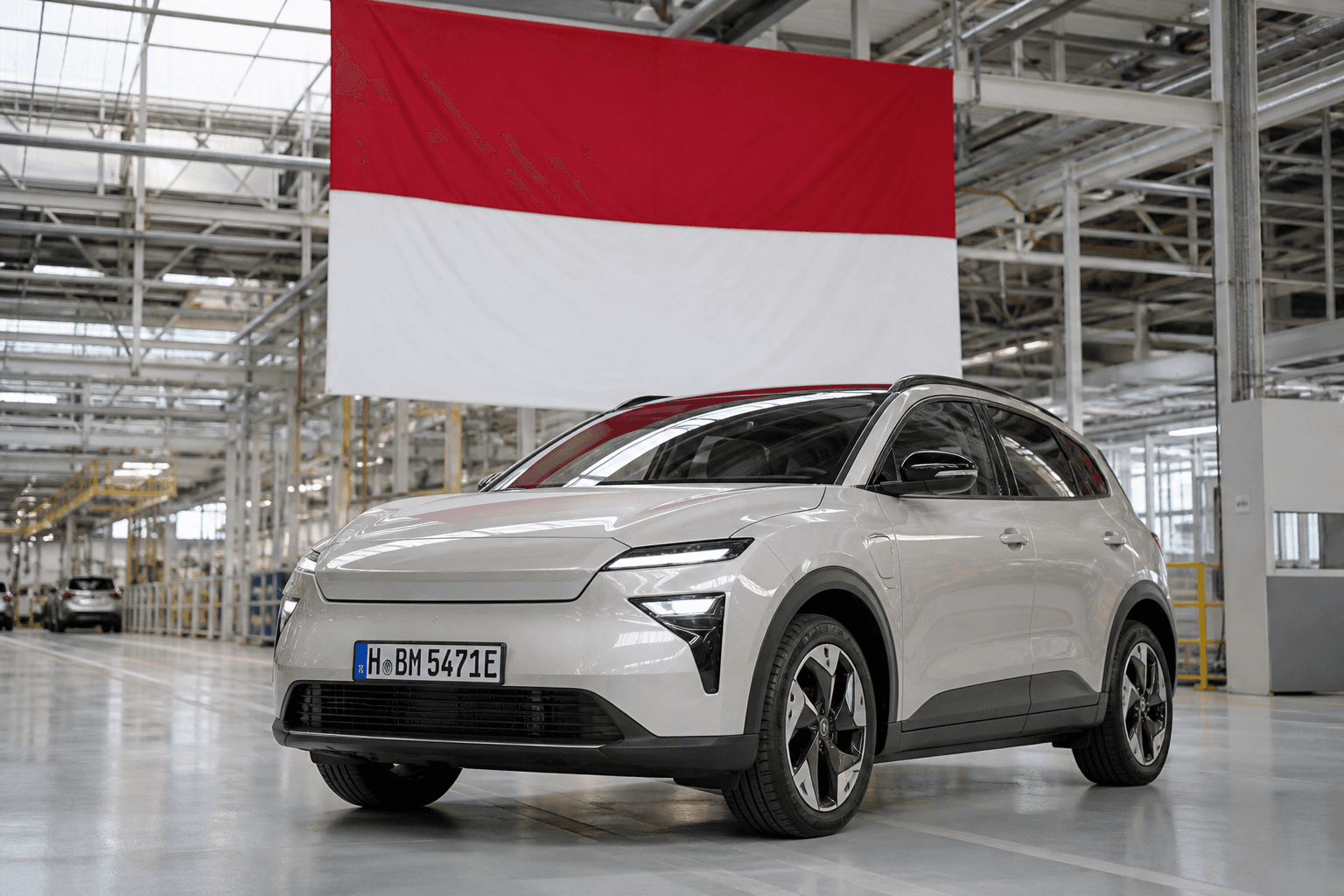
Indonesia plans to begin mass-producing its own electric cars in 2028, President Prabowo Subianto has announced. The goal is to accelerate the widespread adoption of electric mobility in Southeast Asia’s largest economy and reduce the country’s dependence on imports.
For Europe, this is particularly significant as an industrial trend: Southeast Asia is becoming not only a sales market but also a manufacturing hub. In the medium to long term, this could affect supply chains, battery raw materials and pricing pressure in the global EV market.
Figures, Footprint and Capacity: The Planned Factory Complex in Subang
A new factory complex in the Subang region of West Java province is at the heart of the strategy. This is where the vehicles are to be built. The project’s scale is clearly designed for growth, beginning with a smaller initial phase and later expanding into a significantly larger industrial park.
| Development phase | Area | Planned annual capacity |
|---|---|---|
| Initial phase | approx. 60 hectares | up to 50,000 vehicles |
| Expansion | up to 539 hectares | up to 300,000 vehicles |
The capacity targets appear ambitious but are typical of countries seeking to establish an entire value chain. The key question will be how quickly Indonesia can develop its supplier base, battery production, logistics and quality-control processes, because without this foundation, a factory is little more than an empty shell.
2030 Target: 2 Million EVs and 13 Million Electric Motorcycles
Indonesia has set a clear target for 2030: 2 million electric cars and 13 million electric motorcycles on the road. The two-wheeler figure in particular shows where the greatest potential for change lies in everyday transportation.
Motorcycles and scooters are the dominant means of transportation in many parts of Southeast Asia. A successful transition in this segment would have immediately noticeable effects on noise, local emissions and operating costs. It is also relevant to power grids, as millions of small charging points create different requirements from a handful of high-power charging sites along highways.
An Ecosystem Rather Than a Standalone Solution: Manufacturing, Batteries, Charging and Service
Alongside car production, the government is planning a national electric motorcycle program. The approach is notably pragmatic: the aim is to create an integrated ecosystem encompassing manufacturing, batteries, charging infrastructure and customer service.
In practice, this entire chain determines whether electric mobility can succeed in the long term. A low purchase price is not enough if spare parts are unavailable, batteries are difficult to replace or everyday charging is too complicated. In the two-wheeler segment in particular, good service can build trust much faster than any marketing campaign.
Focus on Incentives: Loans, Potential Subsidies and Tax Exemptions
To stimulate sales, state-owned lenders are expected to offer more affordable vehicle loans with longer repayment periods. A trade-in program is also under discussion, potentially allowing combustion-engine motorcycles to be exchanged for electric scooters.
Other measures under consideration include a subsidy equivalent to around €240 for each electric motorcycle purchased and a full VAT exemption for electric cars. Such instruments are not directly comparable from the perspective of the DACH region—Germany, Austria and Switzerland—but the general approach is familiar: purchase incentives lower the barrier to entry, while tax breaks make the market more predictable.
Context: Southeast Asia Accelerates as Thailand Targets 2035
Indonesia is not alone in pursuing this strategy. Several Southeast Asian countries are positioning themselves as electric-mobility hubs. Thailand, for example, aims to permit registrations of electric new cars only from 2035.
This could make the region even more attractive to manufacturers and suppliers, both as a production base and as a growth market. For Europe, this means that competition over costs, batteries and scale will remain intense—and that, in the long term, will push down prices and accelerate technological development.