The ID. Buzz Cargo becomes a roomier electric van
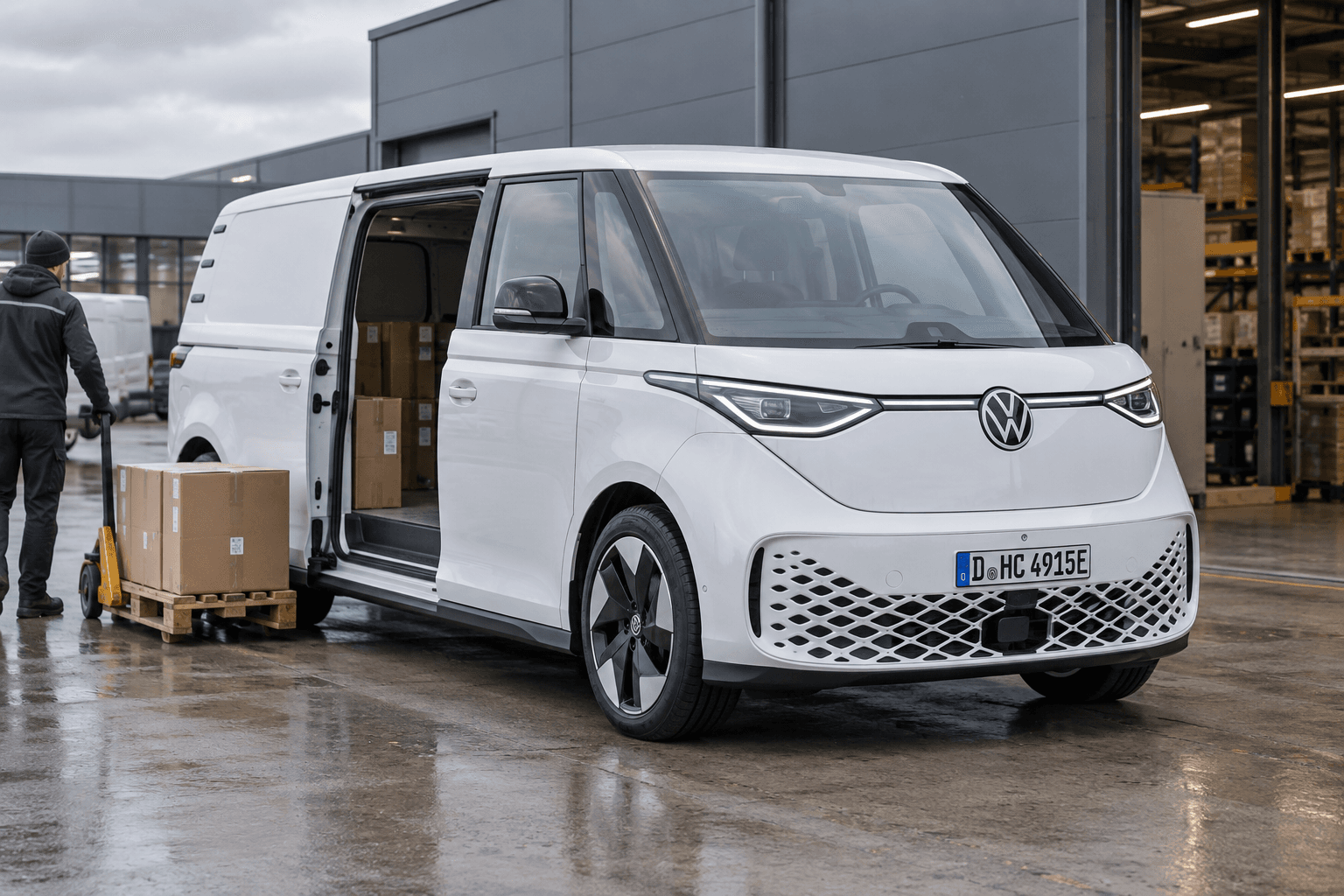
Volkswagen Commercial Vehicles is expanding the ID. Buzz lineup with a long-wheelbase Cargo version. The ID. Buzz Cargo LWB offers 4.4 m³ of cargo capacity, 0.5 m³ more than the existing standard-wheelbase version.
The usable cargo floor grows by 25 cm to 2.46 m. There is 1.23 m of space between the wheel arches, making the electric van better suited to bulky tools, materials, and standardized loads.
The key advantage of the long wheelbase is not only the additional volume, but also more practical everyday loading through the enlarged side door.
A Euro pallet fits through the sliding door
Standard equipment includes a wooden floor and a second sliding door. Its opening is 19 cm wider than before, allowing a Euro pallet to be loaded from the side. In tight urban traffic or on construction sites, this can be more practical than access through the rear.
Volkswagen offers the Cargo LWB with two or three seats. A large tailgate is fitted as standard, while rear barn doors are available as an option.
Rear-wheel drive or 4Motion with up to 250 kW
Both powertrain variants use an 86 kWh battery. This makes the energy storage system larger than that of the short-wheelbase ID. Buzz Cargo, which is offered with 79 kWh.
| Specification | Rear-wheel drive | 4Motion |
|---|---|---|
| System output | 210 kW | 250 kW |
| Battery capacity | 86 kWh | 86 kWh |
| Maximum payload | up to 700 kg | up to 606 kg |
| Braked towing capacity | 1,800 kg | 1,800 kg |
| Net price in Germany | from €48,490 | from €50,630 |
The rear-wheel-drive model offers a higher potential payload, while the all-wheel-drive version provides more power and traction. Both versions have a maximum braked towing capacity of 1,800 kg on both 8% and 12% gradients.
In Germany, the long wheelbase costs around €2,340 extra before tax. The entry-level prices work out to approximately €57,700 including VAT for the rear-wheel-drive model and €60,250 including VAT for the 4Motion. Final prices differ in Austria and Switzerland due to different taxes and market pricing.
V2L turns the ID. Buzz into a mobile power source
Vehicle-to-Load is particularly useful for tradespeople and service companies. A PowerSocket adapter connected to the charging port allows the ID. Buzz Cargo to power electrical devices directly from its traction battery.
Up to 3.0 kW is available continuously, with 3.6 kW possible for short periods. This is enough to operate circular saws, chargers, or other mobile equipment. Park the vehicle, connect the adapter → in many situations, there is no need for an external power source or generator.
The adapter is offered with a Schuko connector, the grounded household plug standard widely used in Germany and Europe, as well as in a CEE 230-volt version. V2L is therefore also becoming a practical additional feature in European vehicles, while bidirectional solutions are likely to become more closely integrated with energy systems and smart homes in the future.
New software adds one-pedal driving
The extended Cargo receives the latest ID. software from the Hanover factory. A new feature is one-pedal driving, in which the vehicle recuperates energy strongly when the accelerator is released and decelerates to a complete stop. This can make everyday driving more relaxed, particularly on delivery routes with frequent starts and stops.
The optional Travel Assist can now also detect traffic lights and automatically brake to a complete stop at a red light. It remains a driver-assistance system and does not relieve the driver of responsibility.
The updated interior includes the Innovision infotainment system with an app store and a multifunction steering wheel with redesigned physical buttons. The app store provides access to services including audio, video streaming, parking, charging, and gaming.
Greater utility for businesses and fleets
With 4.4 m³ of cargo capacity, the ID. Buzz Cargo LWB remains smaller than conventional large vans but becomes considerably more practical. It is aimed primarily at tradespeople, delivery services, and service fleets that need plenty of space but do not want to use a particularly tall or long commercial vehicle.
The larger battery, the ability to load a Euro pallet from the side, and V2L are more important here than performance figures alone. At the same time, competition among electric commercial vehicles is growing, including from the announced Kia PV7 large electric van. By contrast, the ID. Buzz Cargo LWB focuses on more compact dimensions, distinctive styling, and equipment that is now significantly better suited to practical use.