Honda and Nissan Bet on Shared Software and Vehicle Computers
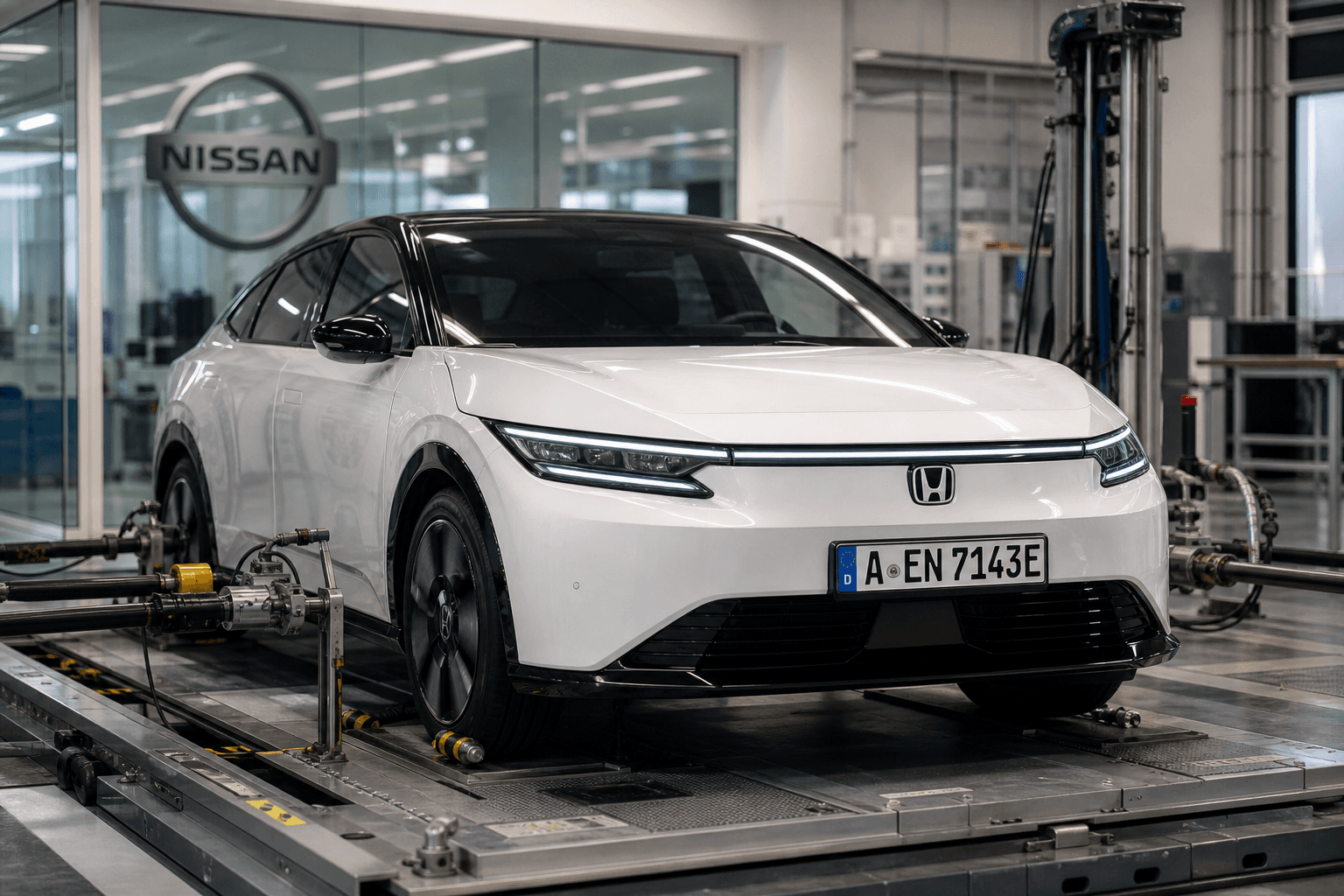
Following failed merger talks, Honda and Nissan are taking a different—and technically much more tangible—path: The two manufacturers plan to jointly develop the core components for software-defined vehicles (SDVs). This does not mean a handful of infotainment apps, but rather the central computing and software architecture that will run large parts of a vehicle’s functions in the future.
The timeline is clearly defined: The shared platform is to be used in new vehicles from 2029, serving as the basis for models from “2029 and beyond.” The partnership is therefore aimed at the next major generation of vehicles, not a short-term facelift.
What Exactly Will Be Developed Jointly
The focus is on standardized electronic control units and the associated software layer. The two companies explicitly mention high-performance central computers and zonal ECUs that cover specific areas of the vehicle. These will be accompanied by a shared vehicle operating system, middleware and vehicle control software.
In practice, this means moving away from dozens of individual control units, each with its own logic, toward an architecture that consolidates functions more centrally and distributes them across “zones” via high-speed data connections. This is one of the prerequisites for adding new features through software at a later date without having to navigate a maze of hardware variants every time.
In Brief: An SDV Is More Than a Large Display
“Software-defined” means that the car is defined more by its software functions than by fixed hardware options. Everyday examples include driver assistance and energy management systems that can evolve through updates, more precise diagnostics, and new convenience features that can be unlocked later, provided the necessary sensors and computing power are available.
When computers, the operating system and middleware are standardized, the car becomes a platform, and product development increasingly shifts to software cycles.
Why Honda and Nissan Are Doing This Now
The two manufacturers cite two main reasons for the partnership: faster development cycles and more efficient investment. SDV architectures are particularly demanding because chips, the operating system, the security framework, the toolchain and the testing strategy all need to work together. Any company tackling this alone pays twice and learns more slowly.
Another advantage comes from economies of scale: If two manufacturers build on similar computers and chip platforms, they can pool production volumes. This can reduce costs and, in the best case, improve supply security as well—an issue that has caused considerable pain for many automakers in recent years.
EVs Are Not Mentioned, but the Connection Is Obvious
The announcement does not explicitly identify electric cars as the sole target. At the same time, it emphasizes that the platform is intended to support SDVs from 2029 and that both brands plan to continue working on technologies that accelerate progress toward carbon neutrality. For the DACH market—the German-speaking region comprising Germany, Austria and Switzerland—this is a clear indication that the architecture is very likely also intended for future generations of electric cars.
In EVs in particular, software plays an increasingly decisive role in everyday use: Preconditioning, charging planning, battery and thermal management, and driver assistance systems are all areas where a strong computing and software foundation can directly improve range and comfort. Manufacturers that catch up here can make their platforms more competitive without having to reinvent every model from scratch.
The Bigger Picture: China, Silicon Valley and the Platform Race
The move fits into a global trend: Manufacturers from China and technology-focused providers have relied on central computers and rapid software rollouts for years. This increases the pressure on traditional automakers, whose businesses historically centered on hardware variants and long model cycles. A shared SDV foundation is therefore also a response to the pace of the market.
From a Tesla perspective, this is interesting because Tesla adopted this platform approach early and pursued it very consistently. That is precisely why regular over-the-air updates, a consistent user interface and rapid feature rollouts have become so normal there. If Honda and Nissan tackle this together, it is less “anti-Tesla” and more a sign that the SDV approach is becoming the industry standard.
What This Could Mean for Customers
If the partnership succeeds, three realistic effects are conceivable from 2029: more stable software across model ranges, faster updates and a more modern electrical/electronic architecture that makes it easier to introduce new functions. Whether this actually produces a noticeable benefit will ultimately depend on implementation: Update policies, UI quality, test coverage and feature priorities—not just the hardware—will be decisive.
Until then, it remains a development project with a stated goal. But it is one that shows how seriously the Japanese manufacturers now take the transition from a “car with software” to a “car as a software platform.”