When an electric vehicle is charged, not all the energy drawn reaches the battery. Some is needed for power conversion, control systems, and battery temperature management, or is dissipated as heat. These charging losses increase actual electricity consumption and therefore costs.
What matters is not only how much energy the battery stores, but how many kilowatt-hours of electricity are drawn and paid for in total.
What are charging losses?
Charging loss is the difference between the energy drawn from the power grid or charging station and the energy stored in the battery. For example, if the battery needs a certain amount of energy, a larger amount must be supplied because of these losses.
The loss rate can generally be calculated as follows: (energy drawn minus energy stored) divided by energy drawn, multiplied by 100. In practice, however, the exact amount of energy stored is not always known. The vehicle's percentage display is only of limited use for this purpose because battery buffers, temperature, and battery management system calibration affect the result.
Depending on the vehicle, charging power, and outside temperature, charging losses are often in the single-digit to low double-digit percentage range. They may be higher under unfavorable conditions.
Where is the energy lost?
| Cause | What happens? | When is it particularly relevant? |
|---|---|---|
| Power conversion | During AC charging, the onboard charger converts alternating current into direct current. This generates heat. | At low charging power and an inefficient operating point |
| Battery temperature management | Heating or cooling brings the battery into a suitable temperature range. | In freezing conditions, extreme heat, and at high DC charging power |
| Vehicle electronics | Control units, pumps, and the battery management system remain active during charging. | During long charging sessions at low power |
| Cables and contacts | Electrical resistance generates heat. | At high currents and with poor or damaged contacts |
| Cell chemistry | Losses also occur within the battery as energy is stored. | At a high state of charge, unfavorable temperatures, and high power |
AC or DC: Which type of charging is more efficient?
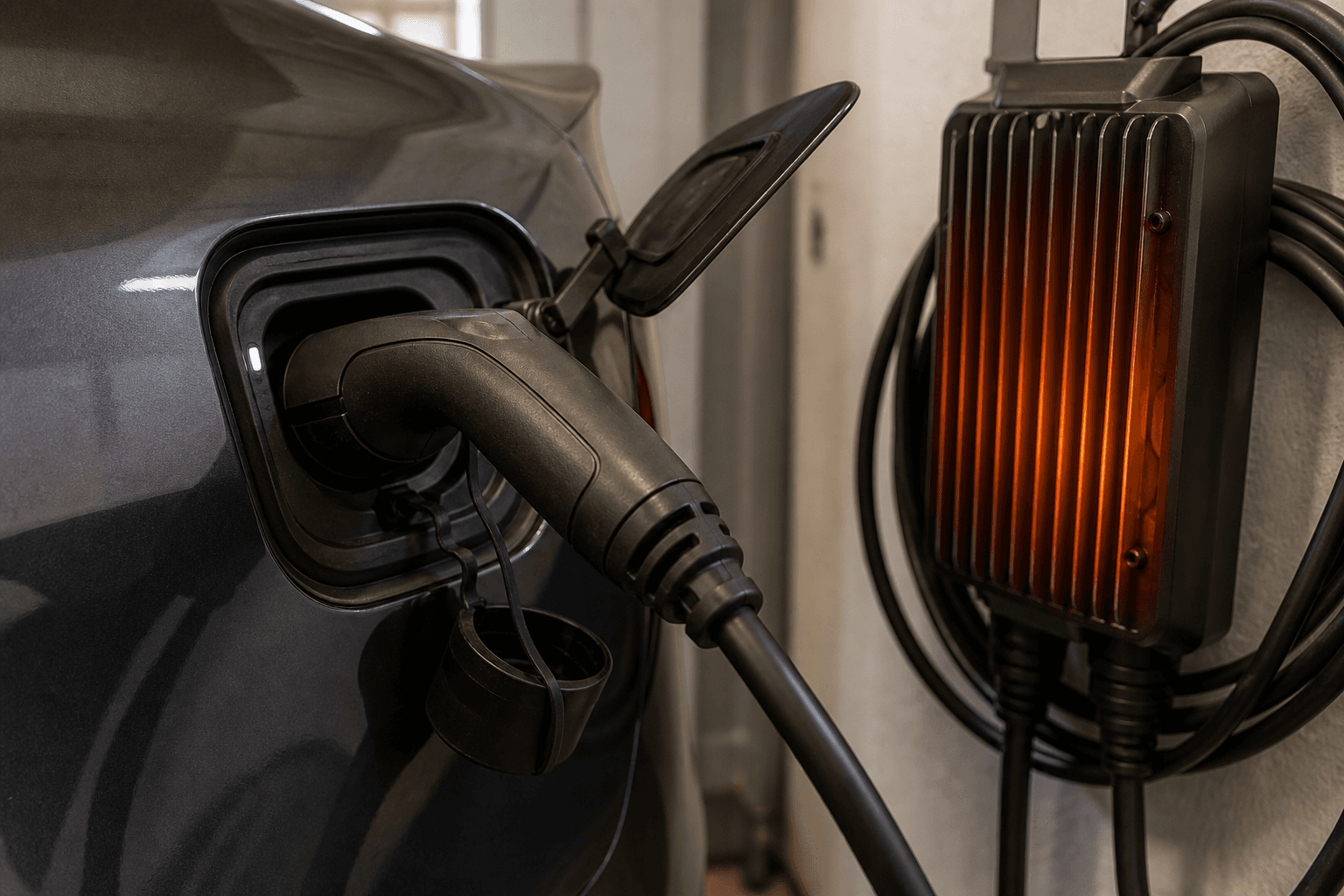
During AC charging, the charger in the vehicle performs the power conversion. A wallbox with suitable charging power is generally more efficient than very slow charging from a household outlet. The reason is that baseline consumers such as control units and pumps operate in both cases. At lower power, the process takes longer → time-dependent auxiliary consumption increases.
During DC fast charging, power conversion takes place mainly in the charging station. This eliminates some of the AC conversion losses inside the vehicle. However, at high power, the battery and charging electronics often require more cooling or heating. Any comparison also depends on where the operator measures and bills the energy supplied.
DC charging therefore does not automatically produce lower losses in every situation. For everyday efficiency, battery temperature, charging power, state of charge, and vehicle technology matter more than any general ranking.
How do charging losses increase costs?
The cost of these losses is calculated as energy drawn × loss rate × electricity price. Drivers who charge at home can record the energy drawn using a suitable wallbox meter or a separate electricity meter. The vehicle's displayed energy consumption while driving does not normally include all the preceding charging losses.
For a fair cost comparison, drivers should therefore not rely solely on the onboard computer reading. The kilowatt-hours recorded by the meter over several charging sessions provide more meaningful data. Short individual measurements can be distorted by preconditioning, cell balancing, and temperature fluctuations.
How to reduce charging losses
- Use a suitable wallbox: Regular charging from a household outlet takes a long time and can increase the share of energy consumed by auxiliary systems. The electrical installation must also be suitable and inspected for this purpose.
- Do not charge unnecessarily slowly: The lowest available charging power is not automatically the most efficient. The optimum is usually a power range in which the onboard charger operates efficiently.
- Avoid extreme battery temperatures: If possible, the car should be sheltered in very cold or hot weather. A battery that is already warm often requires less additional conditioning during charging.
- Coordinate charging with departure: Scheduled charging shortly before a trip can be useful. Any necessary cabin or battery heating is then powered directly from the grid instead of drawing exclusively from the battery later.
- Avoid numerous very short charging sessions: Each start can activate control units and pumps. Fewer, continuous charging sessions reduce this fixed auxiliary consumption.
When should you take a closer look?
Large discrepancies in cold weather, with a hot battery, or during very slow charging do not necessarily indicate a fault. However, if losses remain unusually high over several comparable charging sessions, the meter, charging settings, and measurement method should be checked first. A faulty wallbox, poor contacts, or problems with the onboard charger may also be responsible. If plugs or cables become unusually hot, the installation should no longer be used and should be professionally inspected.