632 km with one short charging break
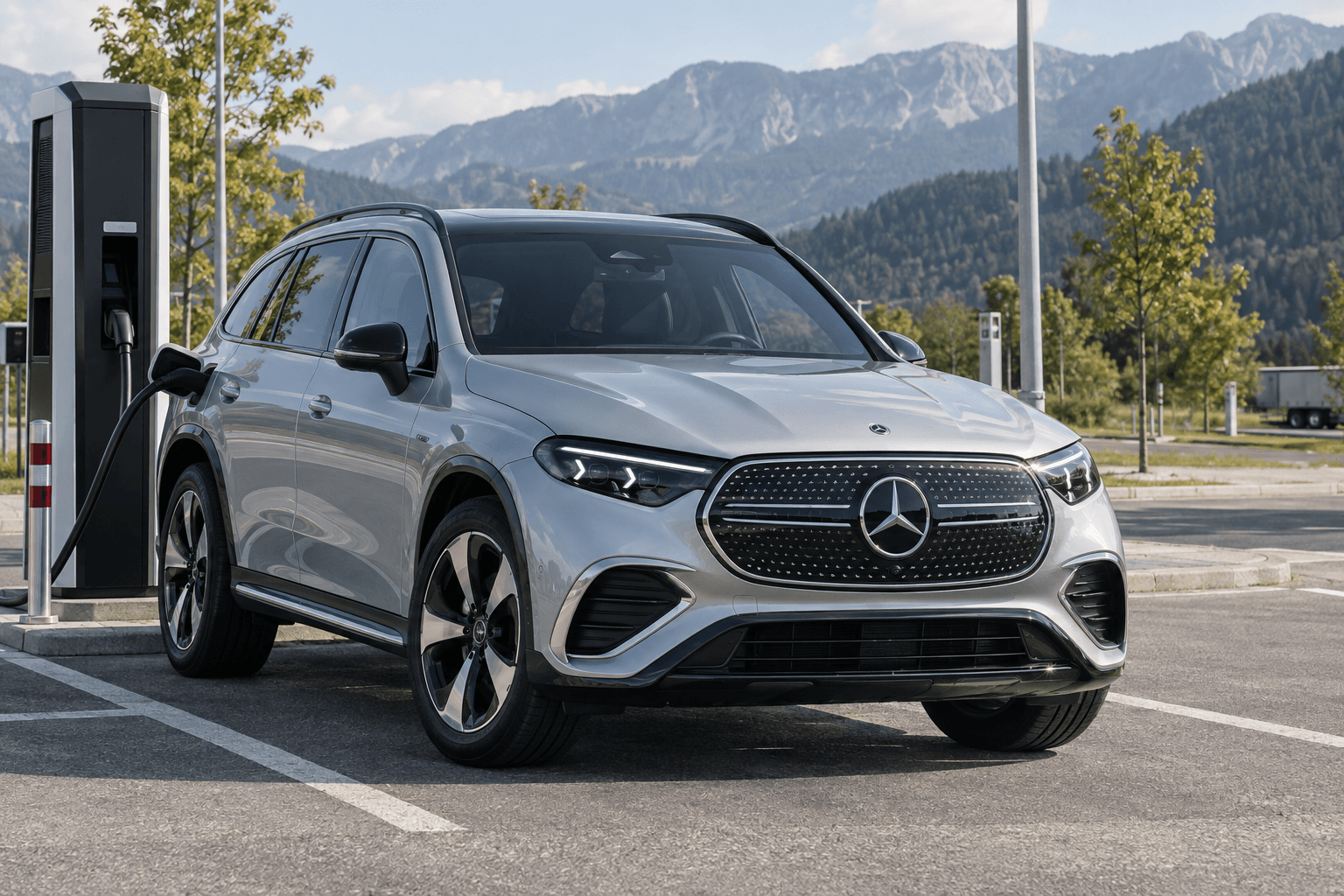
The Mercedes GLC 400 4Matic Electric completed a 632 km journey from Hungary to the Austrian Alps with just one charging stop. Around 80% of the route was on highways, mostly at approximately 130 km/h.
The electric SUV started with a full battery and reached a fast charger in Melk after 308 km. After the charging break, it covered another 324 km to its destination, arriving with 7% battery remaining.
| Metric | Result |
|---|---|
| Total distance | 632 km |
| Highway share | around 80% |
| Usable battery capacity | 94 kWh |
| Battery level before charging | 31% |
| Battery level after charging | 81% |
| Charging time | 17 minutes |
| Energy added | 51 kWh |
| Peak charging power | 275 kW |
| Average charging power | 180 kW |
| Energy consumption | 21.4 kWh/100 km |
| Calculated range | around 439 km |
Average charging power makes the difference
Mercedes specifies a maximum charging power of 330 kW for the electric GLC. During this journey, it peaked at 275 kW, although the battery was not deliberately preconditioned before the stop. The battery’s thermal state can significantly affect the charging power available.
In real-world use, the brief peak figure is not the only factor that matters. A stable charging curve is more important, as the average of 180 kW added 51 kWh to the battery during the lunch break. Our comparison of 400-volt and 800-volt systems in electric cars shows the advantages of a high-voltage platform.
High charging power is no substitute for range, but it can make long days on the road considerably easier.
439 km of real-world range instead of 673 km WLTP
Based on the usable 94 kWh battery and the day’s energy consumption of 21.4 kWh/100 km, the calculated range is around 439 km. This is not a measured full-to-empty figure, but an estimate based on the conditions of this journey.
Depending on the version, Mercedes quotes up to 673 km under the WLTP test cycle. The substantial difference is unsurprising given the high proportion of highway driving, speeds of 130 km/h and the mountain roads that followed. The highway energy-consumption test of various electric cars also illustrates how strongly speed and vehicle design affect energy consumption.
Relevant for long-distance travel in the DACH region
The route represents a realistic scenario for travel through Germany and Austria. In Switzerland, the highway speed limit is lower, which can generally reduce energy consumption, while gradients, weather and vehicle load continue to play a major role. Together, Germany, Austria and Switzerland are commonly referred to as the DACH region.
The key factor is the travel routine: start with a full battery, charge after just over 300 km during a normal break, and then cover another 324 km. Anyone who plans to stop after three hours anyway will lose hardly any additional time in everyday use compared with a similar combustion-engine vehicle.
Not a controlled comparison test
A total of eight electric cars took part in the journey. Although the Mercedes required the least additional energy, different starting charge levels and charging strategies prevent any reliable ranking.
Nevertheless, the result remains meaningful for the GLC itself. Energy consumption of 21.4 kWh/100 km with a high proportion of highway driving is solid, while the short charging break highlights the electric SUV’s real strength. For long-distance driving, what matters is therefore the overall combination of efficiency, battery size and charging curve.