China has installed more solar than coal—and what that means for EVs
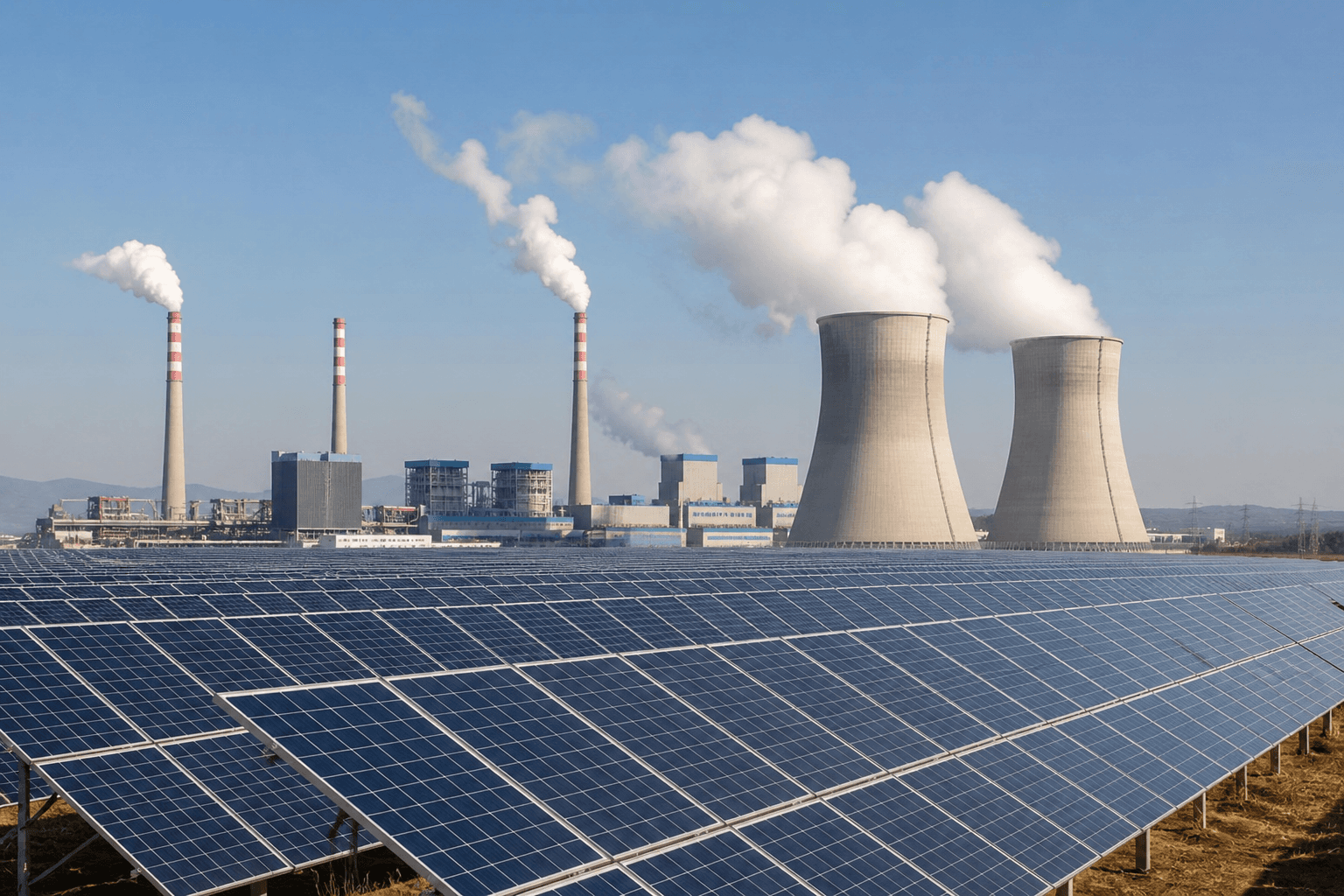
China is the world’s largest electricity market and has reached a notable milestone in expanding its generation capacity: For the first time, installed solar capacity has edged ahead of installed coal-fired capacity. Reported capacity stands at 1,288 GW of solar compared with 1,285 GW of coal. Solar therefore accounts for around 31.5% of total installed generation capacity, making it the largest segment in the system by capacity.
The timing is significant because China is also rapidly electrifying its vehicle market. In the long term, more solar in the system means more miles driven with lower CO2 emissions per kWh, provided that grids, storage and load management expand alongside it. This is also relevant to the DACH region—Germany, Austria and Switzerland—because many EVs and batteries sold in Europe come directly or indirectly from China, along with the electricity mix used in their production.
Important detail: Installed capacity is not the same as electricity generation
The headline sounds like “solar beats coal,” but for now that applies only to installed capacity. In practice, power plants and renewable energy facilities do not constantly deliver their rated output. Solar typically has a much lower capacity factor than coal because the sun does not shine around the clock. Coal, by contrast, can often operate more predictably and for longer periods at higher utilization rates.
Accordingly, China still generates more electricity from coal than from solar. But the trend is clearly shifting: In the first half of 2026, wind and solar together accounted for 24.6% of electricity generation, while coal stood at 49.7%. This is a milestone because coal has fallen below the 50% mark for the first time.
Why is solar still growing so quickly despite reduced subsidies?
Expansion has continued at a record pace for years, driven primarily by large solar farms. Although new capacity additions slowed in 2026 compared with the previous year because China reduced or ended guaranteed feed-in tariffs and solar must compete more directly in the market, construction remains strong because new solar installations are simply inexpensive to build in many regions.
This has a direct impact on the electrification of transportation: The cheaper and cleaner electricity becomes, the better the overall case for EVs, both environmentally and economically.
Coal remains in the system—and that is crucial to the transition
Despite the solar record, coal remains a dominant force in China. One reason is the existence of long-term contracts and coal’s role as a “safety net” for the grid. This can result in fossil-fuel power plants continuing to operate even when renewable energy is available, forcing renewable electricity to be curtailed.
This is where two factors that are equally important for electric mobility and grid stability come into play: storage and flexible consumers. Battery storage and other storage technologies can absorb peaks in solar generation and release the electricity again in the evening. In the future, EVs could serve as flexible loads by charging when abundant renewable electricity is available on the grid.
Real-world impact: Is driving an EV in China now automatically cleaner?
Not automatically, but the trend points in that direction. More solar capacity initially means more potential green electricity. Whether that electricity actually reaches an EV while it is charging depends on the time of day, the region, grid constraints and the availability of storage. Nevertheless, the trend is clear: As coal’s share of electricity generation falls, the carbon footprint of every electrically driven mile improves step by step.
In practical terms, the key point is that wind and solar together already account for almost a quarter of electricity generation and continue to grow, while coal’s share is declining. That is the path that truly scales electric mobility—not only in terms of vehicle sales, but also in terms of emissions.
European perspective: Why this matters to the DACH region
Europe often debates the question, “How green are EVs really?” China currently offers an extreme example of two parallel developments: rapidly rising EV sales and the simultaneous large-scale expansion of renewable energy sources. This matters for the global carbon footprint because China plays a key role in both electricity consumption and CO2 emissions.
What is more, Europe’s EV market increasingly depends on global supply chains for battery cells and components. A cleaner Chinese electricity mix could also improve the carbon footprint of production over the medium term—an important factor in many life-cycle assessments.
What this shows about the EV market in general
More EVs are only half the battle; the electricity mix determines how large the ultimate climate benefit really is.
China has reached a point where the installation figures show that infrastructure for more renewable electricity is being built on a massive scale. At the same time, the challenge remains to displace coal more quickly in actual electricity generation without putting security of supply at risk.
For anyone following competition in electric mobility, there is another clear lesson here: Large markets do not electrify in isolation, but in conjunction with their energy systems. This pace is increasingly becoming a benchmark for Europe as well.