Ceer Exobot Launches as a Sedan and SUV
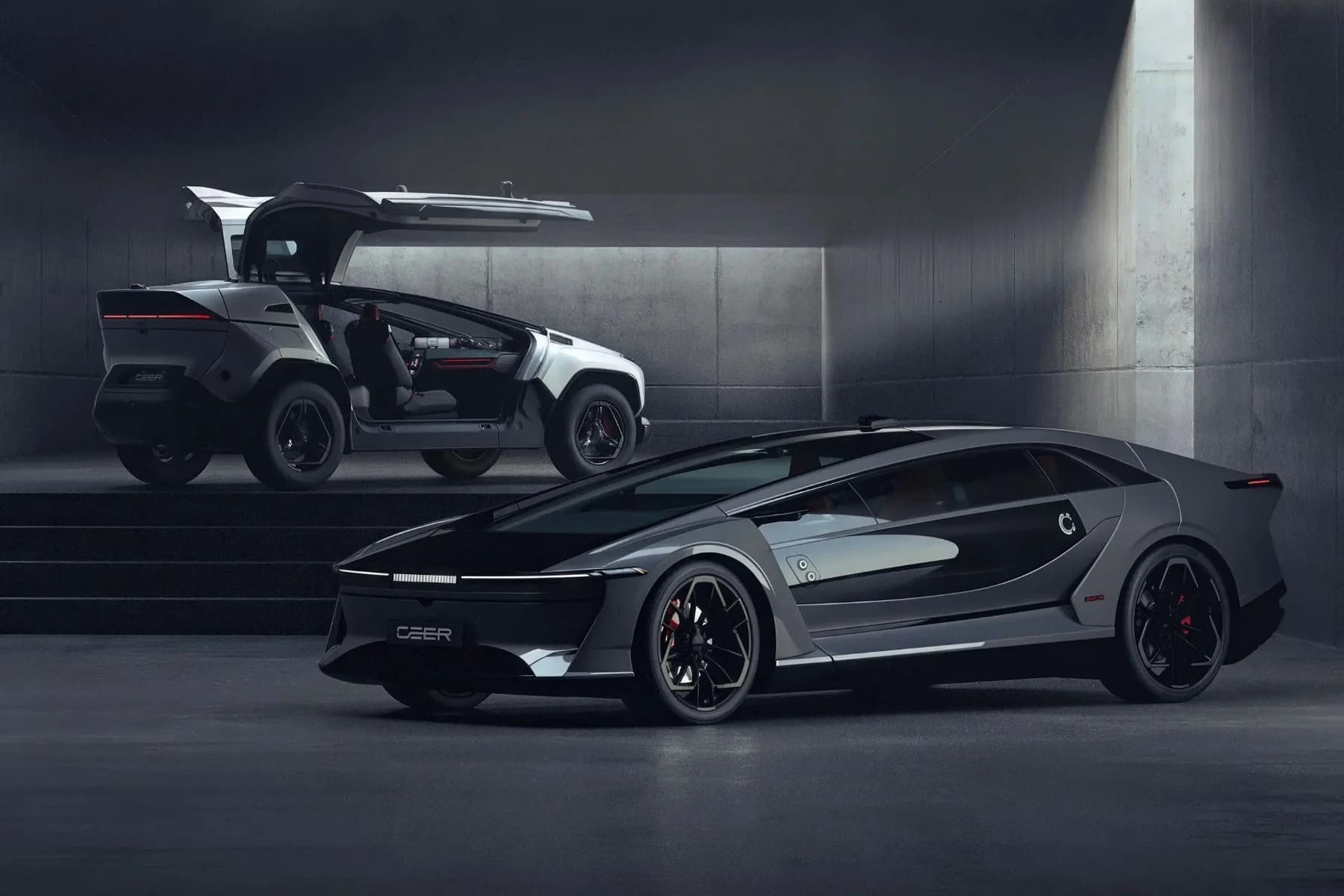
Saudi Arabia’s young electric car brand Ceer has unveiled its first vehicle. The Exobot will be offered as both a low-slung electric sedan and a large electric SUV, marking the start of a much broader model offensive.
Ceer was established in 2022 as a joint venture between Saudi Arabia’s sovereign wealth fund PIF and Taiwanese contract manufacturer Foxconn. By 2030, the brand plans to launch a total of seven models, initially intended primarily for the Middle East and North Africa.
The Exobot is less a cautious market debut than a show of technological and design prowess.
Two Body Styles With Imposing Dimensions
With its pronounced wedge shape, straight surfaces and futuristic lighting signature, the Exobot deliberately sets itself apart from conventional luxury sedans. The sedan measures 5.26 meters, while the SUV is slightly shorter at 5.02 meters but considerably taller.
| Specification | Exobot Sedan | Exobot SUV |
|---|---|---|
| Length | 5.26 meters | 5.02 meters |
| Width | 2.10 meters | 2.10 meters |
| Height | 1.43 meters | 1.69 meters |
| 0–100 km/h acceleration | 2.1 seconds | 2.4 seconds |
| Top speed | 250 km/h | 210 km/h |
The most striking exterior feature is the set of Shahin gullwing doors, which are almost three meters long. They open electrically through an arc of around 60 centimeters and are designed to provide generous access to both rows of seats. They are operated via the vehicle key or touch-sensitive surfaces in the doors.
That is likely to look spectacular, but it will require sophisticated sensors in everyday use. Tight parking garages and low ceilings are, after all, a far more challenging environment than a presentation stage.
Three Motors Deliver Up to 817 kW
In its most powerful version, the Exobot uses an electric tri-motor all-wheel-drive system. Together, the three motors deliver up to 817 kW and maximum torque of 1,500 Nm.
Not all of the technology comes from Ceer itself. Rimac supplies the rear electric motor, while Hyundai Transys contributes two motors for the front axle. BMW is also involved in the powertrain as a technology partner, although no specific details about its contribution have yet been announced.
With a 0–100 km/h time of 2.1 seconds, the sedan performs at the level of electric supercars. The SUV takes 2.4 seconds and is electronically limited to 210 km/h. This positions the Exobot well above conventional premium electric cars and in a segment that also includes the Tesla Model S.
Steer-by-Wire Reduces Steering Wheel Travel
The Exobot is not expected to have a mechanical steering column. Its steer-by-wire system electronically transmits steering inputs to the front axle. This allows the steering ratio, feedback and required steering wheel travel to be configured more flexibly.
Ceer reduces the required steering wheel travel from 400 to 160 degrees. This means less hand-over-hand steering when maneuvering, while the system is also intended to provide a direct steering feel. A similar development can be seen in other luxury models, including the updated Mercedes EQS with steer-by-wire.
48-Inch Display Dominates the Cockpit
Inside, a curved 48-inch display with 8K resolution stretches across almost the entire width of the dashboard. It is complemented by a central 10.4-inch screen and an 8-inch display for rear-seat passengers.
Ceer is therefore pursuing an extensively digital approach. The key question will be whether the software makes effective use of the large display area and keeps important functions readily accessible despite the abundance of screens. Particularly for a new manufacturer, ease of use, software updates and long-term support are just as relevant as sheer screen size.
Production Scheduled to Begin in 2027
According to the current timetable, series production is scheduled to begin in January 2027 at the Ceer Manufacturing Complex in King Abdullah Economic City. Initial deliveries are planned for March 2027. The manufacturer has not yet announced prices or specific battery capacities.
No details have yet been provided regarding range, charging power or potential exports to Europe. For Germany, Austria and Switzerland—collectively known as the DACH region—the Exobot is therefore initially of interest primarily as a technological statement. A market launch in the region has not yet been confirmed.
Ceer Is Part of Saudi Arabia’s Industrial Strategy
The new brand represents more than a single electric vehicle. Through Ceer, Saudi Arabia aims to establish local vehicle production, build technical expertise and create new jobs, thereby diversifying its economy.
By 2034, the share of locally generated value is expected to rise to 45%. The sovereign wealth fund also expects Ceer to contribute around €7 billion to Saudi Arabia’s gross domestic product over the long term and improve the country’s trade balance by approximately €18.5 billion.
Whether these targets will be achieved depends on the production ramp-up, quality and demand. With the Exobot, Ceer is not beginning with a mass-market model, but instead seeking maximum attention through performance, unconventional design and international technology partners.