BYD makes the Seal 07 larger and more powerful
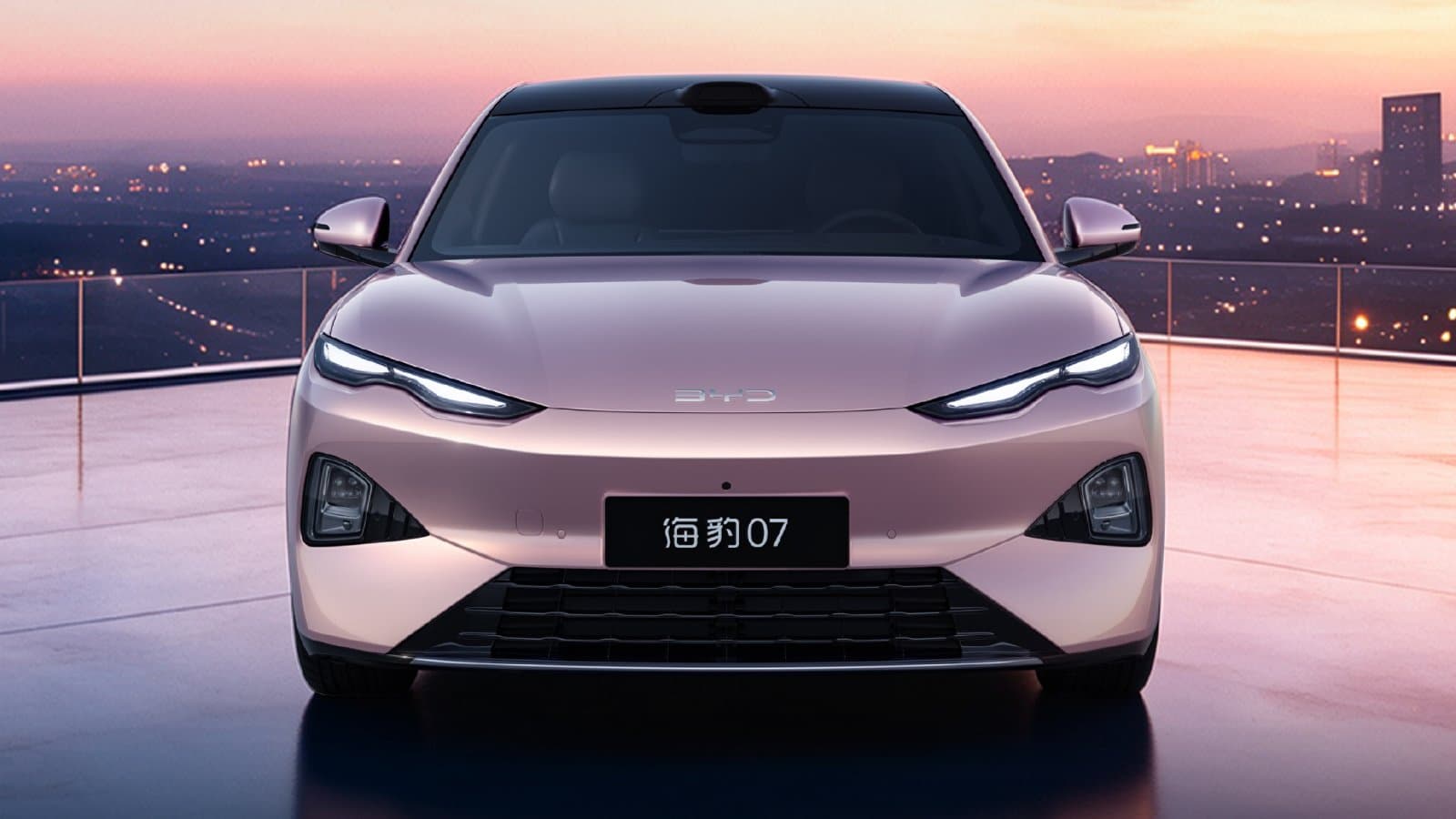
BYD has released the first official images of the second-generation Seal 07. The five-seat sedan grows to 5,080 mm in length, moving it firmly toward the executive-car segment.
BYD continues to offer two powertrain options. Alongside a fully electric version, another plug-in hybrid is planned under the Seal 07 DM-i name. The manufacturer has not yet announced a market launch date or pricing.
Dimensions compared
At 1,960 mm wide and with a wheelbase of 2,960 mm, the new Seal 07 has grown in more than just visual presence. Compared with the electric model introduced as recently as March 2026, the body is 85 mm longer, while the wheelbase has increased by 60 mm.
| Specification | New generation | Change |
|---|---|---|
| Length | 5,080 mm | up 85 mm |
| Width | 1,960 mm | up 50 mm |
| Height | 1,495 mm | unchanged |
| Wheelbase | 2,960 mm | up 60 mm |
| Seats | 5 | unchanged |
The longer wheelbase should primarily benefit rear-seat passengers. At the same time, the height remains unchanged, allowing the Seal 07 to retain its low fastback silhouette. Within BYD’s lineup, this positions it clearly above the more compact BYD Seal.
Electric version gets up to 300 kW
Chinese vehicle registration documents list two electric power outputs of 245 kW and 300 kW. Both variants use LFP batteries and, according to the documents, reach a top speed of 240 km/h.
There are not yet any confirmed details about the new generation’s battery capacity, range, or charging power. The current model combines a 69 kWh Blade Battery with a claimed range of up to 705 km under Chinese testing standards and is among the first BYD vehicles to feature the company’s new fast-charging technology. How extensively BYD develops this concept further is likely to matter more in everyday use than the additional motor power.
More power is a given, but battery capacity, real-world range, and the charging curve remain the key unanswered questions.
BYD continues to rely heavily on lithium iron phosphate for its high-volume models. This cell chemistry is durable, relatively inexpensive, and does not require nickel or cobalt. Its growing dominance is also evident in developments in the Chinese battery market.
Roof-mounted LiDAR points to new driver-assistance technology
Visually, the Seal 07 gains a more sharply styled front end, a new daytime-running-light signature, and a full-width taillight. Semi-recessed door handles and the flowing roofline are intended to keep aerodynamic drag low.
The official images also show a LiDAR sensor on the roof. Which driver-assistance functions it will enable, and whether the sensor will be standard on all variants, remain unclear. The hardware alone does not indicate how capable the system will be in real-world traffic.
Plug-in hybrid remains part of the lineup
The second generation will also be offered as the Seal 07 DM-i plug-in hybrid. Technical specifications for the combustion engine, battery, and electric range are not yet available. BYD is likely to continue targeting buyers who want to drive mostly on electric power but do not wish to give up a combustion engine entirely.
At the same time, BYD is rapidly advancing the electrification of its sedans. The smaller BYD Seal 06 with 800-volt architecture and LiDAR already demonstrates which technologies could be deployed more widely across the Ocean lineup in the future.
European launch not yet confirmed
For now, the presentation concerns the Chinese market. It is not currently known whether the new Seal 07 will come to Germany, Austria, or Switzerland. Chinese prices also cannot be transferred directly to the German-speaking DACH region—Germany, Austria, and Switzerland—because of differences in taxes, equipment packages, and import costs.
At 5.08 meters long, the model would no longer qualify as a conventional midsize car in Europe. If BYD plans to export it, the Seal 07 would therefore need to impress not only with its range and charging performance but also compete on price with established electric executive sedans.