Audi Plans a Clearer Division of Responsibilities in China
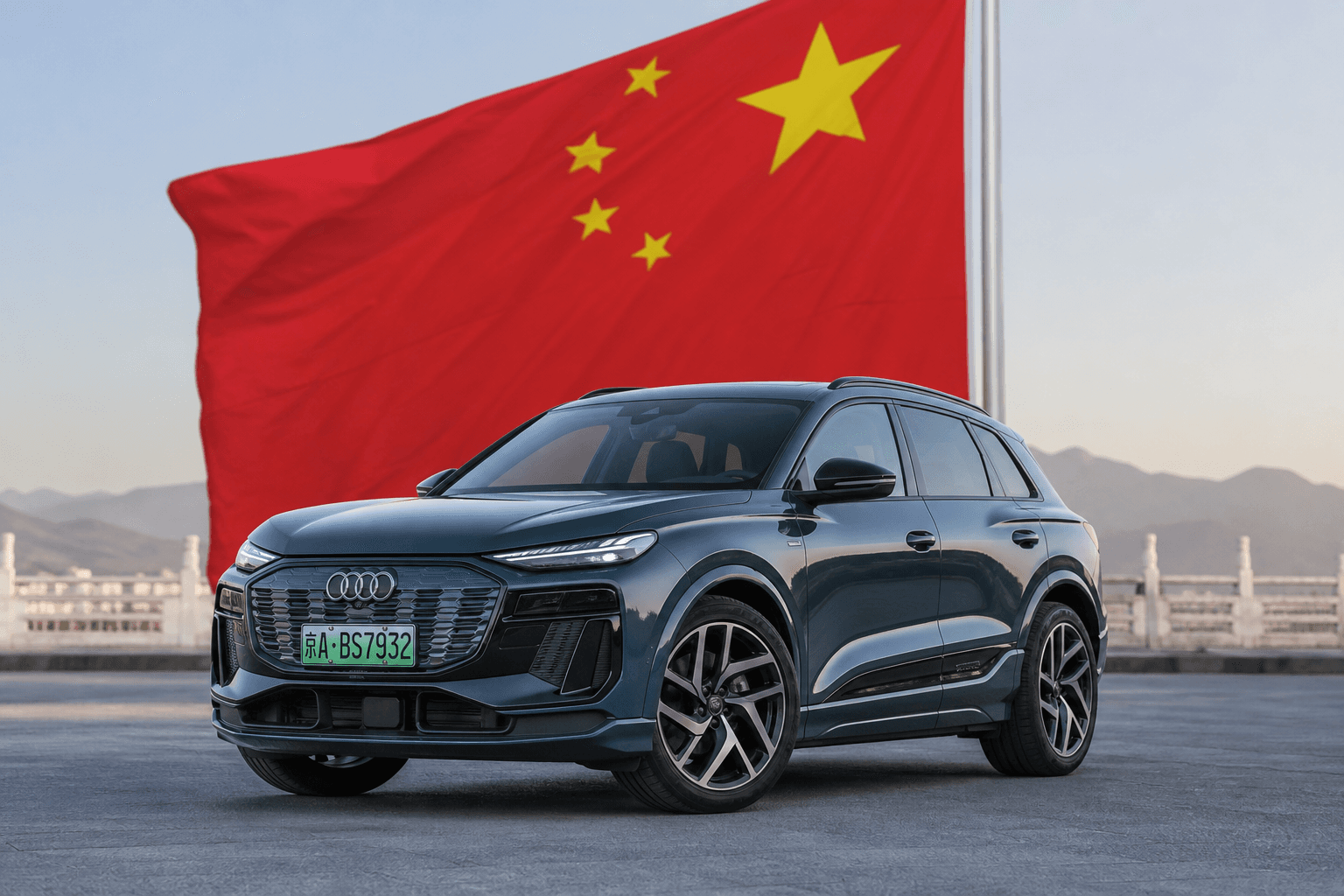
Audi is reportedly preparing a comprehensive reorganization of its China business. Under the plan, FAW-Audi would take responsibility for all models bearing the traditional four rings, while SAIC Audi would focus entirely on AUDI, the brand created specifically for China.
The broad outlines of the plan are said to have largely been agreed. However, a binding agreement has not yet been signed, and there is currently no timetable for implementation. Responsibilities for individual models, sales, and customer service remain part of the negotiations.
In the future, the reorganization will create a clearer distinction between the global Four Rings brand Audi and the standalone Chinese brand AUDI.
FAW and SAIC to Receive Clearly Separated Responsibilities
Audi has worked with several partners in China for years. This dual-partner strategy is not expected to change fundamentally, but the roles of FAW and SAIC would become much more clearly differentiated.
| Partner | Planned responsibility | Focus |
|---|---|---|
| FAW-Audi | Development, production, and sales of Four Rings models | Global Audi models with combustion or electric powertrains |
| SAIC Audi | Establishment and expansion of the AUDI brand | Locally developed electric cars and China-specific digital technology |
FAW-Audi is also expected to take over existing customer services and after-sales support for the Four Rings models previously sold by SAIC. Audi and its partners will need to reorganize not only technical processes but also supply chains, dealership agreements, and warranty procedures.
The Four Rings models previously offered by SAIC Audi include the A5L Sportback, A7L, Q5 e-tron, and Audi Q6. For customers in China, the key issue will therefore be ensuring a seamless transfer of maintenance, warranties, and existing benefits.
AUDI Is Set to Grow Into a Standalone Electric Car Brand
AUDI is not simply a new spelling of the familiar brand name. It uses an uppercase wordmark without the four rings and consistently tailors its vehicles to the Chinese market. This includes a locally developed platform, connected cockpits, and driver-assistance systems designed around Chinese requirements.
The E5 Sportback and E7X are already central to this strategy. Our article on the Audi E5 and E7X provides an overview of the vehicles and their potential prospects outside China.
SAIC Audi has also established a dedicated development center for the AUDI brand in Shanghai. Around 300 employees are expected to work there on vehicle development, driving dynamics, AI-powered cockpits, and the next generation of driver-assistance systems.
Four Additional Models on a New Platform
Audi and SAIC are planning four more AUDI models based on the Advanced Digitized Platform 2.0. The first vehicle from this new generation is scheduled to be unveiled in 2028. Before that, a third model from the original product initiative is planned for 2027.
Audi is therefore placing greater emphasis on local development in China rather than merely adapting global model lines. Shorter decision-making processes and technology designed specifically for Chinese software ecosystems are intended to enable faster model cycles.
Four Rings Business Remains Economically Significant
The division is not without risk for SAIC Audi. In the first seven months of 2026, the company sold more than 12,500 Four Rings vehicles in China. That represented approximately half of its total sales.
More recently, some models have been offered at substantially lower prices. Limited-time prices for the A7L and Q6 were at times only around 60% of their list prices. Such promotions can accelerate inventory reduction, but they are not yet evidence that production is about to end.
Data from external market observers showed no production of the affected models in July. SAIC Audi disputed this account and said that all models were still being manufactured, but did not provide production figures. The available data therefore remains inconclusive.
What the Reorganization Means for Europe
For now, the planned restructuring exclusively affects Audi’s China business. There are currently no direct changes for Audi customers and dealers in Germany, Austria, or Switzerland. The European range of the Audi A6 and other global model lines also remains organizationally separate.
Nevertheless, the development is relevant over the long term. Audi can test new platforms, cockpit concepts, and assistance features more quickly in China, while FAW consolidates the traditional model business. However, no decision has yet been made on whether individual technologies or complete AUDI models will later come to Europe.
Strategically, the separation appears logical: FAW receives a clearly defined business centered on the familiar four rings, while SAIC can focus on a young electric car brand. The key questions will be whether the transition works smoothly for existing customers and whether AUDI can generate sufficient demand with its growing model range.