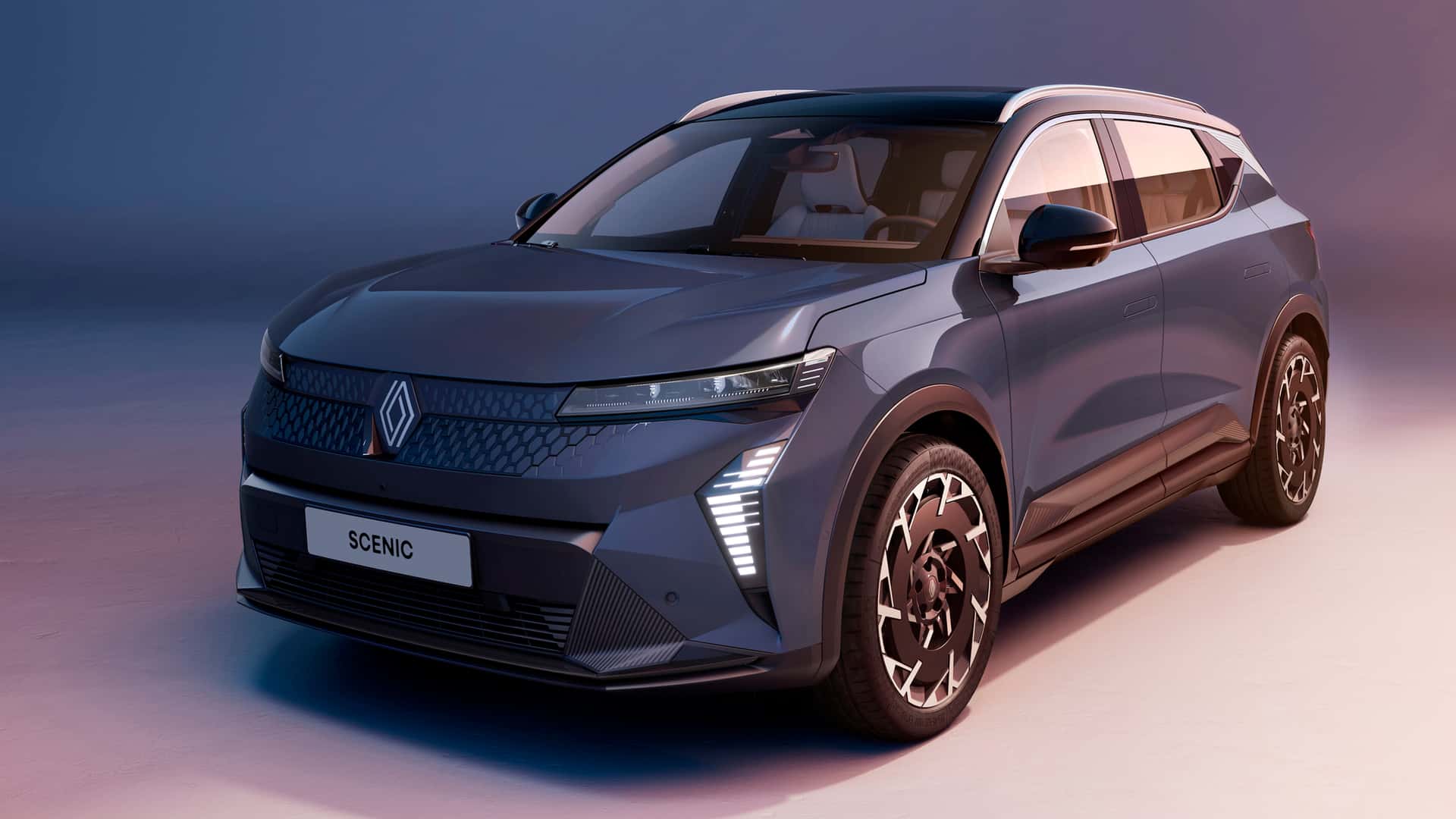
Renault Scenic E-Tech Electric continues into 2027
Renault is giving the Scenic E-Tech Electric significant technical upgrades and price cuts for the 2027 model year. New batteries increase its range, DC charging becomes faster and the previous 125 kW entry-level motor has apparently been dropped from the lineup.
The Long Range version is particularly noteworthy: it will offer up to 632 km of WLTP range and start at €42,590 in Techno trim. That is more than €5,000 less than the previous model with the large battery.
Two new batteries and 160 kW across the range
The previously available 60 and 87 kWh batteries are being replaced by units with net capacities of 67 and 89 kWh. Both versions use an externally excited synchronous motor on the front axle, delivering 160 kW and 300 Nm.
For the smaller battery, Renault is using LFP cells in the Scenic for the first time. This cell chemistry is cost-effective, robust and is increasingly being used in other Renault models as well. A similar move is planned for the Renault 5 with an LFP battery.
| Specification | Comfort Range | Long Range |
|---|---|---|
| Powertrain | Front-wheel drive, 160 kW | Front-wheel drive, 160 kW |
| Torque | 300 Nm | 300 Nm |
| Net battery capacity | 67 kWh LFP | 89 kWh NMC |
| WLTP range | 459 km | 621 to 632 km |
| WLTP consumption | 17.3 kWh/100 km | 17.0 kWh/100 km |
| Acceleration from 0 to 100 km/h | 7.9 seconds | 7.9 seconds |
| Top speed | 170 km/h | 170 km/h |
The entry-level version’s range therefore increases from 423 to 459 km. With the large NMC battery, it rises from the previous 600 km to a maximum of 632 km. Initially, only the Long Range version can be configured; the Scenic with the LFP battery is expected to follow later.
Higher peak power tells only half the story
Both batteries are expected to charge around 25% faster than before. The smaller LFP battery peaks at 165 kW, while Renault quotes a maximum of 150 kW for the large NMC battery.
| Charging figure | Comfort Range | Long Range |
|---|---|---|
| Maximum DC power | 165 kW | 150 kW |
| Charging time from 15% to 80% | 24 minutes | 28 minutes |
| Average from 15% to 80% | around 109 kW | around 124 kW |
| Range added | around 12.4 km per minute | up to 14.7 km per minute |
The higher peak power therefore does not automatically make the smaller battery the faster option for long-distance travel. The charging curve is what matters: the large battery apparently maintains a higher average output across the relevant range and adds more driving range per minute.
A peak of 165 kW sounds more powerful, but on long journeys it is average charging power that matters most.
It is also important to note that Renault uses a charging window of 15% to 80%. Many manufacturers quote figures from 10% to 80%, meaning the stated times cannot be compared directly without further context. Nevertheless, 28 minutes for the large battery remains practical for trip planning, particularly when combined with more than 600 km of WLTP range.
New LFP design with pouch cells
The 67 kWh battery uses a cell-to-pack architecture with 232 cells. Pouch cells are integrated directly into the battery pack without a conventional module structure. This is intended to make better use of the available space and deliver a competitive range despite LFP’s lower energy density.
The combination of less expensive cell chemistry and a compact pack design is likely a major contributor to the lower entry price. At the same time, the Long Range version retains NMC chemistry because it offers higher energy density.
More comfort and smarter driver assistance systems
Renault is also revising the interior. Techno trim receives new PET fabric seat covers containing more than 95% recycled material, revised upholstery and a black dashboard. Esprit Alpine and Iconic also receive new finishes and trim elements.
The standard adaptive cruise control and the trim-dependent Active Driver Assist are intended to assess traffic conditions more precisely. A predictive efficiency assistant recommends lifting off the accelerator early before bends, roundabouts and intersections.
A Smart mode for Multi-Sense is also new. It automatically adjusts the vehicle settings to the situation, for example by providing a more direct response when overtaking and a more efficient configuration in urban traffic.
Google Gemini and better charging plans
In addition to Google Assistant, Google Gemini can now be activated as an AI assistant. The system is designed to understand more natural conversations and more complex, context-related requests.
Google Maps can now filter charging stations along the route by operator, charging power and payment method. This makes longer journeys easier to plan because unsuitable or excessively slow charging points can be deliberately excluded. Our guide to EV range anxiety summarizes additional strategies for relaxed long-distance travel.
All versions receive a driver monitoring system that detects fatigue and distraction. When the driver gets in, it can also load personal settings for the seating position, navigation, multimedia and ambient lighting. Smartphones will support wireless charging via Qi2 or MagSafe.
Prices fall despite larger batteries
| Trim | Comfort Range | Long Range |
|---|---|---|
| Techno | €37,590 | €42,590 |
| Esprit Alpine | Not offered | €44,790 |
| Iconic | Not offered | €45,990 |
The new Scenic therefore starts at €37,590. However, a direct comparison with the previous base model is not entirely straightforward, as the new version has 160 kW instead of 125 kW as well as a larger battery.
Despite its additional range, the Long Range version becomes significantly cheaper. Instead of the previous €48,000, Renault will charge €42,590 for the Scenic Techno with the large battery. This improves not only the technology, but also the balance between price, range and charging performance.
The Scenic will continue to be produced in Douai, France. The battery cells come from Poland, while the electric motor is manufactured at Renault’s Cléon plant in Normandy.