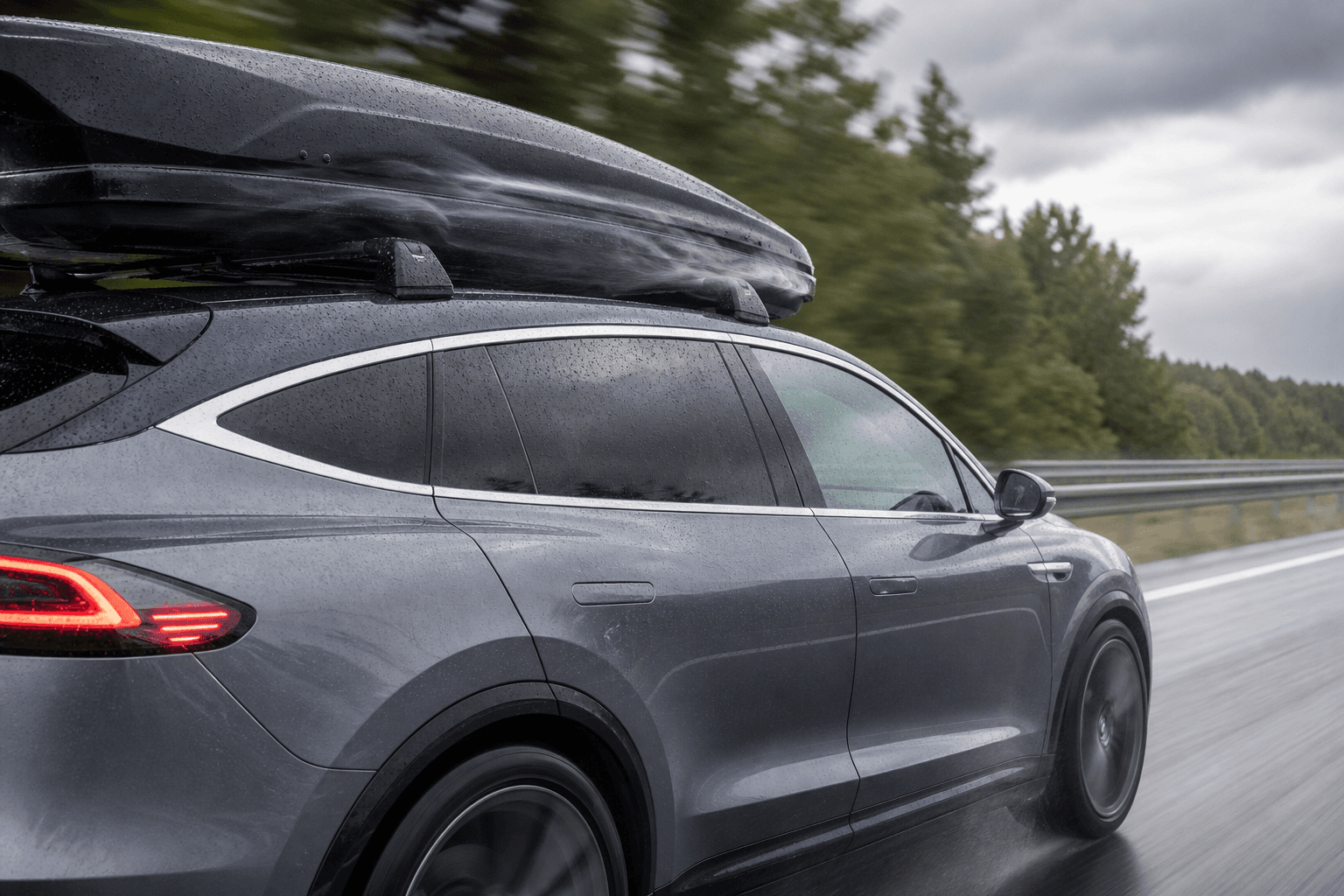
A roof box provides practical extra storage but significantly changes an electric car’s aerodynamics. The additional drag increases electricity consumption and reduces range. The extent of the effect depends primarily on speed, the shape and position of the box, the weather, and the load.
The faster the EV travels, the greater the impact of a roof box on energy consumption and range.
Why a roof box increases energy consumption
Modern electric cars are often aerodynamically optimized. A roof box increases the frontal area and disrupts the airflow over the vehicle. As a result, the motor must use more energy to maintain speed.
Drag increases disproportionately with speed. Its impact is therefore usually manageable in urban traffic. On the highway, however, a roof box can cause a substantial increase in energy consumption. High speed → significantly more energy is required simply to overcome aerodynamic drag.
Even an empty roof rack affects aerodynamics. Crossbars that remain permanently installed can create turbulence and wind noise. They should therefore be removed when they are not needed.
How much range is lost?
There is no universally applicable percentage. Depending on the vehicle, roof box, and driving profile, the increase in energy consumption may remain low at slower speeds or reach well into double-digit percentages on fast highway journeys. Large, wide, or poorly positioned boxes usually have a greater impact than low-profile, aerodynamically shaped models.
| Factor | Effect | What helps? |
|---|---|---|
| Speed | Drag rises sharply at high speeds | Drive steadily and at a moderate speed |
| Roof box shape | Tall or angular boxes create more turbulence | Choose a low-profile, aerodynamic box |
| Mounting position | Poor positioning further disrupts airflow | Follow the manufacturer’s instructions and test the position |
| Headwind | Increases the relative airspeed | Allow for a larger reserve on each leg |
| Additional weight | Has the greatest effect during acceleration and on inclines | Take only essential luggage |
The range loss can be estimated from the increase in energy consumption. For example, if consumption rises from 20 to 24 kWh per 100 km, that represents an increase of 20%. With the same usable battery capacity, a previously calculated range of 400 km falls to approximately 333 km. This example illustrates the calculation but is not a general figure for every roof box.
How to plan a longer journey
- Determine your baseline consumption: Use your car’s actual energy consumption on comparable routes, not just the official test figure.
- Install the roof box and take a test drive: A longer drive at your typical travel speed will provide a useful consumption figure.
- Adjust your charging plan: Plan shorter legs and allow an additional reserve for headwinds, rain, cold weather, or detours.
- Monitor consumption: Check the navigation system’s arrival forecast during the journey and charge earlier if necessary.
Conservative planning is advisable for the first vacation trip with a roof box. Many navigation systems only account for the increased consumption after gathering new data during the journey. A forecast that initially appears optimistic may therefore be revised downward later.
Choosing and installing the right roof box
The roof box must be compatible with the vehicle, the rack system, and the permitted roof load. The roof load includes the combined weight of the box, crossbars, and contents. The specifications provided by the vehicle manufacturer and the manufacturers of the rack and box apply. The vehicle’s permissible gross weight must not be exceeded either.
Heavy objects should ideally not be placed in the roof box. They raise the vehicle’s center of gravity and can impair handling in crosswinds or during rapid evasive maneuvers. Lightweight, bulky items such as clothing, sleeping bags, or ski equipment are better suited to the roof box. The load must be secured to prevent it from shifting.
When installed, the box should sit straight, and the tailgate should still be able to open fully. The maximum speed specified by the box manufacturer is mandatory. After the first few kilometers, it is advisable to check the mountings and fasteners again.
Is a rear-mounted cargo box more efficient?
A box mounted on the tow hitch can be more aerodynamically efficient because it sits in the vehicle’s slipstream. The actual advantage depends on its size and position as well as the vehicle’s shape. The permitted tongue weight, secure attachment, and unobstructed visibility of the lights and license plate must also be taken into account.
Anyone who regularly needs additional storage space should compare roof boxes and rear-mounted cargo boxes in terms of payload, accessibility, and energy consumption. A roof box remains a practical solution for occasional journeys. After the trip, however, both the box and the rack should be removed.