The term “TÜV” is commonly used in Germany to refer to the legally required main inspection (Hauptuntersuchung, or HU), the country’s periodic roadworthiness inspection. It can be carried out not only by TÜV, a German technical inspection organization, but also by another accredited inspection body. In principle, fully electric cars are subject to the same HU deadlines as comparable combustion-engine vehicles. The main differences concern the components inspected: There is no emissions test, while greater attention is paid to the high-voltage system, charging equipment and the condition of the brakes.
When does an electric car need its main inspection?
For a privately used passenger car being registered for the first time, the first HU is usually due after 36 months. It must then be repeated every 24 months. The relevant deadline is the month shown on the HU inspection sticker. The inspection must be completed by the end of that month at the latest.
| Vehicle | First HU | Subsequent inspections |
|---|---|---|
| New electric passenger car | After 36 months | Every 24 months |
| Used electric passenger car | As stated on the current inspection sticker or in the vehicle documents | Usually every 24 months |
| Plug-in hybrid | As for a passenger car in the relevant registration category | HU including the required emissions test |
Shorter intervals may apply to rental cars, taxis, certain commercial vehicles or vehicles used for special purposes. If you are unsure, the next inspection date can be found in Part I of the registration certificate, the most recent HU report or the sticker on the rear license plate.
Missing the deadline may result in a warning or fine. If the inspection is significantly overdue, a more extensive inspection is also required, resulting in higher fees. Insurance coverage does not automatically become invalid, but serious and known vehicle defects may have legal consequences in the event of an accident.
What is inspected on an electric car?
The HU assesses the roadworthiness and operational safety of the entire vehicle. Many inspection points therefore do not differ from those for a combustion-engine car. Among other things, inspectors check the lights, steering, axles, tires, suspension, seat belts, bodywork, windows, windshield wipers and electronic safety systems.
High-voltage system and charging port
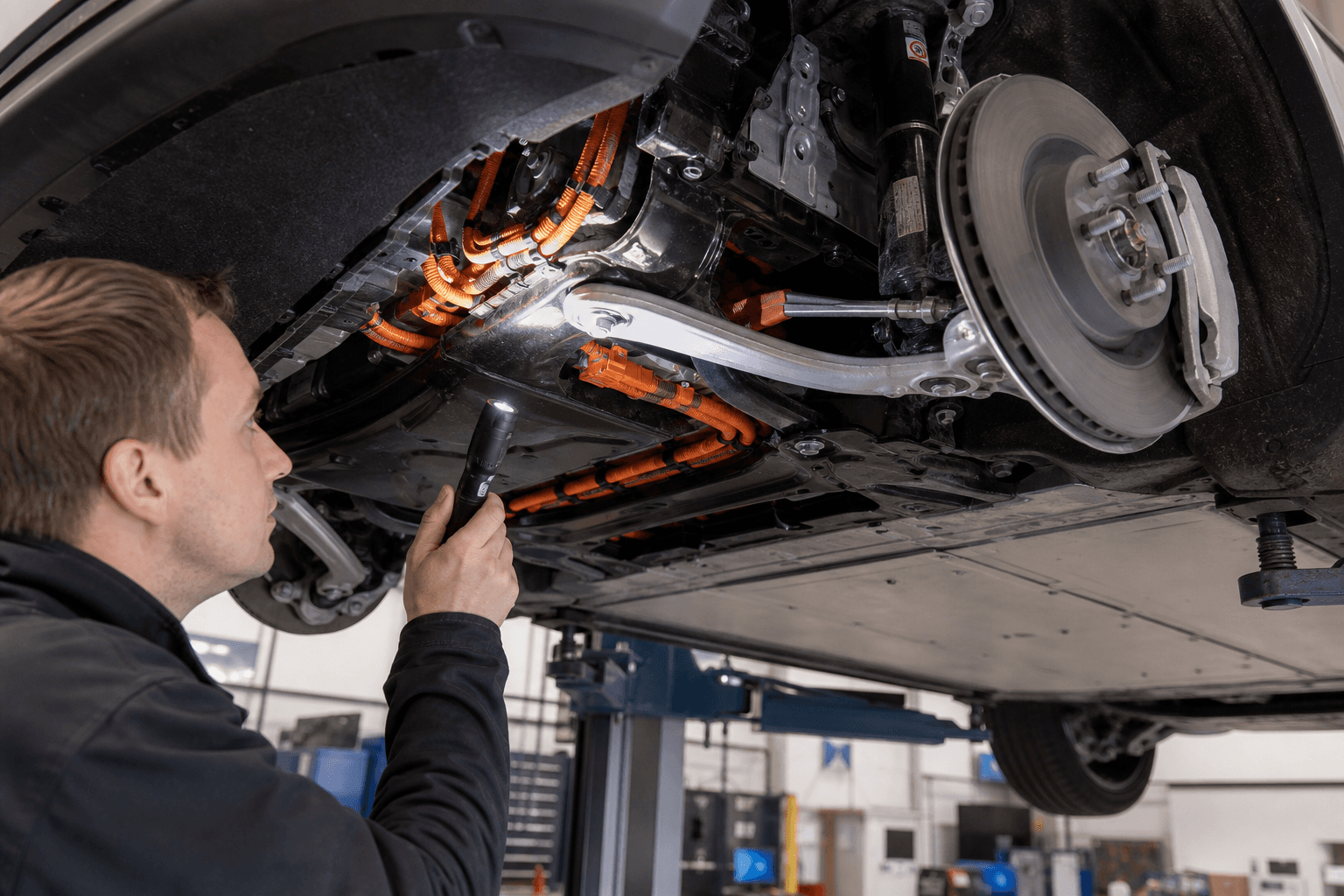
On an electric car, inspectors also look for visible damage and safety-related irregularities involving the high-voltage system. This includes accessible orange high-voltage cables, connectors, protective covers and the charging port. Loose components, damaged insulation or tampering may be classified as defects.
The HU is not a detailed battery health test: Capacity, loss of range and the exact state of health are not normally assessed comprehensively.
Passing the HU therefore does not confirm that the traction battery still has its original usable capacity. A separate battery test may be advisable when buying a used electric car.
Brakes as a typical weak point
Electric cars frequently slow down using regenerative braking. As a result, the mechanical brakes are used less. Limited use → moisture and rust can accumulate more easily on the brake discs. The HU may therefore identify corroded discs, uneven braking performance or stiff components.
The vehicle’s high weight can also place additional strain on tires, suspension bearings and axle components. Inspectors check tread depth, damage, even wear and whether the fitted wheel-and-tire combination is approved for the vehicle.
Is the emissions test waived for electric cars?
A fully battery-electric vehicle produces no local exhaust emissions and therefore requires no emissions test. The situation is different for plug-in hybrids because they have a combustion engine. They are subject to the applicable exhaust-emissions testing requirements.
Even without an emissions test, checks of electronic systems may still be relevant. Warning lights for the airbag, ABS, stability control or other safety-related functions must not remain permanently illuminated. Error messages should therefore be investigated before the inspection.
How much does a TÜV inspection cost for an electric car?
The cost depends on the inspection organization, the German federal state, the type of vehicle and the scope of the inspection. Because a fully electric car does not require an emissions test, the total price may be lower than for a comparable combustion-engine vehicle. However, there is no universal price. Current fees should be obtained directly from the selected inspection center.
Additional expenses arise if serious defects are found and a reinspection is required. An overdue HU deadline or necessary repairs will also increase the total cost. Repair shops often offer a preliminary check and can present the vehicle to an inspection organization on the owner’s behalf. This is convenient but may result in additional workshop charges.
How to prepare your electric car for the HU
- Check the lights: Test the low beams, high beams, turn signals, brake lights, rear fog light and license plate lights.
- Check the tires: Make sure there is sufficient tread, the tire pressure is correct and there are no cracks or signs of uneven wear.
- Keep the brakes in good condition: Use the mechanical brakes safely on a regular basis to prevent surface rust from becoming firmly established.
- Investigate warning messages: Have any persistent warning lights or error messages diagnosed before the HU.
- Inspect the charging area: Check the charging socket, flap and visible cables for damage or loose parts.
- Bring the documents: Have Part I of the registration certificate and any existing modification approval documents ready.
A fully charged battery is not normally required for the HU. However, the vehicle should have sufficient charge to allow maneuvering, a test drive and electronic checks to be carried out without restrictions.