
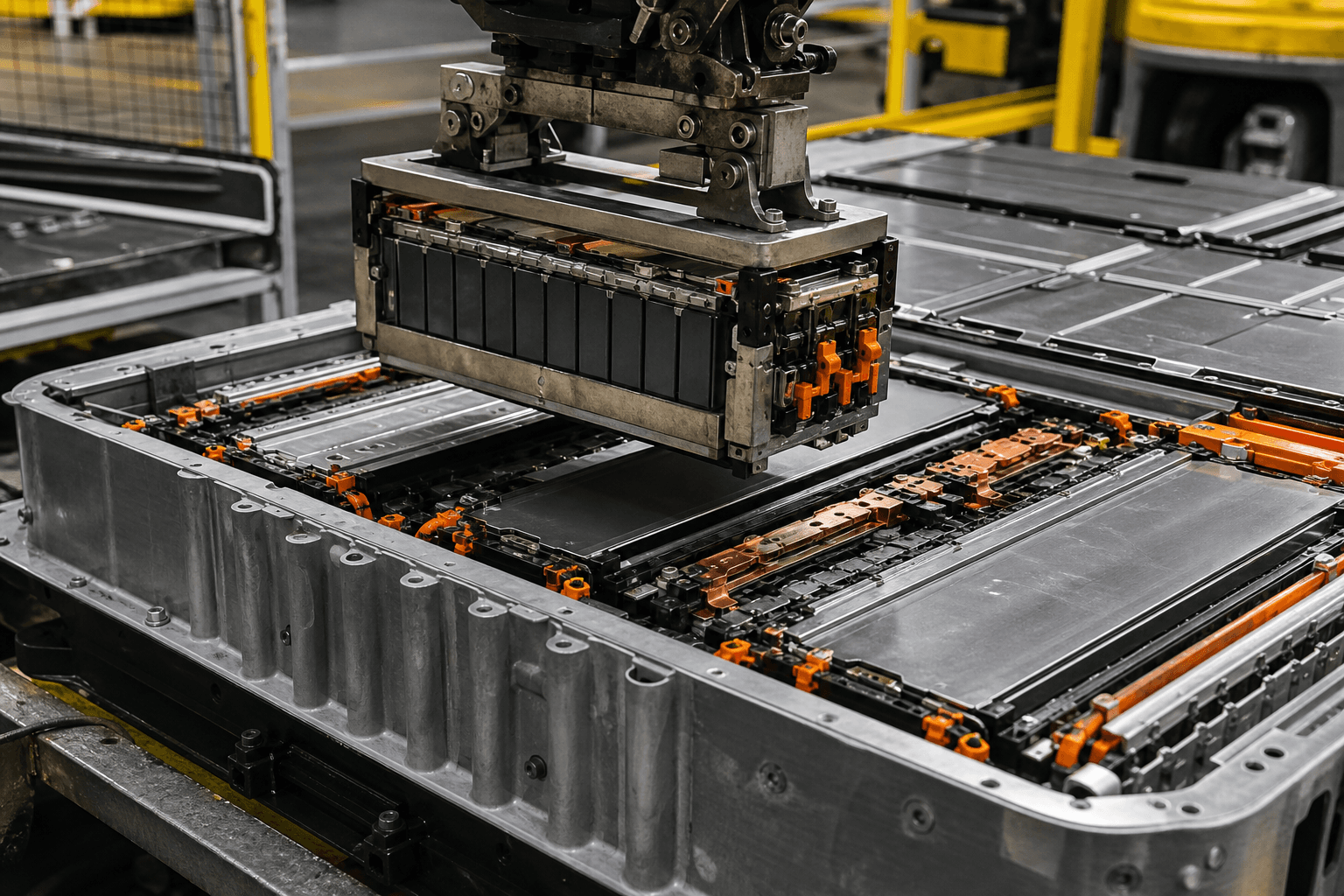
Traction batteries are among the most valuable components of an electric vehicle. When a battery reaches the end of its useful life in a vehicle, that does not automatically make it waste. It is first assessed to determine whether it can be repaired, reused in another vehicle, or deployed as stationary energy storage. The battery is only recycled if these options are not technically or economically viable.
An end-of-life vehicle battery is not useless hazardous waste, but an important source of reusable components and valuable raw materials.
When is an EV battery considered to have reached the end of its useful life?
With increasing use, a lithium-ion battery loses some of its original storage capacity. However, this does not mean that it suddenly fails. Aging usually progresses gradually. A significantly reduced capacity can be problematic in a car because it decreases range and charging performance. The same battery may still be suitable for less demanding applications.
The key measure is the battery’s state of health. Qualified service providers assess factors including remaining capacity, internal resistance, temperature behavior, cell voltages, and stored fault codes. Accident damage, moisture, or unusual temperature events also affect whether the battery can continue to be used.
What paths can an old battery take?
| Option | Requirement | Typical purpose |
|---|---|---|
| Repair | Only individual modules, sensors, or components are defective | Continued use in the vehicle |
| Reuse | The battery is safe and suitable for a compatible vehicle | Replacement or exchange battery |
| Second life | Capacity is no longer sufficient for a car but remains adequate for stationary applications | Storage of solar power or grid electricity |
| Recycling | Continued use is not technically or economically viable | Recovery of metals and other materials |
Second life: Reuse as energy storage
In second-life applications, former vehicle batteries are combined into stationary storage systems. For example, they can temporarily store solar power, reduce peak loads at businesses, or support charging infrastructure. Weight and lower energy density matter less in these applications than they do in a car.
However, second life is not automatically the best solution for every battery. Testing, conversion, certification, and a new battery management system all require resources. Suitable spare parts and condition data must also be available. If a battery has aged very unevenly or is damaged, direct recycling may be the better option.
How recycling works
- Securing and transporting: Trained professionals label, package, and transport the high-voltage battery in accordance with specific safety requirements. Damaged batteries require additional protective measures.
- Diagnosis and discharge: The battery’s condition is documented, and any remaining electrical energy is removed in as controlled a manner as possible. Fully charged or damaged battery → stricter requirements for disassembly and storage.
- Disassembly: The housing, cables, control units, cooling systems, and modules are separated. Aluminum, steel, copper, and electronic components can sometimes be sorted at this stage.
- Shredding and separation: Cells or modules are shredded under controlled conditions. This produces a metal-containing mixture commonly known as black mass.
- Raw material recovery: Chemical or thermal processes separate materials such as lithium, nickel, cobalt, copper, and graphite. After further processing, the recovered materials can re-enter industrial supply chains.
What recycling methods are available?
Pyrometallurgy
In this process, battery components are treated at high temperatures. It is robust and can handle different cell chemistries. However, it requires a great deal of energy. Some materials can only be recovered through additional processing steps.
Hydrometallurgy
In this process, chemical solutions are used to extract metals from previously processed material. It enables the targeted separation of different raw materials. However, it requires careful handling of chemicals, water, and process residues.
Direct recycling
Direct recycling aims to preserve active materials wherever possible and process them for reuse in batteries. This could eliminate energy-intensive separation steps. The method is considered promising, but it imposes strict requirements for sorting, purity, and knowledge of the relevant cell chemistry.
Why is battery recycling important?
Recycling reduces the need for newly mined raw materials and decreases reliance on international supply chains. Lithium, nickel, cobalt, copper, and graphite are particularly important. Which materials are the main economic focus depends on the cell chemistry. Lithium iron phosphate batteries, for example, contain no nickel or cobalt, but can still be recycled for their lithium, copper, aluminum, and other components.
Even so, a fully circular economy will not emerge immediately. New electric vehicles initially increase total material demand, while many of their batteries will not return for recycling until years later. In the long term, however, a growing stock of end-of-life batteries could meet a larger share of raw material demand.
What should vehicle owners keep in mind?
- Never open, disassemble, or discharge high-voltage batteries yourself
- Have damage following an accident, water ingress, or suspected fire professionally assessed
- Arrange returns and replacements through manufacturers, dealers, or qualified service providers
- When buying a used vehicle, request verifiable information about the battery’s condition and any available diagnostic data
For owners, the most important decisions are generally made not at the recycling facility but during diagnosis and repair. A battery designed for modular repair can remain in the vehicle longer. If that is not possible, regulated return channels ensure that the battery is handled safely and reused in the most appropriate way possible.


