The Tesla Mobile Connector is a portable charging cable with a control box and a Type 2 vehicle connector. It can charge a Tesla from different types of electrical outlets, provided the appropriate adapter is available. This makes it particularly suitable as a flexible charging solution while traveling, at a vacation home, or as a backup.
The outlet adapter not only determines the plug type but also tells the Mobile Connector the maximum permissible charging current.
How does the Tesla Mobile Connector work?
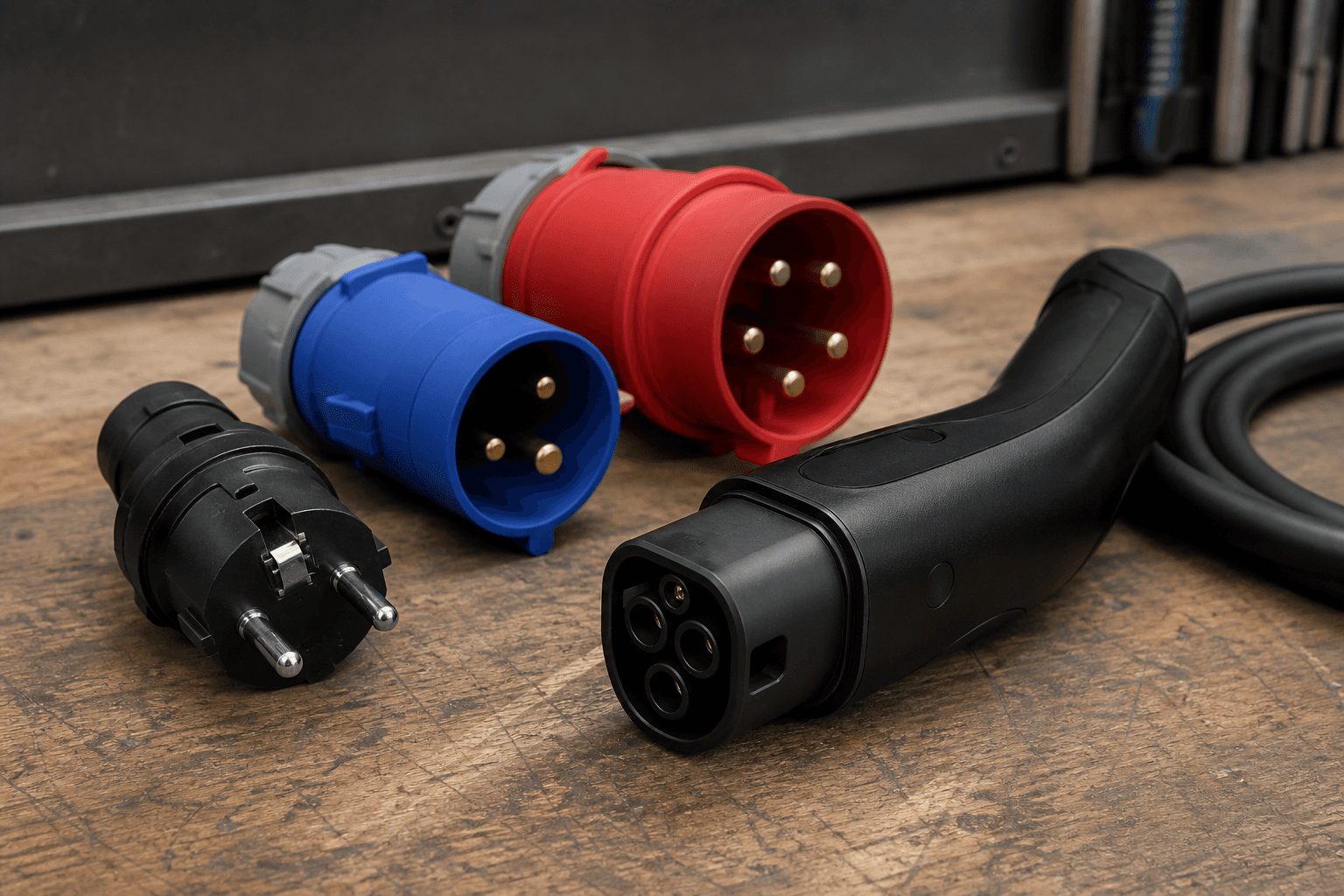
On the vehicle side, the Mobile Connector plugs directly into the charging port. On the power-supply side, it has an interchangeable adapter, depending on the version. This can fit a Schuko outlet—the grounded household socket commonly used in Germany and elsewhere in Europe—or a CEE industrial socket, for example.
The control box handles important safety and communication functions. It only enables charging once the connection has been established correctly. Compatible original adapters also monitor the temperature at the mains plug. If the connection becomes too hot, the device can reduce charging power or stop charging. However, this safety feature cannot compensate for a faulty or undersized household electrical installation.
Schuko, blue CEE, and red CEE compared
| Connection | Typical power | Phases | Best suited for |
|---|---|---|---|
| Schuko | around 2.3 to 3 kW | single-phase | Occasional charging, emergency use, long parking periods |
| Blue CEE, 16 A | up to around 3.7 kW | single-phase | Campsites, workshops, robust continuous connection |
| Red CEE, 16 A | up to around 11 kW | three-phase | Faster AC charging from suitable industrial connections |
The power actually available depends on the Mobile Connector generation, the adapter used, the vehicle, and the electrical installation. Not every adapter is available or approved for every device version. The part number or device generation should therefore be checked, especially when buying a used Mobile Connector.
Schuko: flexible, but with limited capacity
Schuko outlets are available almost everywhere. However, they were not primarily designed to supply high continuous loads for many hours. Old contacts, loose terminals, or corroded outlets can become very hot during charging.
A Schuko outlet may be sufficient for occasional charging if it is in perfect technical condition and the circuit has suitable protection. If the plug or outlet becomes unusually warm, charging should be stopped and the installation inspected. If necessary, the charging current can be reduced in the vehicle: lower current → less thermal stress, but also a longer charging time.
Blue CEE: a more robust single-phase connection
The blue CEE socket is often referred to as a camping socket. It has more robust contacts than Schuko, is better protected against accidental disconnection, and is designed for a defined continuous load. At 16 A, it can provide up to around 3.7 kW on a single phase.
Blue CEE is useful for regular portable charging when no three-phase connection is available. A professionally installed circuit with suitable protection remains essential.
Red CEE: three-phase charging
Red CEE sockets are common in workshops, garages, and agricultural facilities. A 16 A connection can provide up to around 11 kW across three phases. Whether the Mobile Connector actually uses this power depends on its version and the adapter.
A 32 A red CEE socket does not automatically mean that the Mobile Connector can charge at 22 kW. The device limits the current according to its technical specifications. Adapter combinations that merely change the plug type without ensuring correct current limitation are unsuitable.
Which adapter fits?
Tesla has offered different generations and regional versions of the Mobile Connector. Their adapters are therefore not universally interchangeable. The following points should be checked before purchase:
- Mobile Connector generation and part number
- Adapter approval for the specific device
- Local outlet type, number of phases, and circuit protection
- Vehicle’s maximum AC charging power
Adapters specified by the manufacturer are the safest option. Basic travel adapters, homemade converters, or multiple adapters connected in series can overheat and bypass the safety system.
Safe charging: practical steps
- Inspect the outlet, plug, and cable for damage, moisture, and discoloration.
- Connect the appropriate adapter fully to the Mobile Connector.
- Plug the mains plug directly into the wall outlet and avoid using an extension cable wherever possible.
- Connect the Mobile Connector to the vehicle and check the displayed charging current.
- When using the connection for the first time, check the plug and outlet for unusual heat after a short period.
For regular charging in the same parking space, a wallbox is generally more convenient and better suited to long-term use. The Mobile Connector is particularly useful when several connection types are needed or a portable backup is required. A qualified electrician should inspect new or unfamiliar CEE and Schuko connections before they are used regularly for charging.