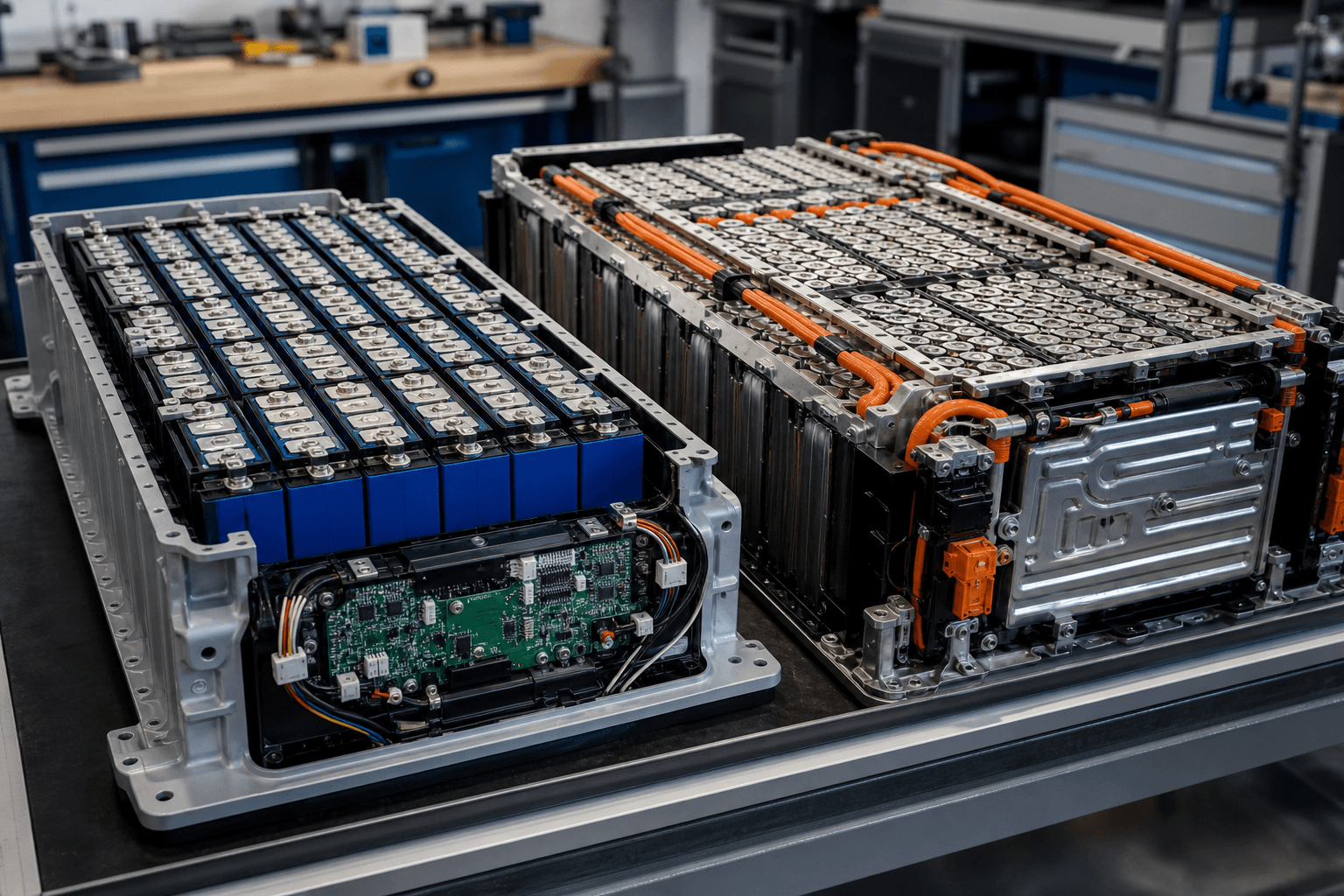
In an electric car, battery size is not the only factor determining range, charging behavior, and longevity. Cell chemistry also plays an important role. NCM batteries and LFP batteries are particularly common. Both store energy using lithium ions, but they differ in the material used for the positive electrode, known as the cathode.
No cell chemistry is inherently better: NCM is particularly suitable for long ranges where installation space is limited, while LFP is ideal for robust, long-lasting batteries for everyday use.
What Do NCM and LFP Mean?
NCM stands for nickel, cobalt, and manganese. The ratio of these metals can vary depending on the cell generation. A higher nickel content generally enables high energy density, but also places greater demands on cell management and cooling.
LFP stands for lithium iron phosphate. This chemistry does not use nickel or cobalt in the cathode. Its stable material structure makes it resistant to high states of charge and thermal stress. However, LFP cells generally store less energy for the same weight and volume.
NCM and LFP Compared Directly
| Feature | NCM | LFP |
|---|---|---|
| Energy density | Higher, providing more range within the same installation space | Lower, making the battery larger or heavier for the same amount of energy |
| Service life | Good, but more sensitive to remaining at a high state of charge for extended periods | Generally offers a longer cycle life and is well suited to everyday use involving frequent full charges |
| Cold-weather performance | Generally better | Greater reductions in performance and charging speed are possible |
| Thermal stability | Requires particularly careful temperature management | More chemically stable and less susceptible to thermal runaway |
| Raw materials | Requires nickel and usually cobalt | Uses no nickel or cobalt in the cathode |
| Typical use | Long-range and performance-oriented vehicles | Budget-focused models, everyday cars, and fleet vehicles |
Advantages and Disadvantages of NCM Batteries
High energy density is NCM’s most important advantage. Manufacturers can fit a large amount of energy into a comparatively compact and lightweight battery pack. This is useful when a vehicle needs to offer a long range without the battery becoming excessively large. NCM cells also often perform better than LFP cells at low temperatures.
In everyday use, however, NCM requires more careful management of high states of charge. Many manufacturers recommend not keeping the battery at 100% continuously for daily driving. It can, of course, be fully charged for longer journeys, but should then ideally be used promptly. The specific charging recommendation in the vehicle manual takes precedence.
Nickel and cobalt also place greater demands on supply chains and raw-material extraction. At the same time, these metals have comparatively high economic value when recycled. With suitable battery and temperature management, modern NCM batteries can also achieve long service lives.
Advantages and Disadvantages of LFP Batteries
LFP cells are considered robust, durable over many charge cycles, and thermally stable. Frequent charging to a high state of charge generally puts less strain on them than on NCM cells. Some manufacturers even recommend charging to 100% regularly so that the battery management system can reliably determine the state of charge. Here too, the manufacturer’s instructions remain decisive.
Avoiding nickel and cobalt can reduce material costs and mitigate certain raw-material sourcing issues. Nevertheless, LFP is not environmentally neutral: these batteries also require lithium, graphite, energy, and complex production processes, among other things. Economically viable recycling can be more challenging because they contain fewer valuable cathode metals.
The biggest disadvantage is lower energy density. At the same capacity, an LFP pack may require more space and be heavier. Internal resistance also rises significantly in cold conditions. Cold battery → lower charging power and limited regenerative braking. Effective battery heating and preconditioning before fast charging are therefore particularly important.
Which Cell Chemistry Suits Which Driving Profile?
NCM is often a good choice if …
- long highway range is important,
- weight and installation space need to be kept to a minimum,
- the vehicle is regularly used at low temperatures.
LFP is often a good choice if …
- the car is used mainly for everyday driving and predictable journeys,
- frequent charging to a high state of charge is convenient,
- longevity, robustness, and a lower vehicle price are priorities.
What Else Buyers Should Consider
Cell chemistry alone does not allow a definitive assessment of a battery. Cooling, heating, battery management, cell quality, and the usable energy buffer all have a significant influence on longevity and charging performance. Before purchasing, real-world winter range, the charging curve, preconditioning, and warranty terms are therefore more important than a single abbreviation in the specification sheet.
Drivers who cover short to medium distances each day and can charge conveniently at home will often find LFP a straightforward solution. NCM may be more suitable for maximum range, low battery weight, or frequent long-distance travel. The vehicle as a whole is what matters, not just the chemistry of its cells.