BYD Is Apparently Building a Huge Fleet of Car Carriers
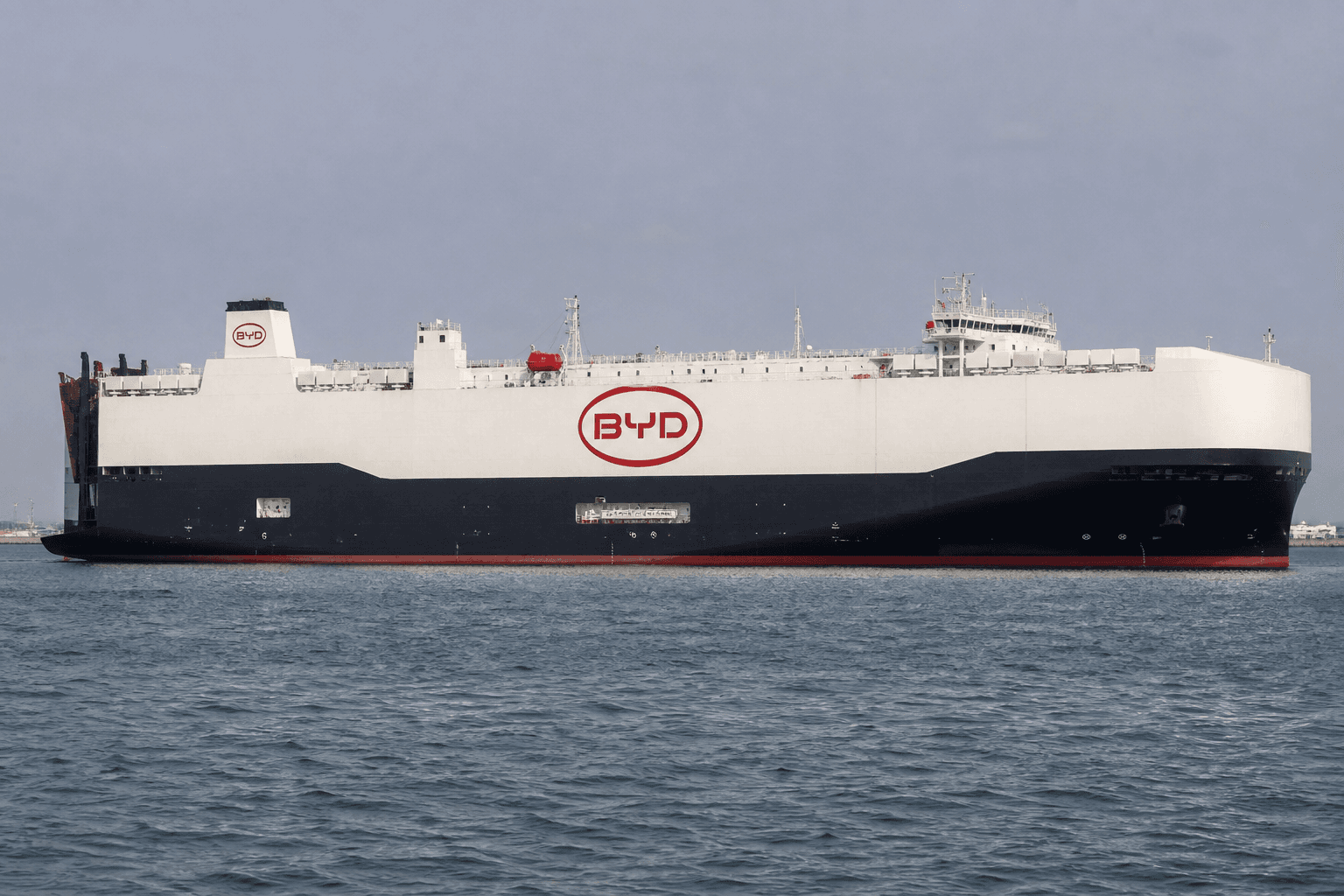
BYD is apparently expanding internationally on the water as well. According to reports from the shipping industry, the Chinese manufacturer has ordered ten new car carriers, each with a capacity of 9,200 CEU.
Neither BYD nor the shipyard commissioned to build them has officially confirmed the order so far. The order value is also unknown. The ships are reportedly scheduled for delivery by two Chinese shipyards between 2027 and 2029.
If the order proceeds as reported, BYD’s own transport fleet will grow from eight to 18 ships.
More Than 130,000 Cars Theoretically Possible per Sailing
CEU stands for Car Equivalent Unit and describes the standardized space occupied by an average passenger car. The actual number of vehicles can vary depending on their dimensions and the cargo mix, for example when large SUVs or commercial vehicles are on board.
Together, the ten additional carriers would provide 92,000 CEU. This would give the entire BYD fleet a nominal capacity of more than 130,000 CEU.
| Fleet segment | Ships | Capacity |
|---|---|---|
| Existing fleet | 8 | 7,200 or 9,000 CEU per ship |
| Reported new order | 10 | 9,200 CEU per ship |
| Potential total fleet | 18 | More than 130,000 CEU |
These figures describe capacity per full load, not annual transport volume. Industry calculations suggest that 18 ships could theoretically transport up to 2.5 million vehicles per year. However, route length, time spent in port, utilization, and maintenance periods would be decisive factors.
RoRo Ships Speed Up Vehicle Logistics
The new vessels are expected to be so-called Pure Car and Truck Carriers. These roll-on/roll-off, or RoRo, ships are designed specifically for wheeled cargo: vehicles are driven aboard via ramps and do not require containers.
BYD built its first fleet of eight car carriers in less than two years. The first ship began operating in early 2024, followed by the eighth in September 2025. Depending on the vessel type, the existing carriers have space for 7,200 or 9,000 CEU.
Having its own fleet gives BYD greater control over schedules, costs, and available capacity. High demand → additional ships can be deployed more strategically to key export markets. This can make delivery times more consistent, but does not in itself guarantee lower vehicle prices.
Exports Are Becoming Increasingly Important for BYD
In August 2026, BYD exported around 184,000 passenger cars from China. That was 131% more than in the same month of the previous year and 6% more than in July. BYD accounted for 35.4% of Chinese NEV exports, meaning new energy vehicles such as battery-electric cars and plug-in hybrids.
From January through August, exports totaled 1.127 million vehicles, an increase of 88%. At the same time, the core brand’s business in its domestic Chinese market came under pressure. Around 184,000 cars were also sold there in August, but that was 35% fewer than a year earlier.
The strong export focus is in line with the broader growth of the European electric-car market. Having its own transport capacity helps BYD ship vehicles to Europe and other regions more regularly without having to rely entirely on external shipping companies.
What the Car Carriers Mean for Europe
BYD does not use its ships exclusively for vehicles from Chinese factories. In September 2025, one carrier transported right-hand-drive vehicles from BYD’s Thai factory to the United Kingdom for the first time. This means the fleet could also integrate production sites outside China into the global distribution network in the future.
For the EU, the country of production is what matters, not the port of departure. Battery-electric BYD models of Chinese origin are subject to a 17% countervailing duty in addition to the standard 10% import tariff. Vehicles from other countries are assessed according to their actual origin.
More ships could nevertheless improve availability in Germany, Austria, and Switzerland. Together with regional price promotions such as the BYD E-Bonus promotion in Germany, the fleet expansion shows how consistently the manufacturer intends to strengthen its international presence.
A Major Step, but Not Yet Officially Confirmed
The reported order would represent an unusually large expansion within a short period. BYD would thus operate not only as a car manufacturer but would also control a significant part of its global logistics itself.
Until an official announcement is made, however, the delivery dates, order volume, and technical details of the ships remain preliminary. Nevertheless, the export figures and the existing eight-ship fleet make the strategic rationale behind the potential order plausible.