Audi A2 e-tron prioritizes efficiency over battery size
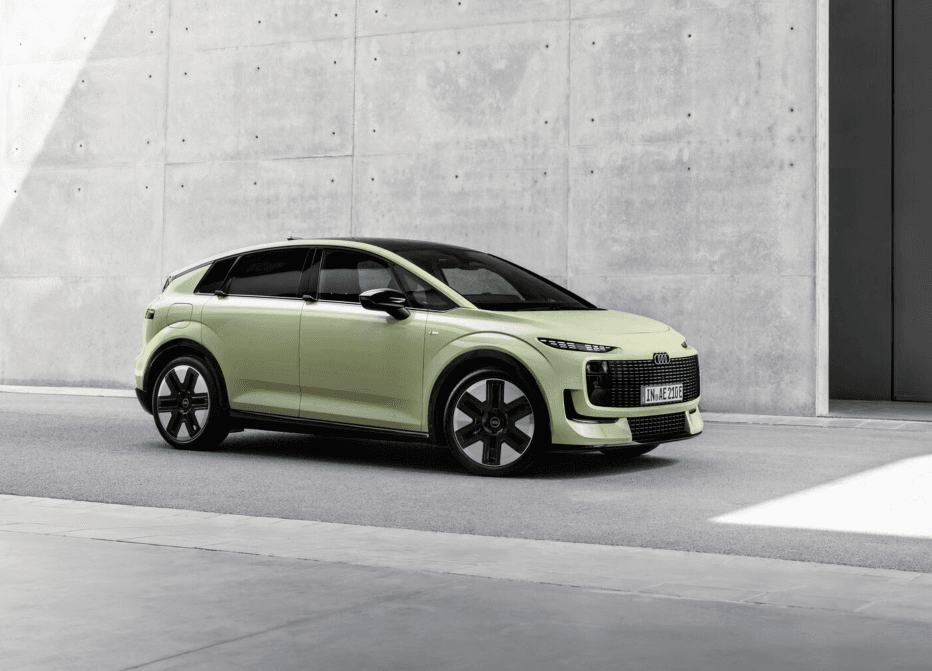
Audi is bringing back the A2 name and pairing it exclusively with an electric powertrain. The new Audi A2 e-tron is expected to deliver up to 646 km of WLTP range and consume just 12.8 kWh per 100 km in its most efficient configuration.
That would make the compact EV the most energy-efficient production model in Audi’s history. Orders open on September 10, 2026, with the first deliveries scheduled to begin in December. The starting price in Germany is €38,200.
The model plays an important role in Audi’s recently rather limited electric vehicle plans. Instead of maximum performance and ever-larger batteries, the focus is on low energy consumption, compact dimensions and flexible everyday use.
Key specifications of the Audi A2 e-tron
| Specification | Figure |
|---|---|
| Power | 125 to 240 kW |
| Torque | up to 545 Nm |
| Gross battery capacity | 52, 61 or 84 kWh |
| Maximum range | up to 646 km under WLTP |
| Lowest energy consumption | 12.8 kWh per 100 km under WLTP |
| Drivetrain | rear-wheel drive with a permanent-magnet synchronous motor |
| Drag coefficient | Cd 0.24 |
| Wheelbase | 2.77 m |
| Price in Germany | from €38,200 |
| Market launch | December 2026 |
An important point for context: the maximum range, lowest energy consumption and starting price do not necessarily apply to the same configuration. The 140 kW version with the optional efficiency package achieves the best consumption figure, while the 84 kWh battery is likely to be crucial for maximum range.
Four power levels and three battery sizes
The range starts at 125 kW and 350 Nm. At the top end, 240 kW and 545 Nm are available. Audi positions additional power variants between them, including the particularly efficient 140 kW version.
Depending on the powertrain, the vehicle uses a battery with a gross capacity of 52, 61 or 84 kWh. This structure allows Audi to offer a broad spectrum ranging from an affordable city car and an efficient commuter vehicle to a compact model suitable for long-distance travel.
Four regenerative braking levels and a genuine one-pedal driving mode help recover energy selectively in everyday use. However, details of the maximum DC charging power and specific charging times are not yet available. These figures will be particularly important in determining the long-distance capability of the large-battery version.
12.8 kWh consumption through a consistent focus on aerodynamics
The low WLTP energy consumption is not the result of a single measure. Audi combines a Cd value of 0.24 with a largely enclosed underbody, an adjustable cooling-air intake and special aerodynamic wheels.
Additional air-guiding elements reduce aerodynamically problematic areas between the wheels and wheel arches. Electric, wing-shaped door handles sit flush with the body. An integrated energy storage unit is intended to allow the doors to be opened even if the vehicle’s electrical system fails.
The A2 e-tron follows a sensible principle: less drag and lower energy consumption → more range without an unnecessarily large battery.
That is particularly attractive to European drivers. An efficient vehicle not only reduces electricity costs but also needs less energy from the same charging station for the next leg of a journey.
V2L and V2H make the battery more versatile
The Audi A2 e-tron optionally supports bidirectional charging. Vehicle-to-Load, or V2L, allows the high-voltage battery to power external devices. These could include e-bikes, tools or camping equipment connected via an outlet in the trunk or an adapter at the charging port.
A comparable feature is also an important topic for the Tesla Model Y’s V2L system. For the DACH region—Germany, Austria and Switzerland—Audi goes one step further and also announces Vehicle-to-Home functionality.
With a suitable DC wallbox, the A2 e-tron can feed energy back into a home’s electrical system in Germany, Austria and Switzerland. This allows the electric car to temporarily serve as stationary storage, similar to the new solutions for bidirectional charging from Hyundai and Kia. Whether V2H makes financial sense depends on the wallbox, electricity tariff, solar installation and applicable regulatory requirements.
Digital cockpit and flexible interior
In the cockpit, Audi combines an 11.9-inch instrument display with a 12.8-inch touchscreen in a curved panoramic display. The digital assistant uses AI features, while the e-tron route planner incorporates charging stops into navigation.
Standard equipment includes adaptive cruise control, emergency braking, evasive steering and driver attention assistants, as well as parking assistance and a reversing camera. An optional panoramic glass roof measuring 1.6 m² is intended to make the cabin feel even more spacious.
For flexible storage, Audi includes a magnetic Fidlock system as standard. Cupholders, charging-cable bags and other modules can therefore be attached or removed in a few simple steps. More than 300 vehicle components also contain recycled materials, including steel, aluminum and plastics.
Production in Ingolstadt saves time and resources
The A2 e-tron will be built at Audi’s main plant in Ingolstadt. The manufacturer will continue using more than 1,200 existing production components and around 250 robots. This reduces the need for new equipment and therefore lowers investment and resource consumption.
Development was also streamlined. Audi says it brought the entry-level electric model to production readiness 21 months faster than comparable previous models. A predefined sequence for customer orders is also intended to reduce inventory and production complexity.
Market launch assessment
With a base price of €38,200, the Audi A2 e-tron sits well above affordable electric small cars but remains attractively positioned for a premium model. Its low energy consumption, choice of three batteries and V2H functionality in particular could set it apart from conventional compact EVs.
A final assessment will have to wait for the complete price list, usable battery capacities, charging power and charging curve. Nevertheless, the technical concept appears coherent: the A2 e-tron aims to achieve range primarily through efficiency rather than mass.