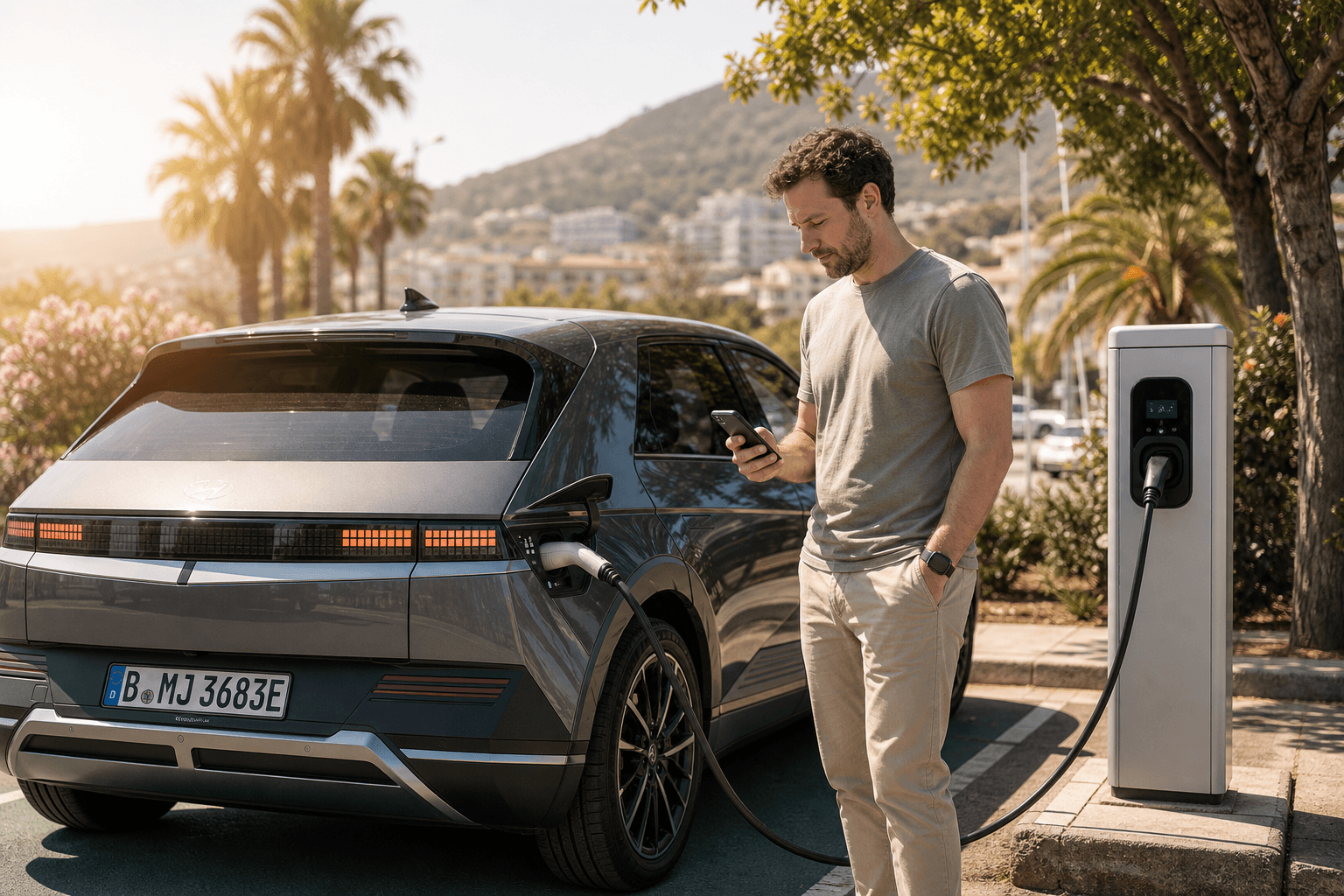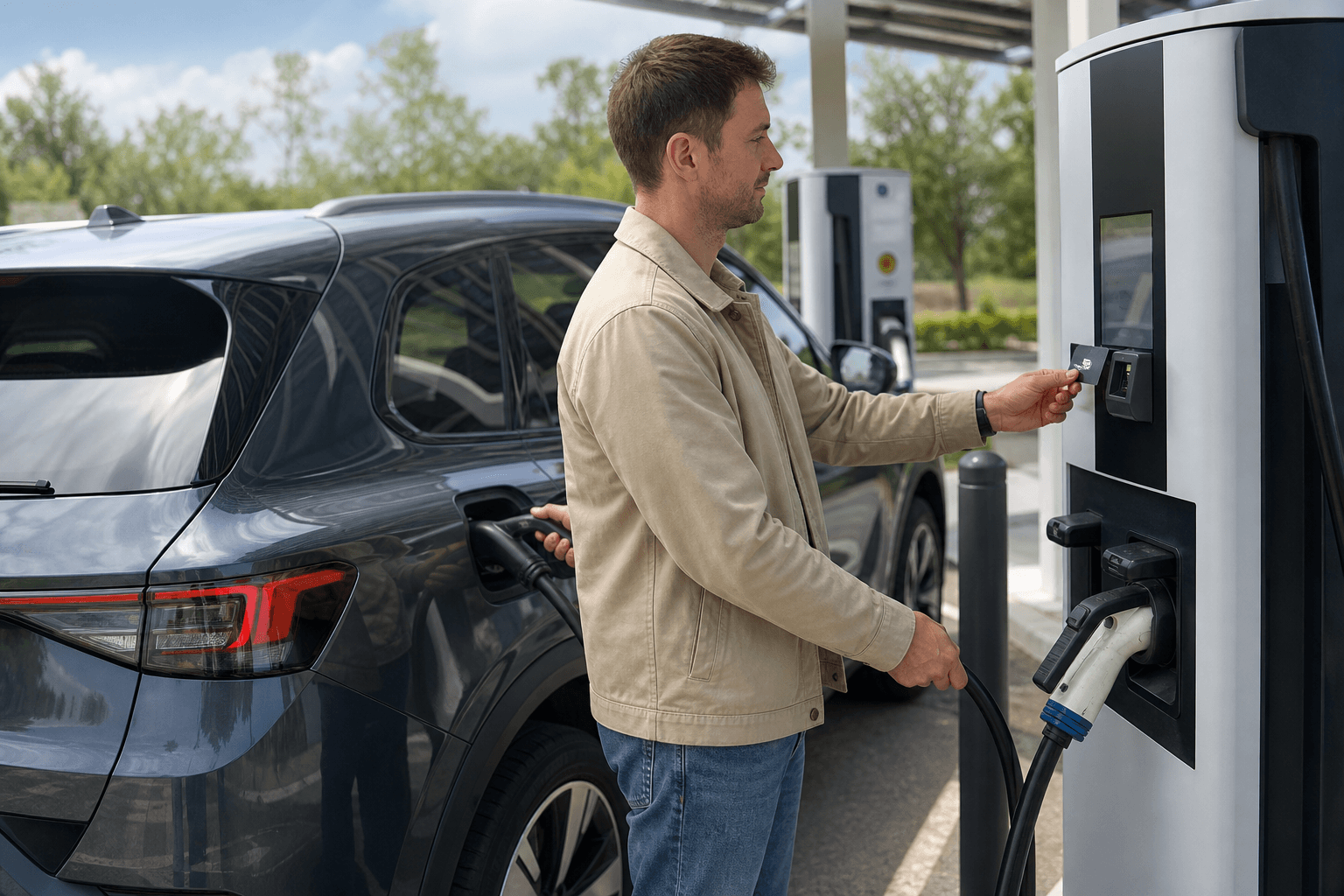
If you only charge at public stations occasionally or are driving someone else’s electric car, you do not necessarily need a charging card or subscription. With ad hoc charging, each charging session is paid for directly, usually by credit card. Depending on the station, payment is made via a card terminal or a mobile payment page opened using a QR code.
Ad hoc charging means no prior charging contract, no membership and generally no mandatory app.
How does paying by credit card work?
There are two common methods. Modern fast-charging stations often have a contactless card terminal. At other stations, a QR code directs users to the operator’s payment page. Card details are entered there or transmitted via a digital wallet.
| Method | Process | Special requirement |
|---|---|---|
| Card terminal | Hold the card or smartphone against the terminal | Fast, with no need to enter card details |
| QR code and website | Scan the code, select the charging point and pay online | Mobile reception and a browser required |
Not every charging station supports every credit card. Contactless debit cards and smartphone wallets may also work, provided they are accepted by the payment system shown. Check the logos on the terminal or payment page.
Ad hoc charging step by step
- Check the charging point: Check the connector, charging power and station labeling. If there are several connectors, make sure you select the correct charging point number.
- Review the price: Before authorizing payment, the energy price and any time-based, session or overstay fees should be displayed.
- Select a payment method: Hold your credit card against the terminal or use the QR code to open the official payment page.
- Authorize the charging session: The payment provider may initially place a hold on your card. The charging point will then be activated.
- Connect the vehicle: Plug in the cable unless this was already required for authorization. The order may vary by operator.
- End the charging session: Stop the session at the station, via the website or using the same card. Then disconnect the cable.
- Save the receipt: Download the receipt immediately or note the transaction ID if the operator provides the receipt later.
Why is an amount reserved on the credit card?
At the start, the payment provider does not yet know how much energy will be delivered. It therefore often places a temporary hold on a set amount as security. After charging, only the actual invoice amount is charged and the remaining hold is released. Depending on the bank, it may take some time for the release to appear in the card account.
A hold does not automatically mean you have been charged twice. However, if several finalized charges remain, document the charging receipt, time, charging point number and card statement, and report them to the operator.
How to check the cost before starting
The ad hoc price may differ from the rate under a charging service contract. You should therefore compare more than just the energy price. Some providers also charge by time or impose an overstay fee after a certain parking period. Slow charging while a time-based fee continues to apply → higher total costs.
The binding price should appear on the display or payment page before payment is authorized. If no clear price is shown, choosing another charging point is the safer option. Always check current rates directly with the operator, as they may change.
Paying securely and spotting manipulated QR codes
QR codes on publicly accessible charging stations can be covered with fraudulent stickers. Check whether the sticker appears damaged or whether a second code has been placed over it. The web address that opens should clearly belong to the operator or its payment provider and use an encrypted connection.
- Do not install an app from an unknown source
- Do not enter your card PIN on a standard website
- If in doubt, access the web address manually via the operator’s website
- Whenever possible, use contactless payment at the station’s fixed terminal
What should you do if charging does not start?
First check that you selected the correct connector and that the plug is fully engaged. Properly end any failed session before trying again. If that does not help, another charging point at the same station may work.
If a payment hold has been placed but no electricity was delivered, contact the operator’s hotline. The telephone number is usually displayed on the charging station. Providing the charging point number, time and error message will help speed up the process. The bank is primarily the appropriate contact if the operator cannot resolve a charge or if the card needs to be blocked for security reasons.
Who is ad hoc charging suitable for?
Direct credit card payment is particularly convenient for occasional long-distance journeys, rental cars, international travel and drivers without a regular charging plan. Anyone who regularly uses public charging should also compare plans from different providers. A contract may be less expensive, while ad hoc charging offers greater flexibility. Keeping a physical credit card in the vehicle is a useful backup, even if you normally use a smartphone or charging card.