Mercedes EQA in Everyday Use: What the ADAC Test Really Shows
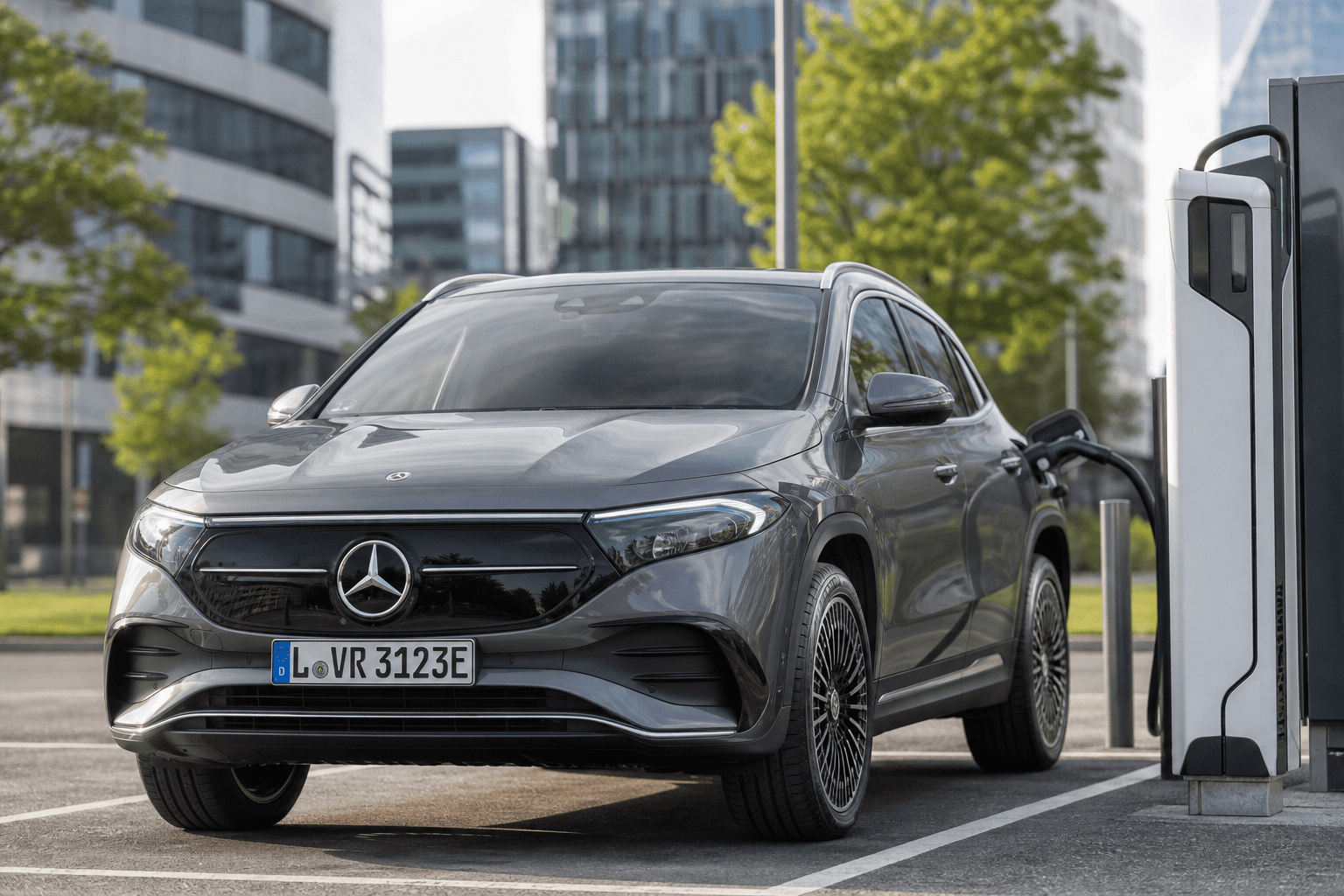
The Mercedes EQA has been Mercedes’ entry-level electric model since 2021 and is essentially the electric version of the GLA. This is evident on the outside (the typical black panel at the front and light bar at the rear), but above all in the body, which remains practically identical. That is not necessarily a disadvantage for buyers: Anyone who likes the GLA’s shape and seating position gets them here with an electric powertrain.
ADAC, Germany’s largest automobile club, has tested the EQA extensively, providing a useful real-world view of its range, energy consumption and charging. Context is important here: WLTP figures are intended for comparison, while the more relevant everyday questions are how far the car actually travels, how quickly it can recharge and how pleasant the overall package is to use on long journeys.
Real-World Range: 350 km Is Achievable, but Not Always
The EQA 250 tested has a battery with 66.5 kWh of net usable capacity. Depending on the version and production period, Mercedes quotes significantly higher WLTP ranges, but the ADAC Ecotest recorded around 350 km under realistic conditions. That is entirely practical for everyday use in a compact SUV, especially for commuting, city driving and mixed routes.
The range varies in typical EV fashion: According to ADAC, 400 km or more is possible in urban driving or at a relaxed pace on country roads. On the highway and in winter, however, the figure drops noticeably because higher speeds and heating consume energy. If you generally drive many long distances, it is worth looking at models that perform particularly well in highway efficiency tests, such as those in our article on the 2026 highway consumption test.
Mercedes also offers versions with a larger battery (EQA 250+) that are intended to increase the WLTP range noticeably. In everyday use, this primarily means fewer charging stops, not necessarily much shorter charging times, as charging power is limited.
Energy Consumption: The EQA Prioritizes Comfort Over Efficiency
In the Ecotest, ADAC measured average energy consumption of 21.6 kWh/100 km, including charging losses. Broken down by driving environment, it used around 18.1 kWh/100 km in urban driving, 22.7 kWh/100 km outside urban areas and approximately 23.8 kWh/100 km on the highway at speeds of up to 130 km/h. That is not disastrous, but it is not a leading figure compared with particularly efficient electric SUVs.
On the positive side, a heat pump is fitted as standard and helps provide cabin heating more efficiently in winter. There is also an automatic regenerative-braking assistant that adjusts deceleration according to the route, speed limit or traffic. In everyday use, this is more than just a nice-to-have, as it makes driving smoother and reduces stress.
Performance and Driving Experience: Confident, With a Few Drawbacks
The front-wheel-drive EQA 250 delivers 140 kW and 385 Nm. Depending on the quoted figure, it accelerates to 100 km/h in around 8.6 to 8.9 seconds, while top speed is limited to 160 km/h. More important in everyday use than the standard acceleration run is mid-range performance: According to ADAC, the EQA takes 4.6 seconds to accelerate from 60 to 100 km/h and just under 6 seconds from 80 to 120 km/h. That makes it feel sufficiently powerful when overtaking.
The drive modes range from Eco to Sport. Eco saves energy, but the very light steering can feel somewhat numb. Drivers wanting greater precision can adjust the steering separately to make it firmer. ADAC recorded an average braking distance of 38.1 m from 100 km/h to a standstill, which is now merely “okay,” although braking performance remains consistent even under heavier loads.
Charging: 100 kW DC Is Fine, but Not State of the Art
Mercedes quotes a maximum of 100 kW DC for rapid charging. The ADAC test occasionally observed just over 110 kW, slightly more than the official figure. In practice, the charging time matters most: Under suitable conditions, the battery is said to reach 80% in 30 minutes. That is respectable, but below what modern 800-volt systems or particularly well-optimized 400-volt models can sometimes achieve. If you are interested in the subject more generally, see our 800V vs. 400V comparison.
On AC power, the EQA charges at 11 kW. That is useful for everyday charging at a wallbox or curbside charger, but it does not set any records. Under ideal conditions, Mercedes quotes around seven hours for a full AC charge from empty; as always, the actual time depends on the temperature, target charge level and preconditioning.
Important on long journeys: The navigation system’s route planner can factor in charging stops and charging times. In everyday use, that is often the difference between “driving an EV is hard work” and “it just works.” Tesla is known for integrating charging planning very seamlessly, particularly in combination with its Supercharger network. Those wishing to compare can find specifications and variants of the Tesla Model Y in our database.
Interior and Space: Lots of GLA, Good Build Quality, Sometimes Fiddly Controls
Inside, the EQA adopts the familiar GLA layout: two 10.25-inch displays in a freestanding housing, plus the MBUX system with voice control. The appearance and perceived material quality are appropriate for this class. From ADAC’s perspective, one criticism is the use of touch-sensitive controls on the steering wheel and the touchpad, as they can cause drivers to look away from the road for longer in everyday use. Dedicated buttons for navigation and media, along with a conventional volume control, are practical by comparison.
The front feels spacious, with enough room even for taller occupants. In the rear, headroom becomes tighter for people taller than around 1.90 m, while the raised floor due to the battery results in more sharply angled legs. Mercedes quotes luggage capacity of 340 to 1,320 liters; using ADAC’s measurement method, the figures are 290 to 1,220 liters, which is fairly average.
Pricing and Positioning: Premium Entry Point Without Subsidies
According to the figures cited, the EQA currently costs between €50,777 and €56,424, depending on the version. The previous subsidy framework, which made many models considerably more attractive at entry level, is no longer relevant. This clearly positions the EQA as a premium offering in the fiercely competitive compact electric SUV segment.
There are many alternatives, including models from the Volkswagen Group and Tesla. Those wishing to compare can also find specifications for the VW ID.4 and ID.5 on our site.
Key Figures From the ADAC Test (EQA 250)
| Metric | Value |
|---|---|
| Battery (net usable capacity) | 66.5 kWh |
| Real-world range (ADAC Ecotest) | around 350 km |
| Total consumption incl. charging losses (ADAC Ecotest) | 21.6 kWh/100 km |
| DC charging (manufacturer figure) | 100 kW |
| AC charging | 11 kW |
| 0 to 100 km/h | 8.6 to 8.9 seconds |
| Braking distance from 100 km/h (ADAC) | 38.1 m |
The EQA impresses as a comfortable premium SUV with practical real-world range, but leaves noticeable room for improvement in efficiency and charging performance.