Voyah Dream 9 Targets China’s Premium Van Market
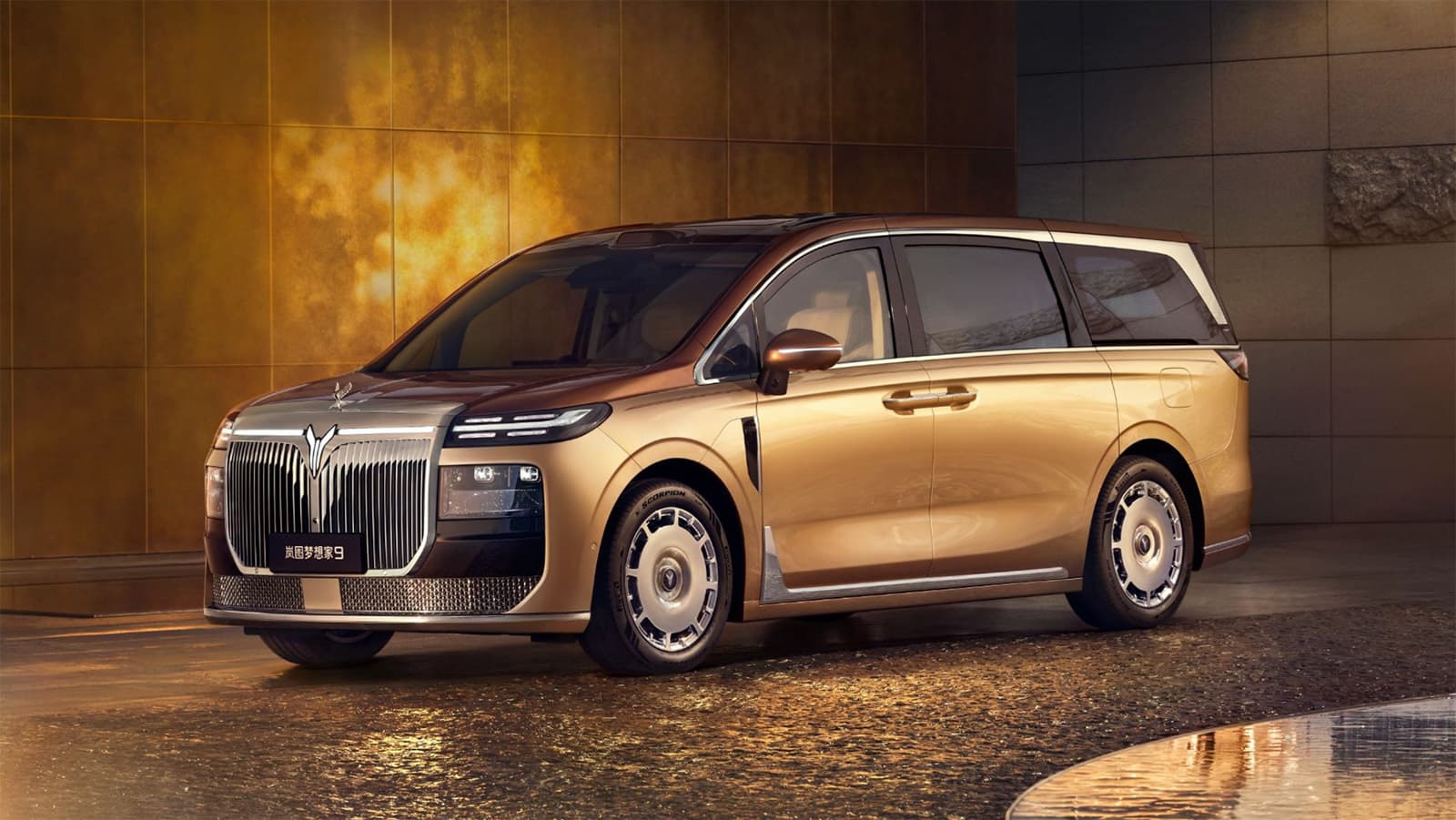
Voyah has opened pre-orders for the Dream 9 in China. The 5.33-meter luxury van is available in three plug-in hybrid and two fully electric versions. Prices start at 429,900 yuan and rise to 529,900 yuan; there is no official price list in euros.
Depending on the version, customers who pre-order receive benefits worth up to 50,000 yuan. Vehicles are already available for viewing and test drives at Chinese dealerships, although a date for the regular market launch has not yet been set.
With its 800-volt platform, large battery, and Huawei technology, the Dream 9 combines traditional luxury-van qualities with an unusually extensive technology package.
BEV and Plug-in Hybrid Technology Compared
All five versions are based on an 800-volt architecture. Our comparison of 800-volt and 400-volt electric-car architectures explains the potential charging and efficiency benefits of the higher voltage.
| Feature | Plug-in hybrid | Electric version |
|---|---|---|
| Powertrain | 1.5-liter turbocharged gasoline engine and two electric motors | Two electric motors |
| Output | 555 kW total system output | 175 kW at the front and 300 kW at the rear |
| Battery | 65 kWh | 120 kWh |
| Charging technology | 800 volts, up to 5C | 800 volts |
| Versions | 3 | 2 |
The plug-in hybrid’s 65 kWh battery is particularly striking. According to Voyah, it can charge from 20% to 80% in 12 minutes. The company did not announce an electric range when pre-orders opened.
The fully electric version receives a 120 kWh battery, which Voyah describes as the largest battery currently fitted to an MPV. However, figures for range, energy consumption, and maximum DC charging power are still missing, making a reliable assessment of everyday usability impossible.
Four LiDAR Sensors and Huawei ADS 5
For its driver-assistance system, the Dongfeng subsidiary uses Huawei Qiankun ADS 5. A total of 37 sensors monitor the vehicle’s surroundings, including a central 896-channel LiDAR and three additional solid-state LiDAR sensors. They are intended to support driving functions in cities, on highways, and when parking.
According to the manufacturer, the electrical and electronic architecture is fundamentally designed for Level 3 automated driving. However, this does not mean that the Dream 9 is already approved as a Level 3 vehicle everywhere. Approval always depends on the software version, market, and local regulations.
Inside, Huawei HarmonySpace 6 operates with the MoLA 2.0 architecture and a multimodal language model. The system is intended to process speech, vehicle information, and other inputs together, although practical tests of its usability have yet to be conducted.
Rear-Wheel Steering for Greater Maneuverability
The Dream 9 measures 5,325 mm long and 1,998 mm wide, with a wheelbase of 3,200 mm. This places it firmly in the luxury segment, and it is larger than many passenger vans sold in Europe.
Rear-wheel steering with an angle of up to 10 degrees is intended to make maneuvering easier. It is joined by three-chamber air suspension, electronically controlled dampers, and a central vehicle-dynamics controller that coordinates the powertrain, brakes, and suspension. Especially in a vehicle of this size, rear-wheel steering can make a noticeable difference in parking garages.
The three-row cabin features rotating second-row seats that can also slide sideways. A relaxation mode and mechanical massage function reinforce its positioning as a comfortable business shuttle.
Projection Lighting Meets Striking Luxury Design
Among the more unusual details are a retractable illuminated hood ornament and Huawei XPixel headlights. These can project navigation arrows and warning symbols onto the road, among other information. Whether such functions could later be offered in Europe would depend on the relevant approval requirements.
In the DACH region—Germany, Austria, and Switzerland—the Dream 9 would enter a still relatively small market for electric premium vans. Upcoming alternatives include the Mercedes VLE with up to eight seats. However, the manufacturer has not yet confirmed a European launch for the Voyah Dream 9.
Dream 9 Aims to Strengthen Voyah’s Profitability
For Voyah, the upmarket van is more than just a technology showcase. The brand increased its revenue by 42.4% to 18.16 billion yuan in the first half of the year, while deliveries rose by 35.9% to 76,264 vehicles.
At the same time, its gross margin fell to 17.7%, and the company recorded a net loss of 389 million yuan. A high-margin luxury model such as the Dream 9 is therefore intended to improve the brand’s model mix. Whether it succeeds will depend not only on its technology but, above all, on demand in China’s fiercely competitive premium segment.