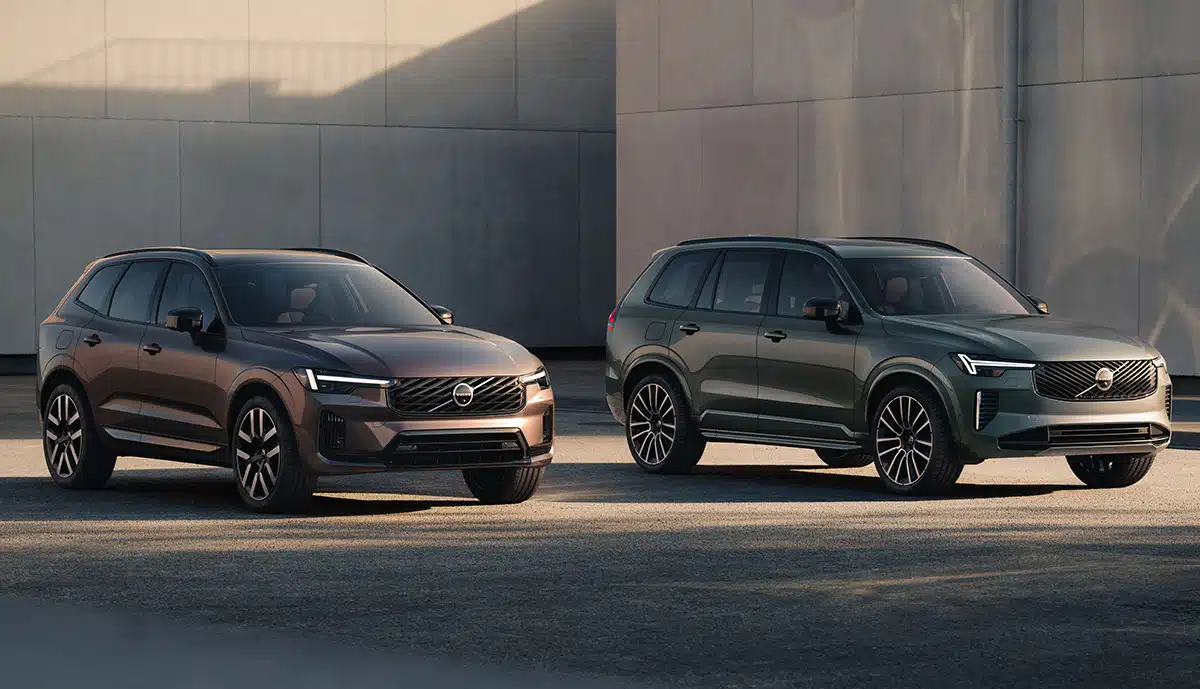
XC60 and XC90 receive a significantly larger battery
Volvo is substantially expanding its plug-in hybrid lineup. The XC60 will offer up to 200 km of electric WLTP range, while the larger XC90 will achieve up to 164 km. This increases the electric range to more than two and a half times that of the previous versions.
This is made possible by a 41.2 kWh battery integrated into the vehicle floor, replacing the previous 18.8 kWh unit. The electric motor is also more powerful, now producing 130 kW instead of 115 kW. A gasoline engine remains on board in each model for longer journeys.
| Model | Electric range | Battery | Electric motor | Combined output | Price in Germany |
|---|---|---|---|---|---|
| Volvo XC60 plug-in hybrid | up to 200 km WLTP | 41.2 kWh | 130 kW | 262 or 339 kW | from €69,990 |
| Volvo XC90 plug-in hybrid | up to 164 km WLTP | 41.2 kWh | 130 kW | 339 kW | from €90,990 |
How the long electric range changes everyday use
With a WLTP range of 200 km, the XC60 moves well beyond the typical range of conventional plug-in hybrids. Even longer commutes could be completed entirely on electric power. In winter, on highways and with a low state of charge, however, the actual range will be below the WLTP figure.
Its usefulness still depends on regular charging. Full battery → many everyday journeys can be completed with zero local emissions. If the vehicle is driven mostly with an empty battery, however, the gasoline engine also has to move the weight of the large battery.
No specific details on charging power or charging time are available yet. This is a crucial point for a battery of this size, as slow charging would limit flexibility when charging away from home. Buyers still deciding between an electric car and a plug-in hybrid because of long-distance travel should also review the facts about EV range anxiety.
XC60 also receives a major facelift
Volvo is combining the XC60’s new powertrain with an extensive redesign. The grille, bumpers, hood, fenders, tailgate and LED taillights have all been redesigned. The familiar Thor’s Hammer lighting signature has been simplified and combined with matrix LED technology.
The interior has also been revised. Changes include a new dashboard, redesigned door panels, additional wood trim options and optional ventilated Nappa leather. The infotainment system uses an 11.2-inch screen.
New driver-assistance features in the XC60
- Door Opening Alert warns occupants of approaching bicycles and vehicles when opening the doors.
- An intersection braking assistant is designed to detect potential collisions when turning or driving straight ahead.
- The emergency steering assistant can initiate an automatic evasive maneuver.
- Pilot Assist will also provide support when changing lanes.
- The 360-degree camera gains a three-dimensional vehicle view.
Google Gemini is integrated directly into the infotainment system. The voice assistant is intended to control journey planning, stops and messages using naturally phrased commands. Regular over-the-air updates are designed to keep both SUVs technically up to date.
XC90 adopts the powertrain without another major facelift
For the XC90, Volvo is building on the facelift already introduced for the 2025 model year. The seven-seater adopts the new long-range powertrain as well as Google Gemini. The premium Bowers & Wilkins sound system remains available as an option.
With an electric WLTP range of 164 km, the XC90 is positioned as an alternative for families that want to drive electrically in everyday use without having to rely exclusively on charging stops during longer journeys. Those who want to dispense with the combustion engine entirely can choose the similarly sized battery-electric Volvo EX90.
Prices start just below €70,000
The XC60 with a combined output of 262 kW costs at least €69,990 in Germany. The more powerful 339 kW version starts at €78,990. The XC90 with 339 kW starts at €90,990, although prices may differ in Austria and Switzerland.
Production is scheduled to begin during the fall. The XC60 and XC90 will also remain available as mild hybrids. Volvo is therefore deliberately offering several powertrain options and sees the long-range plug-in hybrids as a transitional choice for customers who are not yet ready to switch entirely to an electric car.