Luxeed RX now starts with an 81 kWh battery
Luxeed is expanding the RX range with a new entry-level version featuring an 81 kWh battery. The electric SUV can be preordered in China from 269,800 yuan, equivalent to around €32,000 depending on the exchange rate.
Compared with the previous entry-level model with a 100 kWh battery, the preorder price falls by 30,000 yuan, or 10%. These prices initially apply to the Chinese market and are not yet comparable with any potential offering in Germany, Austria or Switzerland.
Overview of versions and prices
| Version | Battery | Preorder price in China |
|---|---|---|
| Entry-level version with LiDAR | 81 kWh | 269,800 yuan, around €32,000 |
| Version with L3-ready architecture | 81 kWh | 329,800 yuan, around €39,000 |
| Existing model range | 100 kWh | 299,800 to 359,800 yuan |
The smaller battery is primarily aimed at customers who do not need maximum long-distance range. According to the manufacturer, around 70% of existing customers who have preordered the vehicle already live in a household with at least one other car. The 81 kWh pack should therefore be sufficient for daily commuting and weekend trips.
Even by European standards, 81 kWh is not a small battery but a practical capacity for a large electric SUV.
Large SUV with coupé-like bodywork
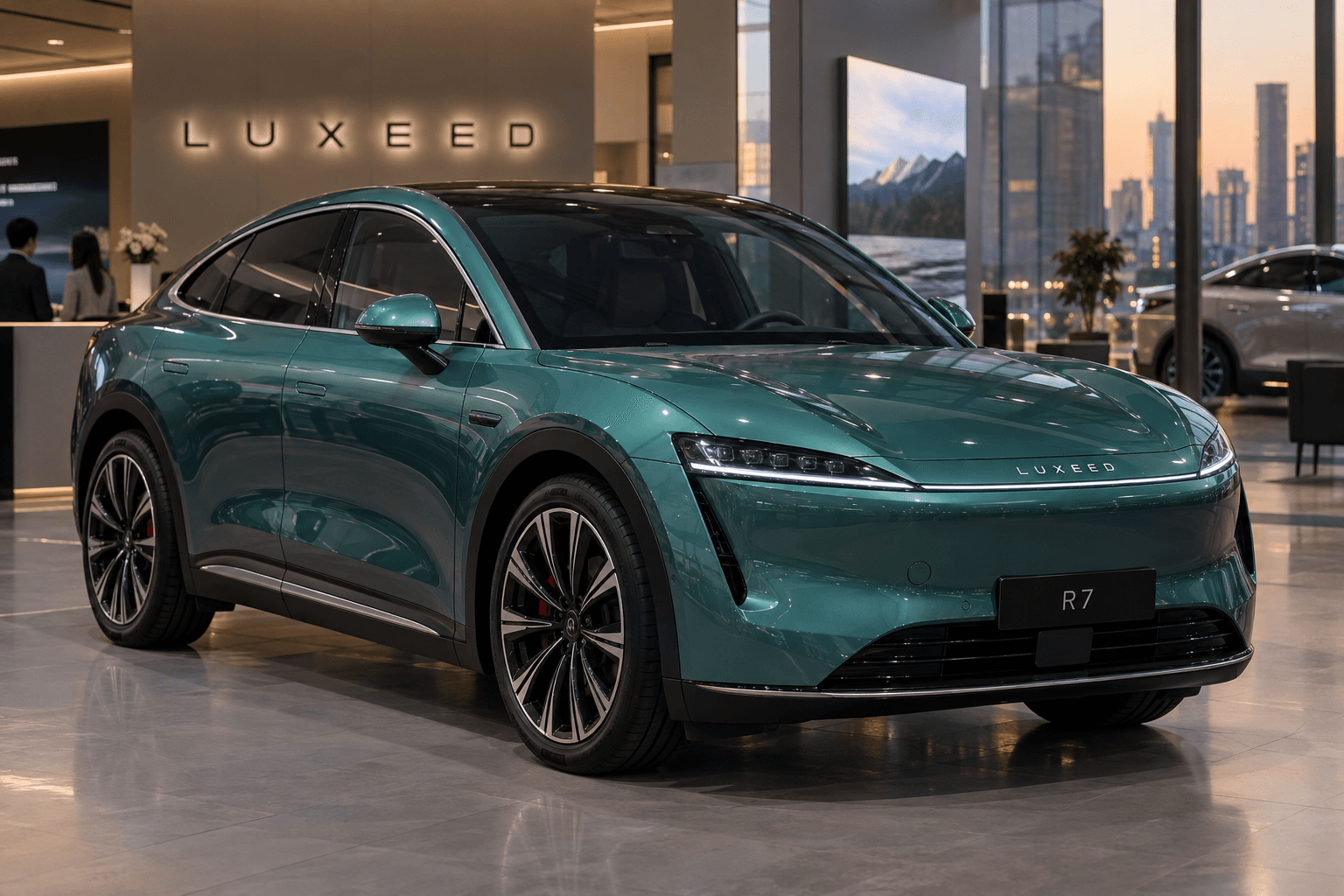
The Luxeed RX is 5.02 metres long, 2.01 metres wide and 1.59 metres high. Its wheelbase measures 3.00 metres. This clearly places it in the upper SUV segment, although the lower roofline gives the model a sportier appearance.
Buyers can choose between rear-wheel drive with one electric motor and all-wheel drive with two motors. The RX uses Huawei’s Tuling platform and is the first model to feature the new generation of Huawei’s performance-focused electric drive system.
Up to 852 km under China’s CLTC cycle
Luxeed quotes a maximum range of 852 km under CLTC for the model range. This figure is based on the Chinese test cycle and cannot be compared directly with the WLTP figures used for European vehicles. CLTC results are generally more optimistic, so real-world range and any future WLTP figure are likely to be considerably lower.
Luxeed has not yet clearly specified the exact range of the new 81 kWh version. The smaller battery reduces weight and price, while an efficiently tuned drivetrain could offset some of the capacity disadvantage.
Huawei opts for an extensive LiDAR sensor suite
According to the manufacturer, the RX features a total of 38 sensors for detecting its surroundings. These include an imaging LiDAR sensor with 896 channels and two optical paths, as well as three high-precision solid-state LiDAR units.
The more expensive version receives an architecture designed for Level 3 automated driving. However, this does not mean that the RX is permitted to drive autonomously at Level 3 everywhere. In addition to the hardware, approved software and the legal requirements of each market are also decisive.
More pressure on Xiaomi in the Chinese market
The lower entry price brings the Luxeed RX closer to the Xiaomi YU7. Its base version starts at 233,500 yuan in China and therefore remains cheaper, but Luxeed is positioning the RX further upmarket with its Huawei technology and sophisticated sensor suite.
Luxeed is a joint electric vehicle brand created by Huawei and Chery. The RX joins the existing S7, R7 and V9 model range and is scheduled to launch officially in China in autumn 2026. Sales in Europe have not yet been confirmed.